Your Overwintering Pepper Dropped All Its Leaves. It's Probably Fine.
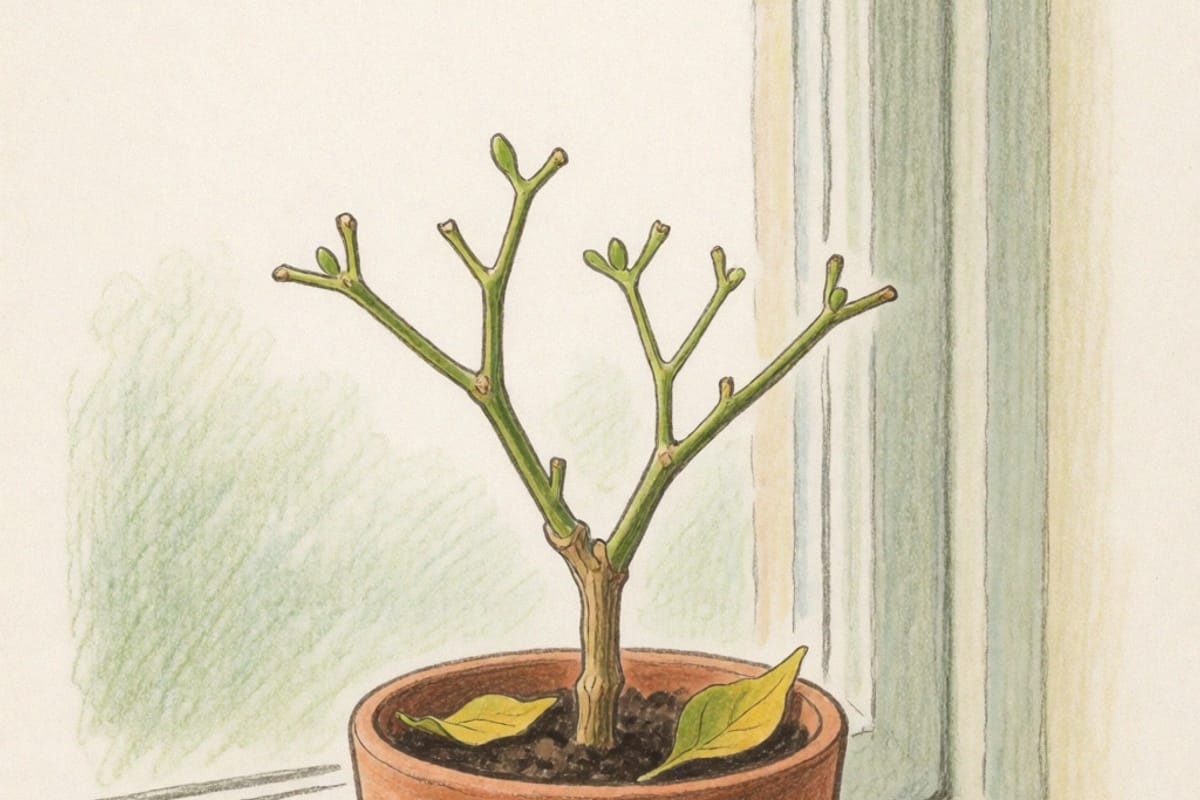
You did everything right in October. You dug the pepper, cut it back, hosed it off and brought it in before the frost. Three weeks later there’s a ring of yellow leaves on the windowsill and a bare stick in the pot, and it’s easy to think you killed it.
You almost certainly didn’t. A pepper moved from a sunny garden to a dim indoor window drops leaves, often all of them, and that’s the plant shutting down for the winter it would never have had where peppers come from. I mentioned this in passing when I wrote about keeping peppers over the winter, and it’s the point where most people give up. Don’t throw it out yet. Check a few things first.
The test that settles most of it
Scratch the stem gently with a thumbnail, about halfway up the woody part. Green underneath means living tissue. Then squeeze the base of the stem where it meets the soil. It should feel hard and woody, like a pencil.
A green scratch and a firm base means the plant is fine. Look closely at the nodes, where leaves used to join the branches. You’ll often see tiny green or purplish buds sitting there. Those are next spring’s shoots, and they’ll wait for months.
If the scratch is brown and dry, try lower down. Branch tips often die back a little over winter and that’s no great loss. Keep scratching toward the base until you find green. If you get all the way to the soil and it’s brown everywhere, the plant is gone.
When it’s normal
Normal leaf drop is gradual. Leaves go pale yellow, often starting with the oldest ones lower down, and then fall off dry while the stem stays firm. It tends to start within a week or two of the move and can carry on for a month. Some plants hang on to a few small pale leaves at the tips all winter, while others go completely bare.
The cause is mostly light. Even a south-facing window in November gives a pepper a small fraction of what it had outside, so it drops leaves it can’t feed. A cool room slows everything further, which is what you want.
What you do about normal leaf drop is very little. Leave it where it is, water only when the top couple of inches of soil are dry, skip the fertiliser, and sweep up the leaves so they don’t sit in the saucer and rot.
When it’s root rot
This is the one that kills overwintered peppers, and it’s nearly always the watering can. A plant with no leaves uses almost no water. Keep watering it on the same schedule as your houseplants and the soil stays wet for weeks, and the roots start to rot.
The signs: leaves that wilt and go yellow while the soil is damp, a stem base that feels soft or has gone dark and wrinkled at the soil line, and soil that smells sour when you sniff the pot. A cloud of little black flies around the pot is another hint that it’s been wet for too long.
Slide the plant out and look. Healthy roots are white to light tan and firm. Rotted ones are brown, mushy, and the outer skin slides off when you pull one between finger and thumb. If some roots are still firm, cut away the soft ones, repot into fresh, barely damp mix in a pot just big enough to hold what’s left, and don’t water again until it’s properly dry. If the base of the stem is soft, I’d let it go.
When it’s spider mites or aphids
Both come indoors on the plant, however carefully you hosed it, and both love a warm, dry room. Look for these before the leaves are all gone, because the leaves are where you’ll find them.
Spider mites leave leaves finely speckled with pale dots, as if someone flicked a toothbrush of bleach at them. Later you’ll see fine webbing at the tips and in the angles of the branches. Hold a sheet of white paper under a branch and tap it. Tiny moving specks on the paper are mites. Leaves damaged this way go dull, then yellow, then drop, often faster than normal winter drop.
Aphids are easier: clusters of small soft-bodied insects on the newest growth and the undersides of leaves, sticky shiny patches on the leaves below them, and little white cast skins scattered about.
For either one, move the plant away from your other plants, rinse it thoroughly in the shower or the sink with the pot tipped so the soil stays out of it, and follow up with insecticidal soap, wetting the undersides and the stem. One round won’t do it, because eggs hatch after you’ve sprayed. Repeat every five to seven days for a few weeks. Mites hate humidity, so a cooler room away from a heat vent helps too. If you open Garden Planner Pro’s pest guides, spider mites and aphids are both in there with treatment tips.
A bare plant is easier to treat than a leafy one, which is a small consolation.
When it’s cold
Indoors doesn’t always mean warm. The glass on a single-pane window can get very cold on a clear night, and a pepper with its leaves pressed against it, or sitting by a door that opens all day, or in a garage that dropped close to freezing, can get chilled.
Cold damage looks different from the other three. Leaves go dark, limp and water-soaked, almost like they’ve been boiled, and they hang on the plant rather than turning yellow and dropping cleanly. Stem tips may blacken. It shows up a day or two after a cold snap rather than gradually.
Move the plant somewhere that stays reliably above freezing and away from drafts, and pull it back an inch or two from the glass at night. Cool is good for a dormant pepper. Cold enough to blacken leaves isn’t. Don’t prune the damage straight away. Wait until new growth in late winter shows you which wood is still alive, then cut back to just above a live bud.
What to do this morning
Scratch the stem. If it’s green, check the soil with a finger before you even think about watering, and look at any leaves still on the plant for speckling or stickiness. Most of the time you’ll find a firm green stem, dry-ish soil and nothing crawling, and the job is to leave it alone until the days get longer in late February.
The plants I’ve lost over the years were never the ones that looked dead in November. They were the ones I kept fussing over.