Tiny Black Flies Came Indoors With Your Potted Plants
You brought the pots in when the nights turned cold. The rosemary, the geranium, a couple of herbs, the pepper you’re trying to keep for next year. Everything settled in fine. Then, a few weeks later, you notice tiny dark flies drifting up out of the soil when you water, walking around on the rim of the pot, and turning up on the window glass behind it.
These are almost certainly fungus gnats. They’re a nuisance, they’re very common in pots indoors in winter, and on an established plant they do very little real harm. You can get rid of them. It takes a few weeks, because the part you can see isn’t the part doing the breeding.
Make sure that’s what you’ve got
Three small flying things turn up around indoor plants, and they’re easy to mix up at first glance.
Fungus gnats are tiny, a couple of millimetres long, dark grey to black, with long legs and long antennae. They look like very small, thin mosquitoes. They fly weakly, in short hops, and spend most of their time on or just above the soil. If you disturb the pot, they lift off the surface and settle again nearby.
Fruit flies are tan or light brown, rounder and stockier, and if you get close you’ll see red eyes. They hang around the fruit bowl, the compost caddy and the kitchen drain more than the plants. If the flies are worse near the bananas than near the pots, they’re fruit flies and the plants are innocent.
Whitefly are white, not black, and they live on the plant rather than the soil. Turn a leaf over and you’ll see them sitting on the underside, and when you brush the plant a little cloud of them flies up. They often come indoors on plants that spent the summer outside, so check the undersides of leaves on anything you brought in, especially hibiscus, peppers and tomatoes.
If what you’re seeing is black, thin, and coming off the soil, read on.
Why they showed up now
Fungus gnats lay their eggs in damp potting mix, and the larvae live in the top inch or two of it. They’re small, see-through little worms with shiny black heads, and they feed on fungi and rotting organic matter in the soil. Wet soil is the whole story.
Outdoors in summer, a pot dries out fast. Bring it inside in autumn and everything slows down. There’s less light, the plant grows more slowly and uses less water, and the mix stays damp for days after you water. Most of us carry on watering on the summer schedule anyway, out of habit. That’s a perfect gnat nursery. The eggs may have come in with the pot, or with a bag of potting mix, or through an open window, and a few weeks of damp soil was all they needed.
If you want to see the larvae for yourself, push a slice of raw potato gently into the soil surface and lift it after a couple of days. Larvae tend to collect underneath it.
How to get rid of them
The order matters here, and the first step does most of the work.
Let the top inch of soil dry out between waterings. Push a finger in. If it’s damp at the first knuckle, don’t water. Larvae can’t survive in dry surface mix, and adults don’t lay eggs in it. Most indoor plants in winter are happier drier anyway. Empty any water sitting in saucers or cachepots, too, because a pot standing in water stays wet at the top.
If a plant really can’t take drying out, water from the bottom instead. Sit the pot in a dish of water for half an hour, let it soak up what it needs, then lift it out. The surface stays drier that way.
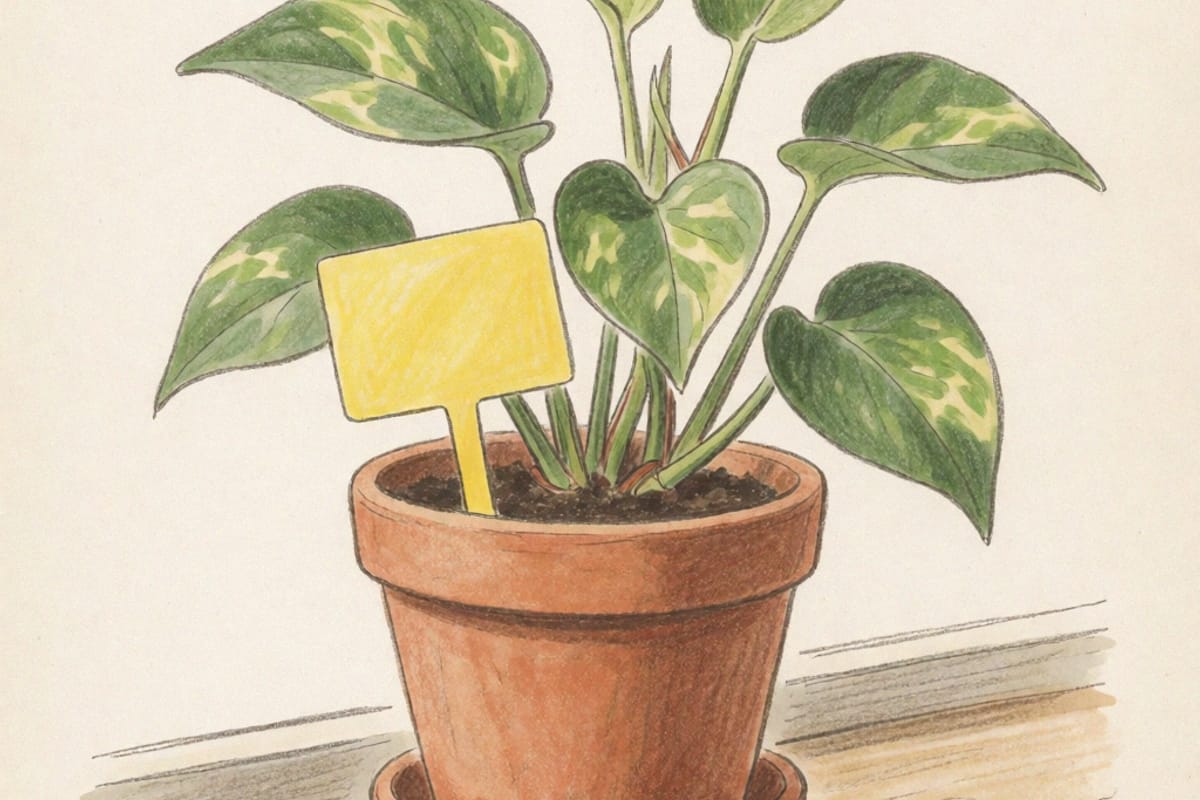
Put up yellow sticky traps. These are small yellow cards on a stake that you push into the soil, and the adult gnats are drawn to the colour and stick. They won’t clear an infestation by themselves, since the larvae are still in the soil, but they catch adults before they lay more eggs and they tell you how things are going. A card that’s still clean after a week is good news.
For a bad case, use a BTI product. BTI is Bacillus thuringiensis subsp. israelensis, a soil bacterium that kills fly larvae (gnats and mosquitoes) and is sold for organic use as granules, liquid, or the floating “dunks” meant for ponds and water butts. You soak or dissolve it in water according to the label and water the pots with it, and it works on the larvae in the soil. It doesn’t touch the adults, and it doesn’t last long in the mix, so plan on repeating it per the label for a few weeks while the adults you already have die off.
I fought gnats for a whole winter once on a tray of overwintering herbs, and it was entirely my own fault. I’d been watering them every Sunday like it was still August. Spacing out the watering was what fixed it. The sticky cards were mostly a way of watching it work.
What not to bother with
Don’t repot into fresh mix as your first move. It’s a lot of disturbance for a plant in low light, and if the watering doesn’t change, the new mix gets colonised just as fast. And don’t reach for a houseplant insecticide spray for the flying adults. You’d be treating the part of the problem that lives a week or so, and leaving the part in the soil.
Gnats are worth taking seriously on seedlings and fresh cuttings, where the larvae can damage tender roots. Keep any seed trays you start this winter away from infested pots, and let their surface dry between waterings once the seedlings are up.
Getting the watering right is the long-term fix. The watering recommendations and reminders in Garden Planner Pro help with that, so the pots get water when they need it rather than because it happens to be Sunday.
Give it three or four weeks. You’ll see fewer and fewer gnats on the cards, and one morning you’ll water the pots and nothing will lift off the soil.