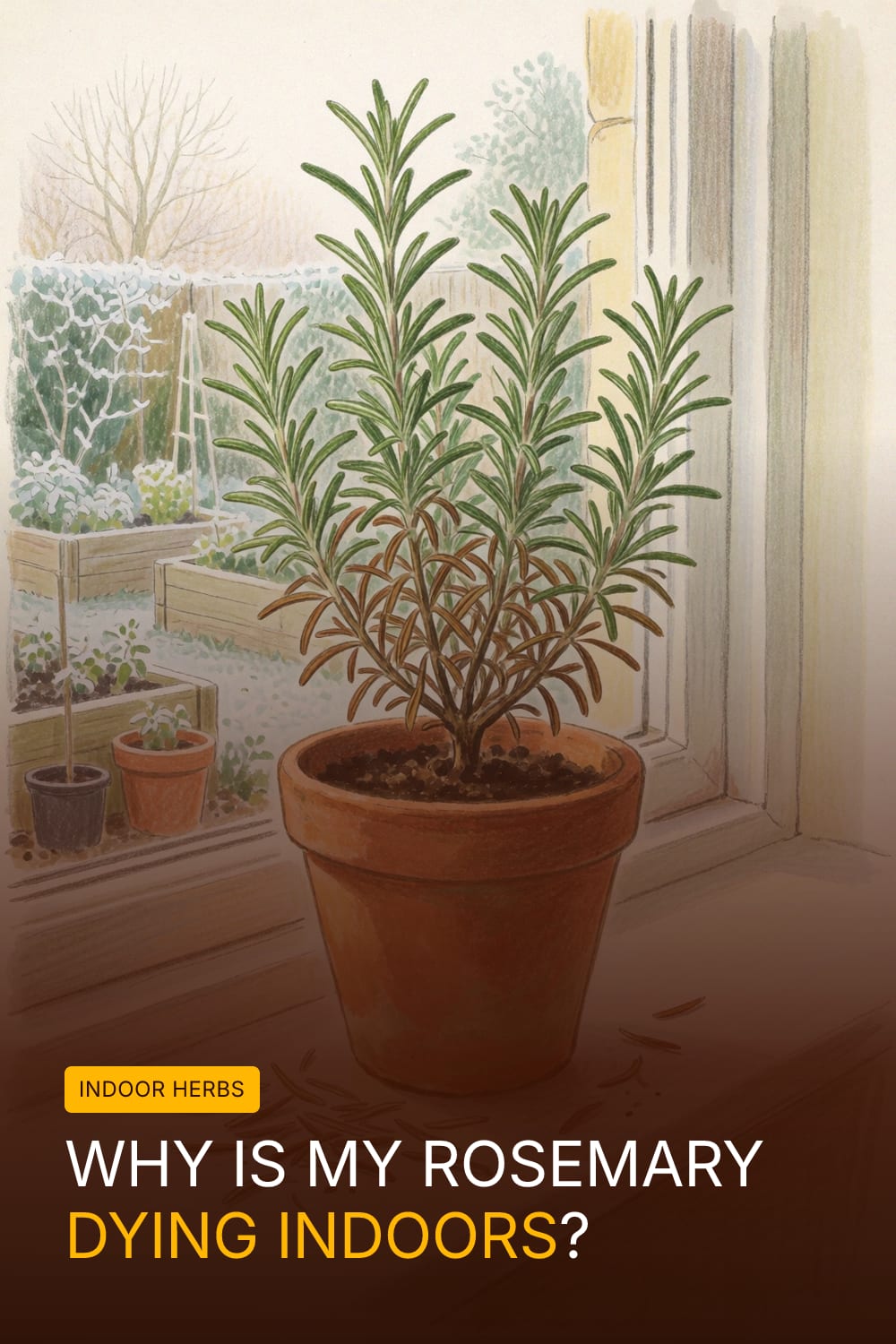
Why Is My Rosemary Dying Indoors? Blame the Window Before the Watering Can
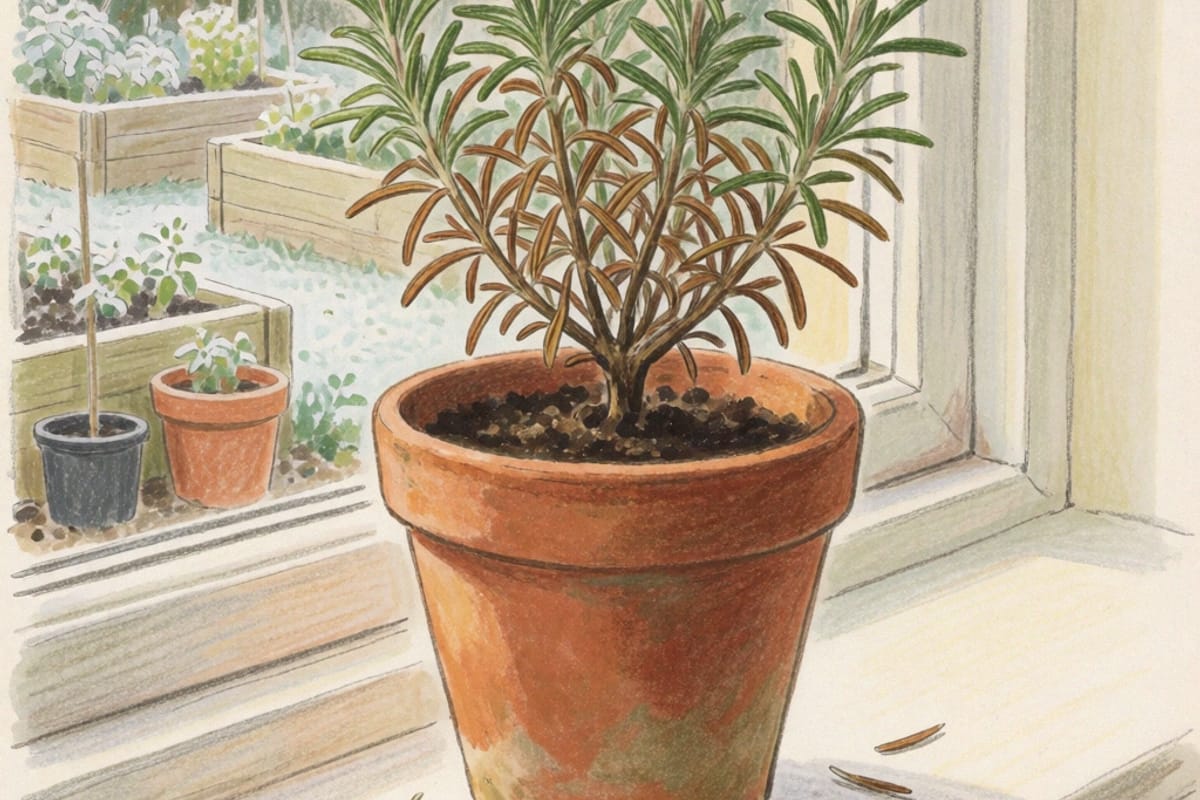
You brought the rosemary in before the first frost, put it somewhere sunny, and watered it carefully. For a few weeks it looked fine. Now the needles at the bottom are going brown and dropping when you brush past, and the tips look dull and greyish. You’ve read that it’s overwatering. You’ve also read that it’s underwatering. Both can’t be right.
Both can be right, which is the frustrating part. But I’ve come to think they are both symptoms, and that the thing deciding whether a potted rosemary survives a winter indoors is where you put it. Get the spot right and the watering becomes easy. Get it wrong and there’s no watering schedule that saves it.
What a rosemary expects from winter
Rosemary is a shrub from dry, rocky hillsides with long sunny summers and cool, bright winters. In a mild garden it stays outside all year, and plenty of varieties will take a fair bit of frost if the soil drains well. What it gets in winter there is lots of daylight, cool air, and a slow, steady growth rate.
Now look at the windowsill you put it on. Even a south-facing window gives far less light than an open garden, because glass, overhangs and short days all take their share. And the room is warm, often much warmer than the plant wants in winter, with dry heated air on top.
Warm says grow. Dim says don’t. The plant gets the two messages at once and handles it badly.
How the window turns into a watering problem
In low light, rosemary barely grows, and a plant that’s barely growing barely drinks. So the pot that dried out every few days on the patio in July stays damp for a week or more on a windowsill in December. If you keep watering on the summer schedule, the roots sit wet, and rosemary roots rot quickly in wet soil. The first you see of it is browning needles, and by then a good part of the root system has gone.
The opposite happens too, especially next to a radiator. The heat dries the pot out faster than you’d expect from how little the plant is growing. And rosemary has a cruel habit of not wilting. A basil plant flops when it’s dry and tells you. Rosemary looks exactly the same right up until the needles go crisp, and once the root ball has dried out completely it often doesn’t come back.
So you get conflicting advice because people are describing two different windowsills. The fix for both is the same.
Find the coolest bright spot in the house
What a rosemary wants in winter is as much light as you can give it and as little warmth. The best places I’ve found are an unheated porch, a cool sunroom or a bright spare room with the radiator turned off. Anywhere that stays above freezing but feels chilly to you is probably about right.
In a cool, bright spot the plant ticks over slowly. It uses water at a steady, predictable rate, the needles stay green, and powdery mildew, which loves warm still air, has a harder time getting going.
If the only bright window is in a warm room, add light rather than settling. A cheap LED grow light a few inches above the plant for twelve hours or so a day makes up for a lot of what the window lacks. I keep mine on a plug-in timer so it isn’t one more thing to remember.
The watering, once the spot is right
Push a finger into the pot. When the top inch or so is dry, water thoroughly until it runs out of the bottom, then empty the saucer. Don’t water again until the top inch is dry again. In a cool spot that might be every week or ten days. In a warm one it might be every few days. Checking with a finger works in both, where a fixed schedule only works in one.
A clay pot helps, because it breathes and dries out more evenly than plastic. Make sure it has a drainage hole, and never let it sit in a saucer of water.
The other two things to watch for
Look for a fine white dust on the needles, often starting low on the plant. That’s powdery mildew. Snip off the worst stems, give the plant more space from its neighbours, and run a small fan nearby for an hour or two a day if you can.
Look for fine webbing between the needles and tiny speckles on them. That’s spider mites, which thrive in dry heated air. Rinse the plant thoroughly in the shower, undersides included, every few days for a couple of weeks.
If the indoors just isn’t working
Sometimes there’s no cool bright room, and that’s most houses. Two other routes are worth knowing about.
If you’re somewhere mild, the rosemary may do better left outside. Some varieties, ‘Arp’ being the one most often mentioned, are noticeably hardier than the common kind. Put the pot against a sheltered south-facing wall, out of the wind, in free-draining mix, and keep the winter rain off it.
Or take cuttings. A small rooted cutting adapts to a windowsill much better than a big plant that spent the summer outside.
I still lose one now and then, and each time I’ve been able to trace it to the plant being somewhere too warm and too dim. If you’re keeping track of your herbs, Garden Planner Pro has watering reminders, which help, as long as you still push a finger into the pot before you pour. But move the pot first. Today, if the needles are already dropping.