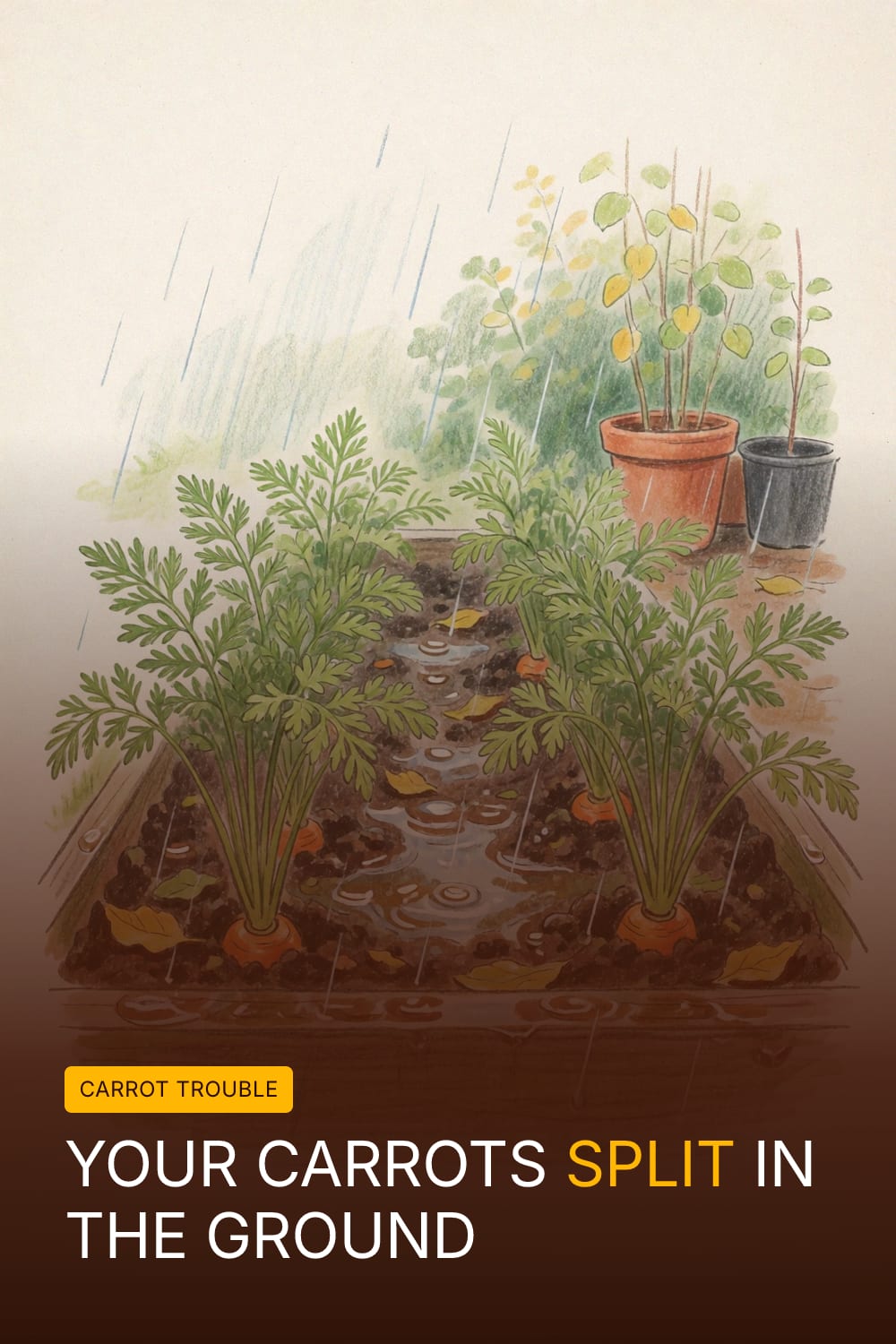
Your Carrots Split in the Ground. The Fall Rain Did It.
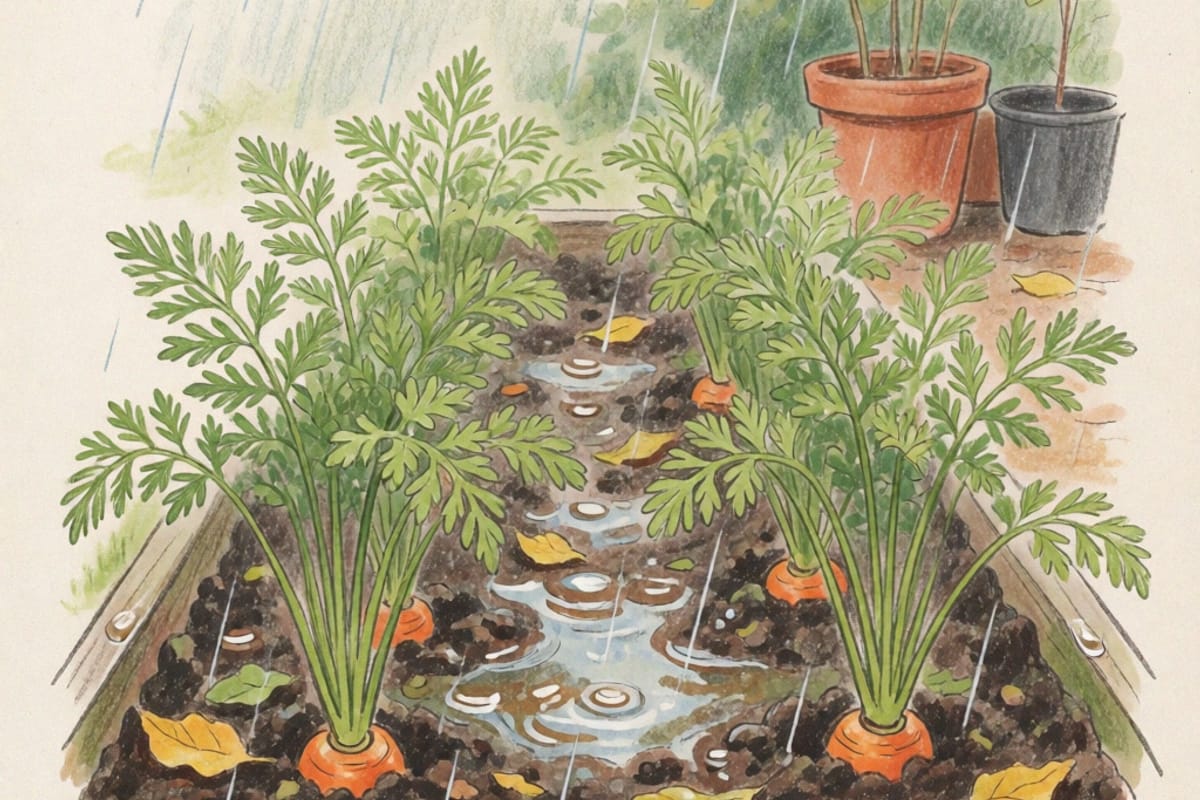
You went out to pull a few carrots for dinner and the first one came up with a crack running down its side, top to nearly the tip, like someone had taken a knife to it. Then the second one did too. They looked perfect from above. Feathery tops, good shoulders showing at the soil line. And underneath, half of them have split open.
They’re fine to eat. A split carrot is a carrot that grew too fast for its own skin, and there’s nothing wrong with it except the crack. And if you’ve had a dry spell followed by a week of autumn rain, that rain is almost certainly what did it.
Why carrots split
A carrot is mostly water. Through a dry stretch, the root slows down and its outer layers firm up. Then the rain comes, the soil goes from dry to soaked in a day or two, and the root takes up water fast. The inside swells faster than the outside can stretch, and the skin gives way along its length.
It happens most to carrots that are already full size, which is why it shows up now. Roots that have been sitting in the ground at maturity for a few weeks waiting to be dug are the ones most likely to crack when the weather turns wet. Some varieties are more prone to it than others, too. I lost most of a row one wet October to a variety I’d never had trouble with in the spring, and I still don’t really know whether that was the variety or just that year’s rain.
Is it a split, a fork, or something eating it?
New growers tend to lump every ugly carrot together, and they have different causes. Lay the bad ones out on the path and look at them in daylight.
A split is one clean crack running lengthwise, usually deep, sometimes gaping. If it happened in the last few days, the inside is bright and moist. If it happened weeks ago, the edges will have dried and healed over with a rougher, darker skin. Either way, there are no holes and no tunnels. The rest of the carrot is firm.
A fork is a carrot with two or more legs, or one that bends sharply partway down. That isn’t the rain. It happened months ago, when the growing tip of the young root hit something: a stone, a hard clod, a compacted layer, or sometimes a patch of rich, fresh manure. Forked carrots taste the same as straight ones; they’re just a nuisance to peel. The fix is in the soil next spring, and the carrot growing guide goes through it.
Tunnels are a different matter. Thin, winding, rust-brown channels just under the skin, often more of them toward the lower half of the root, mean carrot rust fly (the same insect UK growers call carrot fly). If you snap a damaged carrot you may find a small, creamy-white maggot inside. That’s an insect problem, and it’s the one on this list that’s worth doing something about.
Small round holes, straight and narrow, as if made with a thin skewer, are usually wireworms. They’re the shiny, stiff, orange-brown larvae of click beetles, and they’re common in beds that were lawn not long ago. Shallow, scooped-out holes near the top of the root are more likely slugs.
What to do today
Dig a few more from different parts of the row so you know what you’re dealing with, rather than judging the whole bed by the first two.
If they’re split, bring the split ones in and eat them first. Cut out any part of the crack that’s gone soft or dark, and use the rest as you normally would. Raw, roasted, in soup; nobody at the table will know. What split carrots don’t do is keep. The crack lets rot in, so don’t put them in a storage box with the good ones. Treat them as this week’s carrots.
For the rest of the row, look at the forecast. If more heavy rain is on the way and the carrots are already a good size, I’d dig them now and store them somewhere cool rather than leave them to swell and crack. If you’d rather keep them in the ground (they hold well there in a lot of places), a thick layer of straw or shredded leaves over the row helps keep the soil moisture more even and the ground from freezing hard later. There’s more on that in the hard freeze post.
If you found rust fly tunnels, the advice flips. Dig the whole row now, don’t leave it in for winter. The larvae keep feeding in roots left in the ground, and the damage only gets worse the longer they sit. Cut away the tunnelled parts and the rest of the carrot is perfectly edible, but these won’t store well either, so eat them over the next few weeks. Bag the scraps rather than composting them next to the carrot bed. If what you dug up had tunnels and you’re not sure which insect made them, the pest guides in Garden Planner Pro have treatment tips and can help you put a name to it.
Wireworm-holed carrots are edible once you cut out the holes. They tend to be worse the first year or two after turning lawn into a bed, and they ease off as the bed gets worked.
Next year’s carrots
For splitting, the cure is even moisture. Carrots that get a steady supply of water all season don’t go through that dry-then-flooded swing, and a layer of mulch between the rows once the seedlings are up helps a great deal. You can’t stop it raining in October, but if the soil was never bone dry beforehand, the rain does far less damage. Dig carrots once they reach a good size instead of leaving the whole row in as a store, at least in a wet autumn.
For rust fly, the reliable answer is a physical barrier: fine insect mesh or row cover over the row from sowing day, edges sealed, so the adult flies can’t lay eggs at the base of the plants.
And if this is your first year growing carrots and half the row came up cracked, that’s an ordinary first-year carrot harvest. The split ones roast exactly as well as the straight ones.