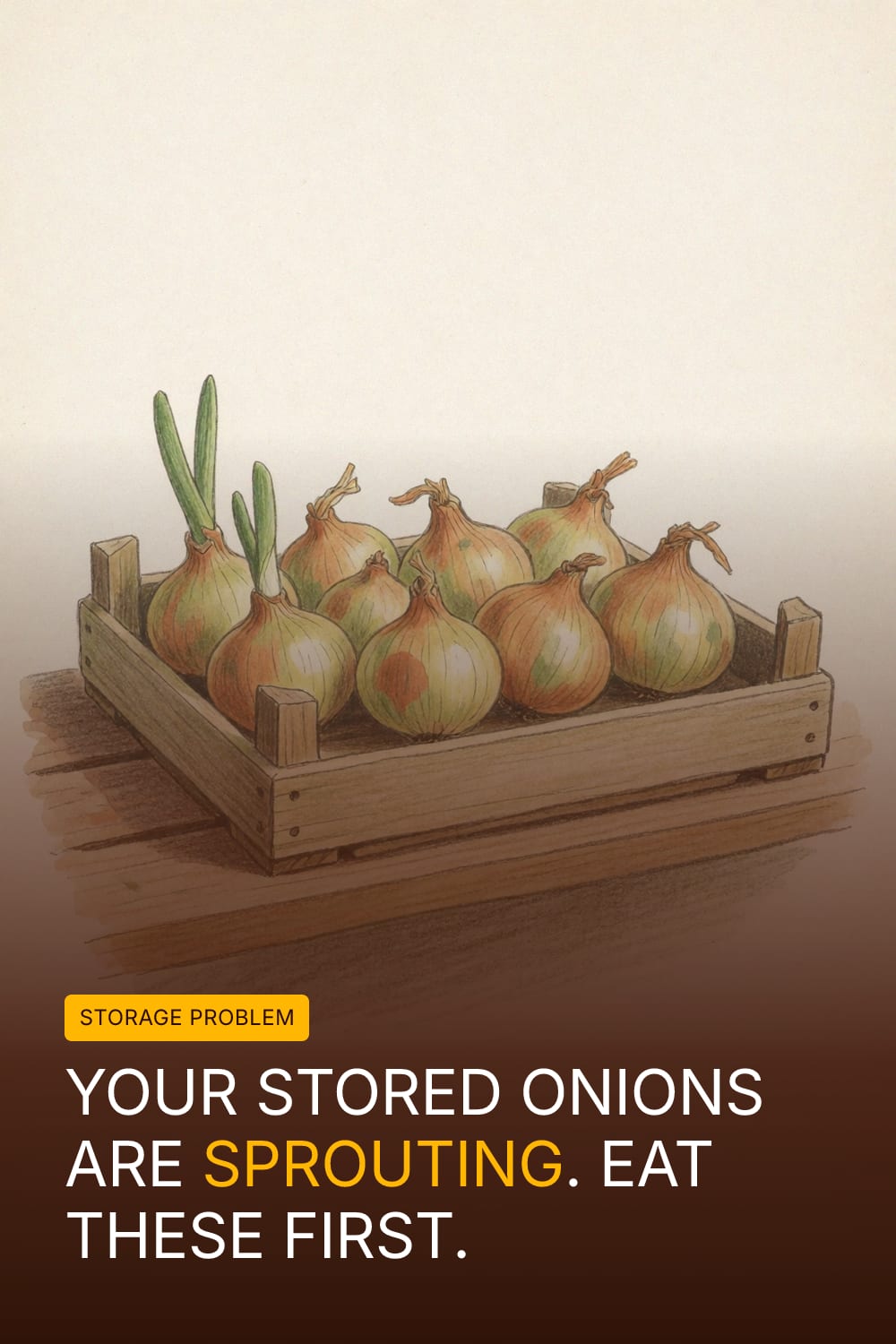
Your Stored Onions Are Sprouting. Eat These First.
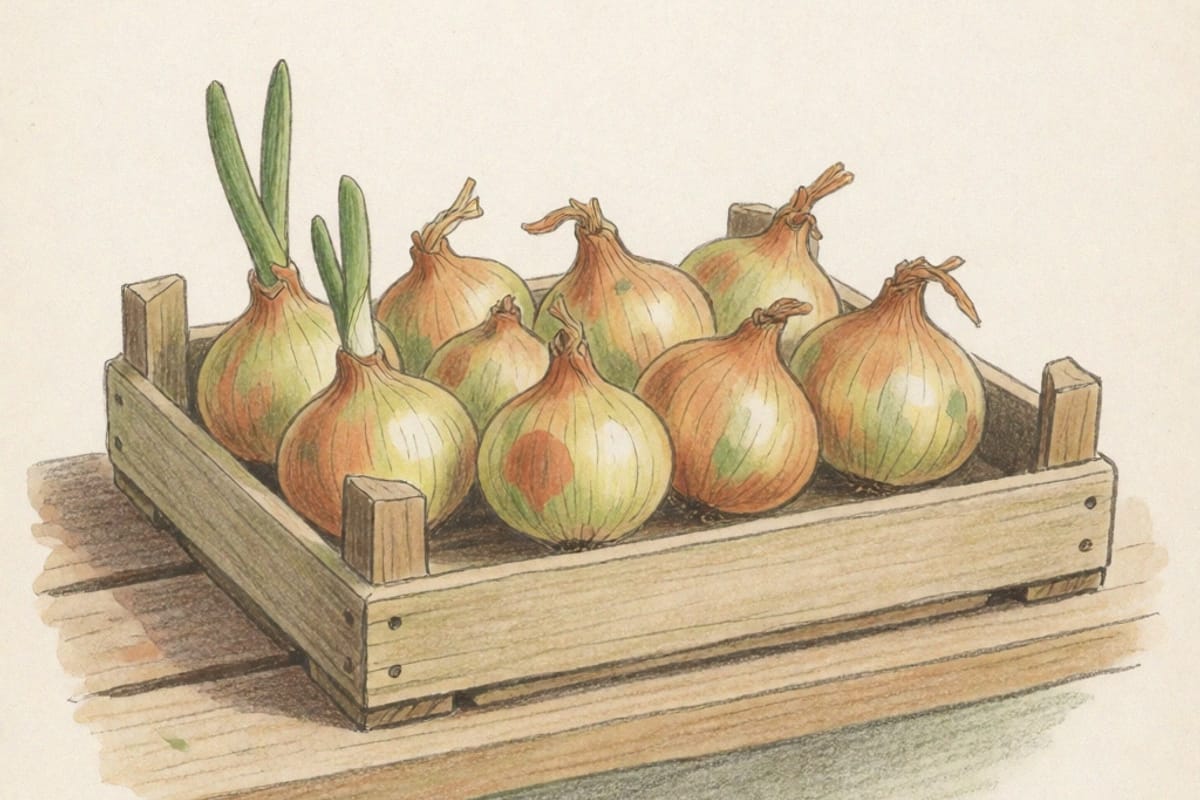
You go down for an onion and the one on top has a pale green point coming out of its neck, an inch long and very pleased with itself. Then you notice two more. The crate you cured so carefully in late summer has decided, in the week before Thanksgiving, that it’s spring.
Those onions are fine to eat. A sprouting onion is a living bulb doing what bulbs do, and nothing about it is unsafe. What the sprout does mean is that the onion has started spending itself, so it won’t keep much longer. Pull the sprouting ones out, put them on the kitchen counter, and cook with them first.
Why they wake up now
An onion that has been cured goes dormant. That rest period is what lets it sit in a crate for months, and it doesn’t last forever. Every onion you put away in September is on a clock, and sooner or later all of them will try to grow. Good storage slows the clock down. It can’t stop it.
A few things run the clock fast.
Warmth is the big one, and specifically the middle range. Onions stay dormant longest near freezing, and keep reasonably well in a warm, dry room, but a cool-not-cold spot in the 45 to 55°F range is close to ideal sprouting weather for them. An unheated back room or a mild garage in late autumn often sits right in that range, which is part of why potatoes and onions want different rooms.
Damp air is the second. If you see little white roots starting at the base as well as a shoot at the top, the air around them is too moist. That’s common when onions are kept in a closed bin, a plastic bag, or anywhere near the potatoes.
The third is the onion itself. Thick-necked onions never seal as tightly as thin-necked ones, and they’re usually the first to sprout as well as the first to rot. Variety matters even more. Sweet and mild onions are bred for eating fresh and were never going to last long. The pungent yellow storage types are the ones meant to sit in a crate into the new year. If your whole crop was a sweet type, sprouting in November is about what you’d expect, and it’s no reflection on how you stored them.
What a sprouted onion is like to eat
Cut one in half from top to bottom and you’ll see the green shoot running up through the middle. The rings around it are still good onion. As the sprout grows, it draws on those rings, so the longer you leave it the softer and thinner the inner layers get.
At an inch or two of sprout the onion cooks the way it always did. You can lift out the green core if you don’t like the look of it, or chop it in with the rest. The young green shoot tastes like a mild scallion, though some people find it a bit bitter, so try a sliver before you make up your mind.
Once the sprout is long and the bulb has gone soft and light in your hand, there isn’t much onion left to use. At that point you could pot it up on a sunny windowsill and cut the green tops for the kitchen through the winter. A few years back I filled a whole windowbox this way, more out of guilt than planning, and had green onion for soups until February.
Sort the whole crate this weekend
One sprouting onion usually means others are about to start, and the same damp corner that woke them up is the corner where rot begins. Take everything out and make three piles.
Onions that are firm all over, with a dry, tight neck and no shoot, go back into storage.
Onions with a shoot, a neck that gives a little when you squeeze it, or roots starting at the base go to the kitchen. These are this week’s onions.
Anything soft and wet, slimy between the layers, or smelling sour goes out. So does an onion with grey mould around the neck, which is the neck rot that starts back at harvest time. You may also find black, sooty powder under the outer papery skins. If it’s only on those dry outer layers and the flesh underneath is firm and clean, you can peel them away, wash the onion and use it soon. If the black has reached the fleshy layers, or the onion is soft, throw it out.
Wipe down the crate or replace the bag before the keepers go back in.
Too many onions to use this week
If the kitchen pile is bigger than you can cook through, don’t let it sit there sprouting further. Chopped raw onion freezes well for cooking. It goes soft when it thaws, so it’s for soups, sauces and stews rather than salads. Better still, cook a big pan of onions down slowly until they’re soft and golden, then freeze that in small portions. It’s the slowest part of a lot of recipes, done in advance.
Slow the rest down
For the onions that went back in, aim for one of the two places they rest well: close to freezing and dry, or warm and dry. Avoid the cool middle. Somewhere with air moving matters as much as the number on a thermometer, so a mesh bag or an open slatted crate beats a box with a lid. Keep them away from potatoes and out of the fridge’s damp crisper drawer.
Then look through them every couple of weeks. You’re looking for the next shoot and the first soft neck, and catching them a week earlier is the difference between using an onion and composting it.
It also helps, next summer, to know which onions held. If you log the harvest in Garden Planner Pro’s yield tracking, each crop has a date and a weight against it, and you can see which variety was still sound in February and which one had you eating onions every night in November. That’s the information that decides what to grow next time.
And if it turns out your crate was mostly sweet onions, eat them happily now, and order a storage variety for the spring.