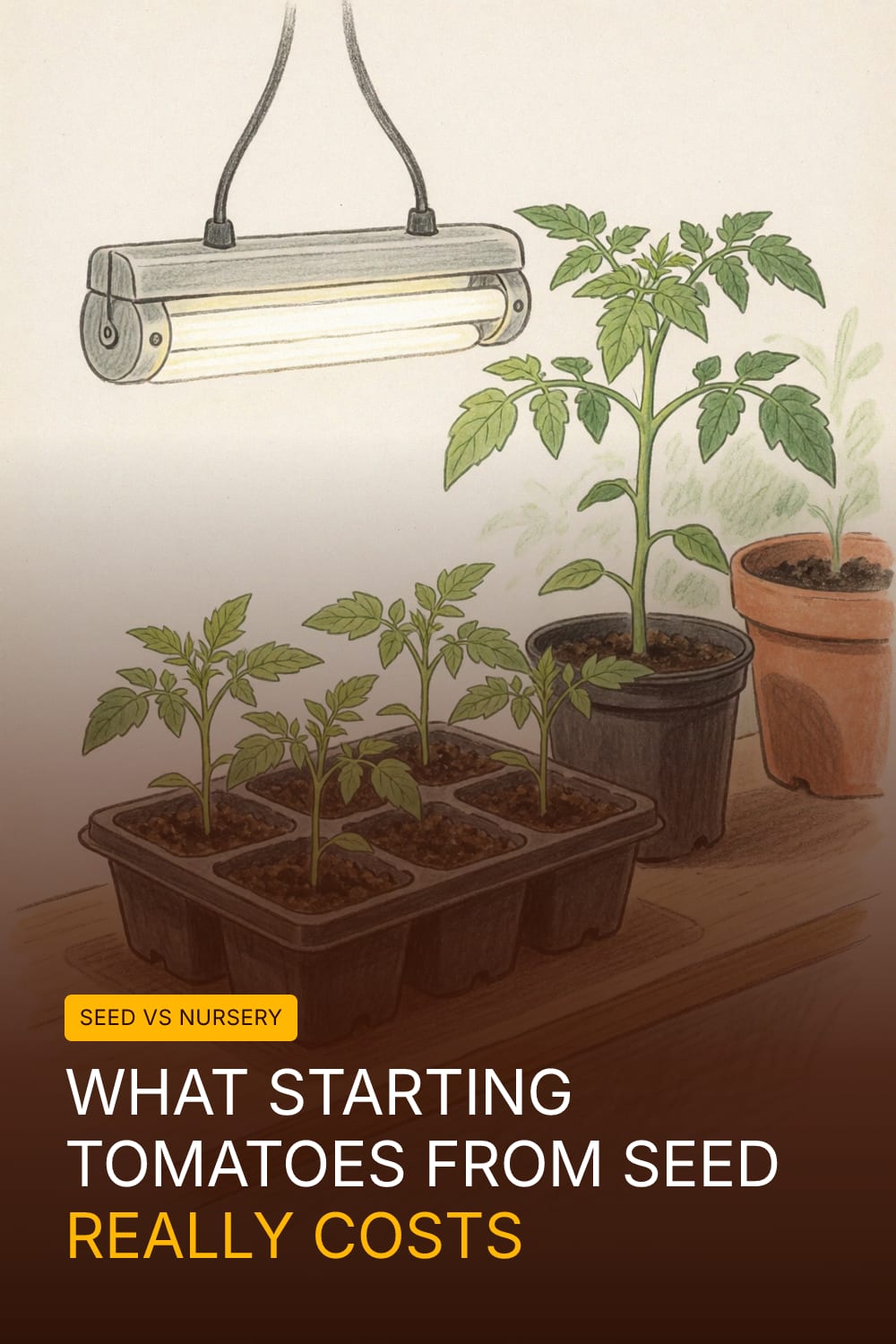
What It Really Costs to Start Your Own Tomatoes From Seed
The seed catalogues are starting to land, and with them comes the question every grocery-minded gardener eventually asks at the kitchen table: is starting your own tomatoes from seed cheaper, or is it a hobby that tells itself it’s thrift?
It can be cheaper. Most years it is, for me. But the saving doesn’t come from where people expect it to, and in the first year it often isn’t there at all. The seed costs next to nothing. The light, the trays and six weeks of your attention are the real price, and whether they pay depends on how many plants you want and how many springs you use the same kit for.
The seed is the cheap part
A packet of tomato seed usually costs about the same as one nursery transplant, sometimes less. Inside you’ll get anywhere from a dozen seeds to a few dozen, depending on the variety and the seller (hybrids tend to come in smaller counts). Kept cool and dry in a jar, tomato seed stays good for several years, so one packet can cover more than one spring.
Do that sum once and it’s hard to unsee. One packet is roughly one nursery plant, and one packet is also enough for every tomato you’ll grow for a couple of seasons. Per plant, the seed is a rounding error.
And if you grow an open-pollinated variety, you can save seed from your best fruit and stop buying it altogether.
The kit is where the money goes
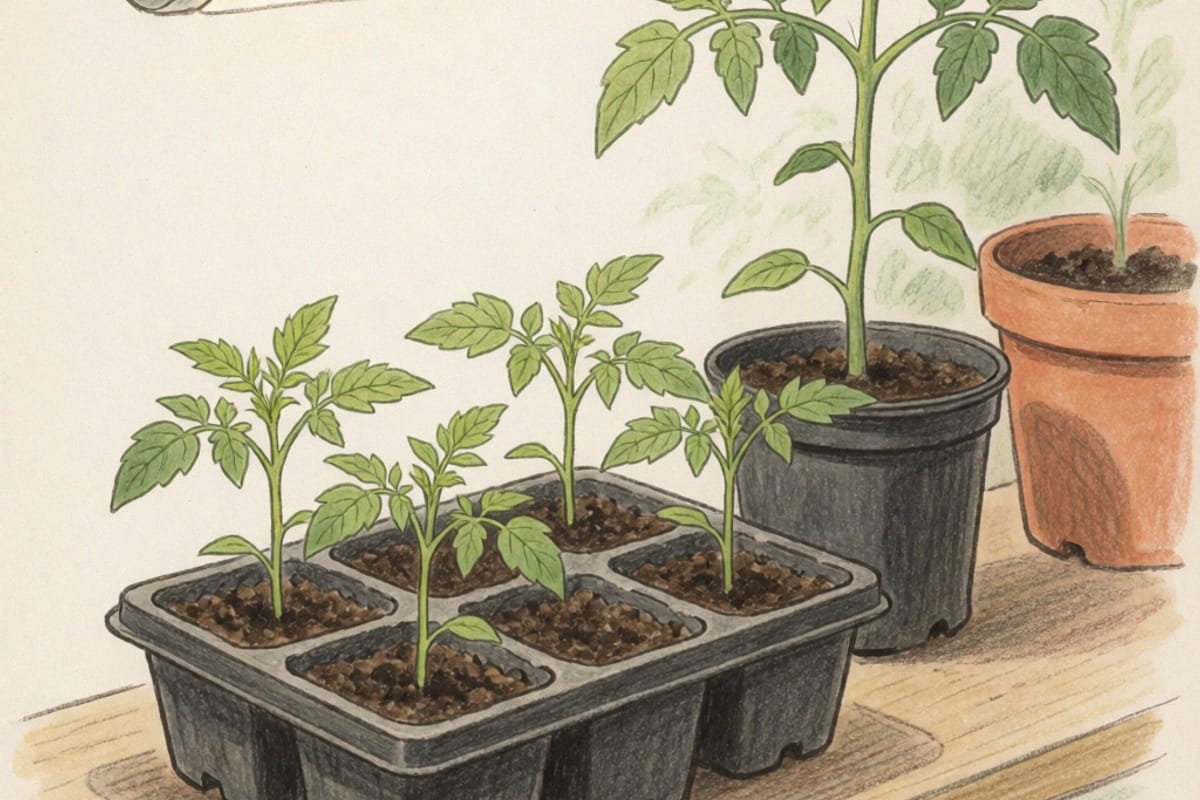
What costs money is everything a tomato seedling needs to grow indoors for the six to eight weeks before your last frost. That means light, something to grow in, seed-starting mix and, for some people, a heat mat to get the seed going.
Light is the big one. A windowsill on its own rarely gives tomato seedlings enough, and what you get is a tray of tall, pale stems leaning at the glass. A plain shop light hung a few inches above the tray does the job, and it doesn’t need to be anything fancy (the grow light post goes into why distance matters more than the spec). Trays and cell packs can be washed and reused for years. The mix is the one thing you buy fresh every spring.
This is where people get burned. If you buy a light and trays this winter and grow four tomato plants, those four plants have cost you more than four nursery plants would have. Usually quite a lot more. Plenty of people try it once, do that sum in May, feel a bit foolish and never try again.
Spread the light over the years you’ll use it
The light is a one-off cost that pretends to be this year’s cost. Next spring it’s already paid for. The spring after that, the same.
It also doesn’t care what’s under it. The light that grows your tomatoes grows the peppers, the onions, the basil and a flat of lettuce for the first bed. So the fairer way to cost a tomato seedling is to take what the light and trays cost you, divide it by the number of springs you can reasonably expect to use them and by everything you’ll start under them, then add the mix and the seed. My shop light is older than my car, and its cost per seedling by now is too small to bother measuring.
Then put that next to what your own garden centre charges for the same number of plants. Prices vary far too much from one place to the next for me to give you a figure, which is why it’s worth ten minutes with your own receipts.
There’s electricity too. A shop light running most of the day for a couple of months is a modest bill, but it isn’t zero. The fixture lists its wattage, and your bill lists your rate.
What you pay that isn’t money
Starting seed takes daily attention for six to eight weeks: checking the water, raising the light, potting up once, then a week of hardening off before anything goes in the ground. Some years you lose a tray to damping off, or to a cat, or to a warm afternoon on the porch that turned into a cold night.
A nursery plant has had all of that done for it by someone whose job it is. That counts for something, and it’s fair to put a value on your own March.
What seed gets you that the nursery can’t
This is the part of the sum that doesn’t show up on a receipt. A garden centre stocks a handful of tomato varieties, chosen because they sell. A seed catalogue lists hundreds.
If you garden to cut the grocery bill, that choice is worth a lot. A paste tomato for sauce, a cherry that ripens early in a short season, a variety that copes with the disease that wiped you out last August: those decide how much food you get, and most of them never reach a nursery bench. The cheapest tomato plant in the world is no bargain if it’s the wrong tomato for how you cook.
When buying plants is the right call
If you want two or three tomato plants, buy them. The sums will never favour a light for three plants unless you’re starting other things under it. The same goes if you have nowhere to hang a light, or your spring is already more than you can manage, or this is your first garden and you’d rather learn to grow the plant before you learn to raise it.
There’s a middle path, too. A packet has far more seed than one household needs, so split it with a neighbour, and the light as well if they’re up for it. Or buy your transplants this spring and start only tomatoes from seed the year after, once you know you like the work.
Whichever way you go, write down what the plants gave you. If you log your harvests in Garden Planner Pro, it keeps a running seasonal-savings total, which makes next winter’s decision a lot less of a guess.
And if you’re still on the fence, buy one packet this winter and, when your sowing date comes round, sow six seeds on your brightest windowsill, alongside the nursery plants you’d have bought anyway. Six stretched seedlings will tell you more about whether a light is worth it than any sum on the back of an envelope.