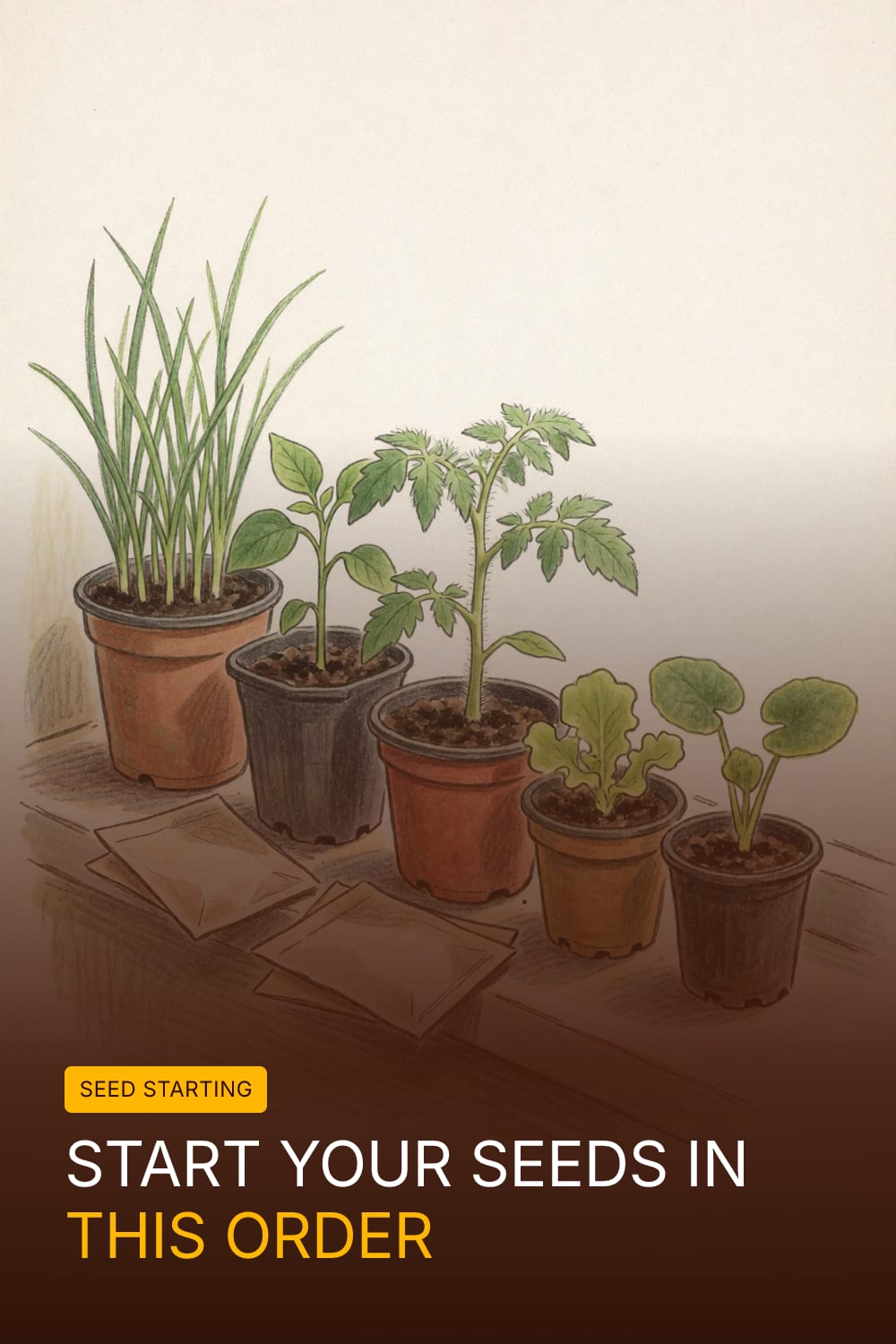
Start Your Seeds in This Order or Your Peppers Will Be Late
The seed catalogues will start landing in a month or so, and sometime in January you’ll sit down with a cup of tea and a pile of packets and try to work out what goes in first. Every packet gives you a number of weeks. None of them tell you how that number fits with the eight other packets on the table.
So here they are in one place, in the order they go in. Every number is weeks before your average last spring frost, which is the date everything else counts back from. If you don’t know yours yet, find it before you do anything else on this list, because a two-week error in that date shifts every row.
| Rank | Crop | Start indoors, weeks before last frost | Goes outside |
|---|---|---|---|
| 1 | Onions and leeks from seed | 10 to 12 | A few weeks before last frost |
| 2 | Celery and celeriac | 10 to 12 | Around last frost |
| 3 | Peppers | 8 to 10 | Once nights stay warm, after last frost |
| 4 | Eggplant | 8 to 10 | Once nights stay warm, after last frost |
| 5 | Broccoli and cabbage | 6 to 8 | Two to four weeks before last frost |
| 6 | Tomatoes | 6 to 8 | After last frost |
| 7 | Lettuce | 4 to 6 | A few weeks before last frost |
| 8 | Basil | 4 to 6 | Well after last frost |
| 9 | Squash, cucumbers and melons | 3 to 4 | After last frost, into warm soil |
These are the ranges that show up again and again on seed packets and in seed-starting charts, and they work for most gardens. Your house matters too. A cool spare room under lights grows things more slowly than a warm kitchen, so if your seedlings always seem to be ready late, shift toward the earlier end of each range.
The early ones: onions, leeks and celery
These go in first because they grow slowly for a long time. An onion seedling is a single blade of grass for weeks. It’s not in any hurry, and it doesn’t mind being cut back with scissors to a few inches tall when it gets floppy, which keeps it sturdy.
Celery is the fussier of the two groups. The seed is tiny, it needs light to germinate so it barely gets covered, and it can take a couple of weeks to show itself. Start it on the early side and be patient.
The ones people start too late: peppers and eggplant
Peppers are where most first-time seed starters go wrong in the other direction from everything else. They start them at the same time as the tomatoes, and the tomatoes race ahead while the peppers sit there.
Pepper seed germinates slowly in a cool room. It likes the mix warm, around 80°F, and at ordinary room temperature it can take two or three weeks to come up. Then the seedlings grow slowly for their first month. So they need their extra fortnight, and a heat mat under the tray helps more for peppers than for anything else on this list. Eggplant behaves much the same and goes in at the same time.
The ones that go out before the last frost
Broccoli, cabbage, lettuce and onions are planted out while there’s still a risk of frost, because they can take a light one once they’ve been hardened off. That’s why broccoli and cabbage sit higher on the list than tomatoes even though they grow faster. They need to be ready weeks earlier.
Lettuce is the one I’d say is optional to start indoors at all. It can be sown straight into the bed in early spring and does well. I start a few under lights anyway, just to have something green to plant out on the first mild weekend, which is more for my morale than the lettuce.
Tomatoes, in the middle where everyone puts them
Six to eight weeks, and if anything, resist the urge to go earlier. A tomato seedling started ten or twelve weeks ahead will be tall, root-bound and flowering in its pot by the time it’s safe to plant out, and it often sulks for weeks after transplanting while a younger one overtakes it. Every year I think I’ll get ahead by starting them early, and every year the later sowing does as well or better.
The late ones: basil, squash and cucumbers
Basil hates cold more than tomatoes do and will turn black at temperatures a tomato shrugs off, so it goes out last and doesn’t need to be started early.
Squash, cucumbers and melons grow so fast, and dislike having their roots disturbed so much, that three or four weeks indoors is plenty. Start them in individual pots big enough that you won’t need to pot them up, and plant the whole thing out without breaking up the root ball. A lot of people skip starting these indoors altogether and sow them straight into warm soil, which works well once the weather has settled.
Doing the counting
The maths isn’t hard, just tedious. Take your last frost date, count back ten weeks for the onions and peppers, eight for the tomatoes, and so on, and write the dates on the calendar.
Or skip the arithmetic. Garden Planner Pro takes your local frost dates and puts a start-indoors date against every crop you’re growing, so in January you get a list of what to sow this week rather than a pile of seed packets and a pencil.
Either way, do it before the catalogues arrive. It’s much easier to order the right amount of seed when you can see which week the peppers go in, and that you only have room under the lights for one tray at a time.