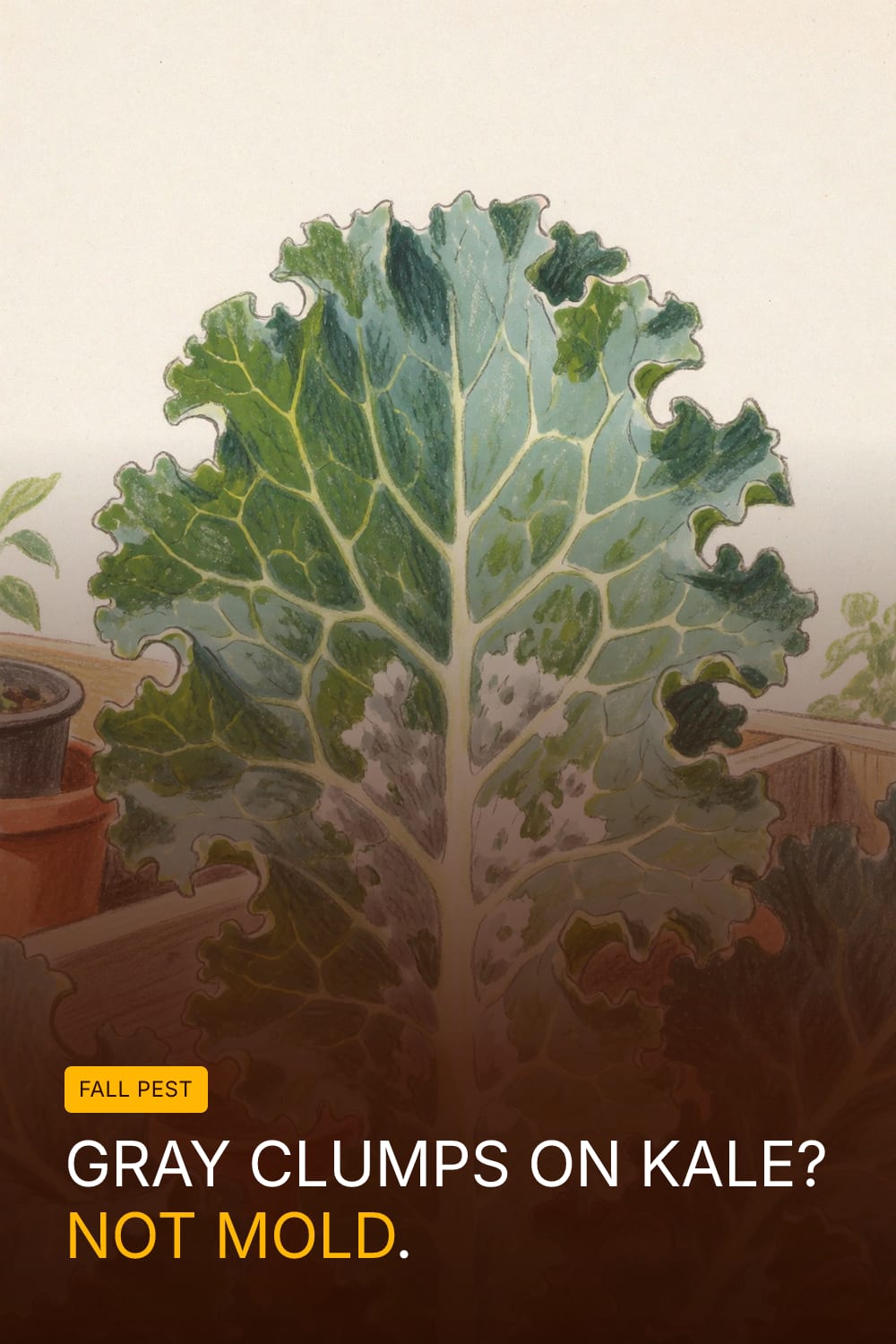
Those Gray Clumps on Your Kale Aren't Mold, and Washing Won't Fix Them
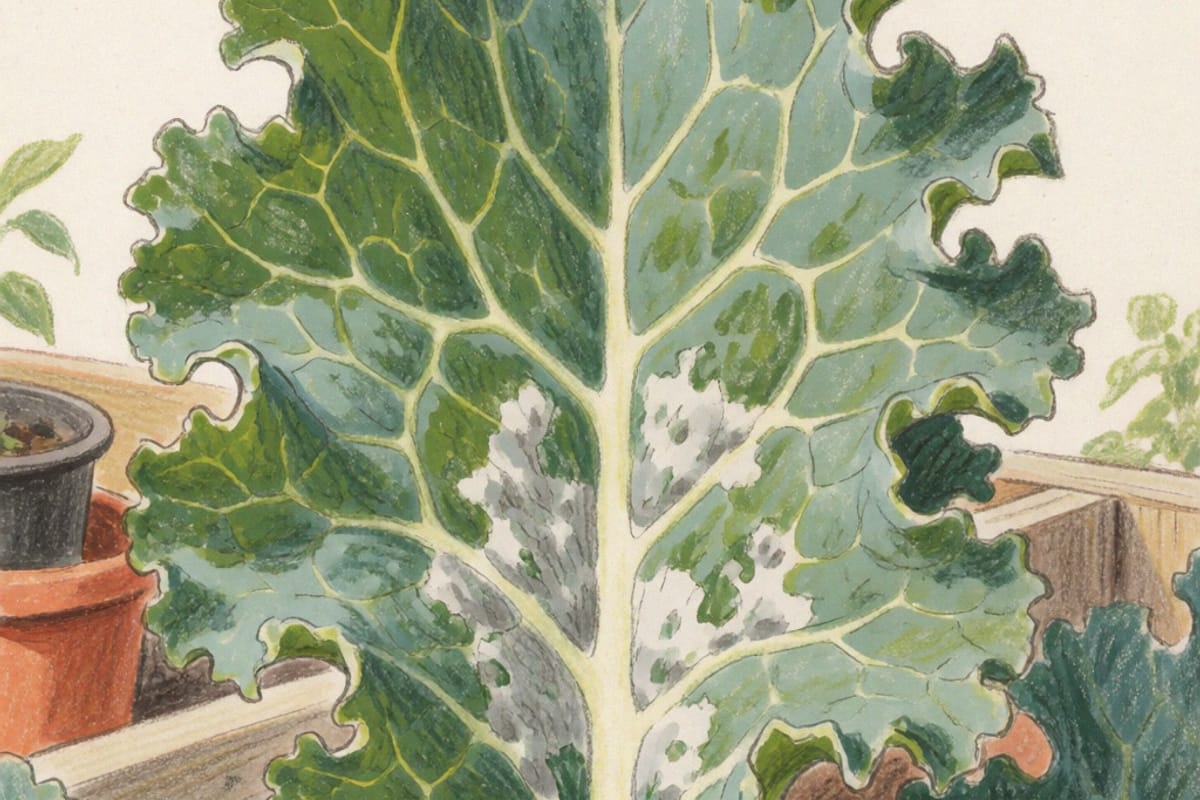
You go out to cut kale for dinner, turn a leaf over, and there is a gray-white crust packed into the crook where the midrib meets the blade. It looks like dust. It looks a bit like mold. It does not look like an insect, because it is not moving and because there is no obvious individual anything in it.
Then you look closer, and the crust has a texture, and a bit of it shifts.
Cabbage aphids. They are the defining fall pest of kale, collards, brussels sprouts and cabbage, they peak more or less exactly now, and almost everything that makes them frustrating comes down to the fact that they do not look or behave like the aphids you already know.
Three things it could be, and how to tell
The gray-white appearance is doing all the confusion here, because two other common problems look similar from four feet away.
Powdery mildew sits on the surface of the leaf as a flat coating, mostly on the upper side, and it wipes off onto your thumb as a powder. It is a film. There is no depth to it and nothing in it moves.
Whiteflies are also pale and also cluster underneath leaves, but they fly. Brush the plant and a small cloud lifts off and resettles. Cabbage aphids do not do this. They sit.
Cabbage aphids are gray-green, roughly pinhead-sized, and covered in a waxy coating that gives the whole colony a mealy, dusted look. They pack tightly rather than spreading out, they concentrate in the growing tip and down in the crown where the new leaves are still furled, and if you look for a full ten seconds you will see one of them move a leg.
That last detail is the one worth waiting for. It is the only test that does not depend on your judgment about what “powdery” means.
The other giveaway is location. Powdery mildew starts on old lower leaves. Cabbage aphids start at the top, in the newest growth, because that is the tenderest tissue and easiest to feed on. A problem that is worst at the growing tip is not a fungus.
Why the soap spray you already tried didn’t work
Most people’s first move is insecticidal soap or a homemade dish-soap mix, and most people’s second move is confusion about why it did nothing.
That waxy coating is the reason. It is water-repellent, and it is why the colony looks dusty rather than shiny in the first place. A spray that would flatten green peach aphids on a pepper plant beads up and rolls off a cabbage aphid, and you have essentially rinsed them.
Two things follow. First, whatever you spray has to be applied hard enough and thoroughly enough to actually wet them, which means getting the nozzle underneath the leaves and into the crown rather than misting the top of the plant. Second, one application is never enough. Eggs and the ones tucked into the furled center survive, and you are back where you started in a week unless you go again.
There is also a purely physical problem that no product solves. The colony’s favorite spot is inside the curled new growth at the top of the plant, and on curly kale in particular that is a geometry a spray cannot reach. On a badly infested plant, cutting that growing tip off and bagging it removes more aphids in four seconds than an afternoon with a sprayer.
What to do this afternoon
Start with water. A hose with a decent jet, aimed underneath the leaves and into the crown, knocks a large share of the colony off, and knocked-off aphids largely do not make it back. It costs nothing and it is the step people skip because it feels too simple.
Then go through the plants and take off the worst leaves and any growing tips that are solidly crusted. Bag them or throw them out. Do not put a heavily colonized tip on the compost pile, where it will sit at ambient temperature being a nursery.
If you are going to spray, spray after the water knock-down rather than instead of it, get underneath, and plan on repeating it every five to seven days for a few rounds. Do it in the evening rather than in full sun.
Before any of that, though, look for swollen tan-colored aphids among the gray ones. Those are mummies, aphids that have been parasitized by a tiny wasp, and each one is a wasp on its way out to find more. If a decent number of the colony has gone tan, the thing that fixes this is already happening, and blanket-spraying will kill the wasps along with the aphids and set you backward. Hoverfly larvae, which look like small pale maggots working through the colony, are doing the same job.
That is the judgment call, and it is genuinely a judgment call. Light infestation with mummies present: water, remove the worst, leave it alone. Heavy infestation with nothing helping: intervene properly.
The part that matters for next year
Cabbage aphids overwinter as eggs on brassica material, and they are happy on wild mustards and other brassica weeds along a fence line. So the same bed gets it again, at the same time, every year, and people conclude their soil is cursed.
Clearing spent brassicas properly at the end of the season is most of the fix. Not turning them in, not leaving the stumps standing over winter, which is exactly what a lot of us do with brussels sprouts and kale because they look alive right up until they aren’t. Pull them, and take the brassica weeds along the edges while you are there.
The other half is not planting brassicas in the same spot next year. Aphids find brassicas regardless, but a bed with last year’s eggs in the debris gets colonized earlier and harder than a clean one.
Kale that has had aphids on it is still perfectly good to eat, incidentally, once you have dealt with them. Soak it in cold salted water rather than rinsing it, give it a few minutes, and they let go. The ones packed into the crown are the reason to cut and discard the tip rather than trying to wash a plant you have already lost the argument with.
One more thing worth knowing, because it explains the timing: these aphids do better as it cools, which is the opposite of most garden pests and the reason they show up when you thought the pest season was over. September and October are their months, not July’s. If your kale got through the summer clean, that is not evidence it is going to stay clean.