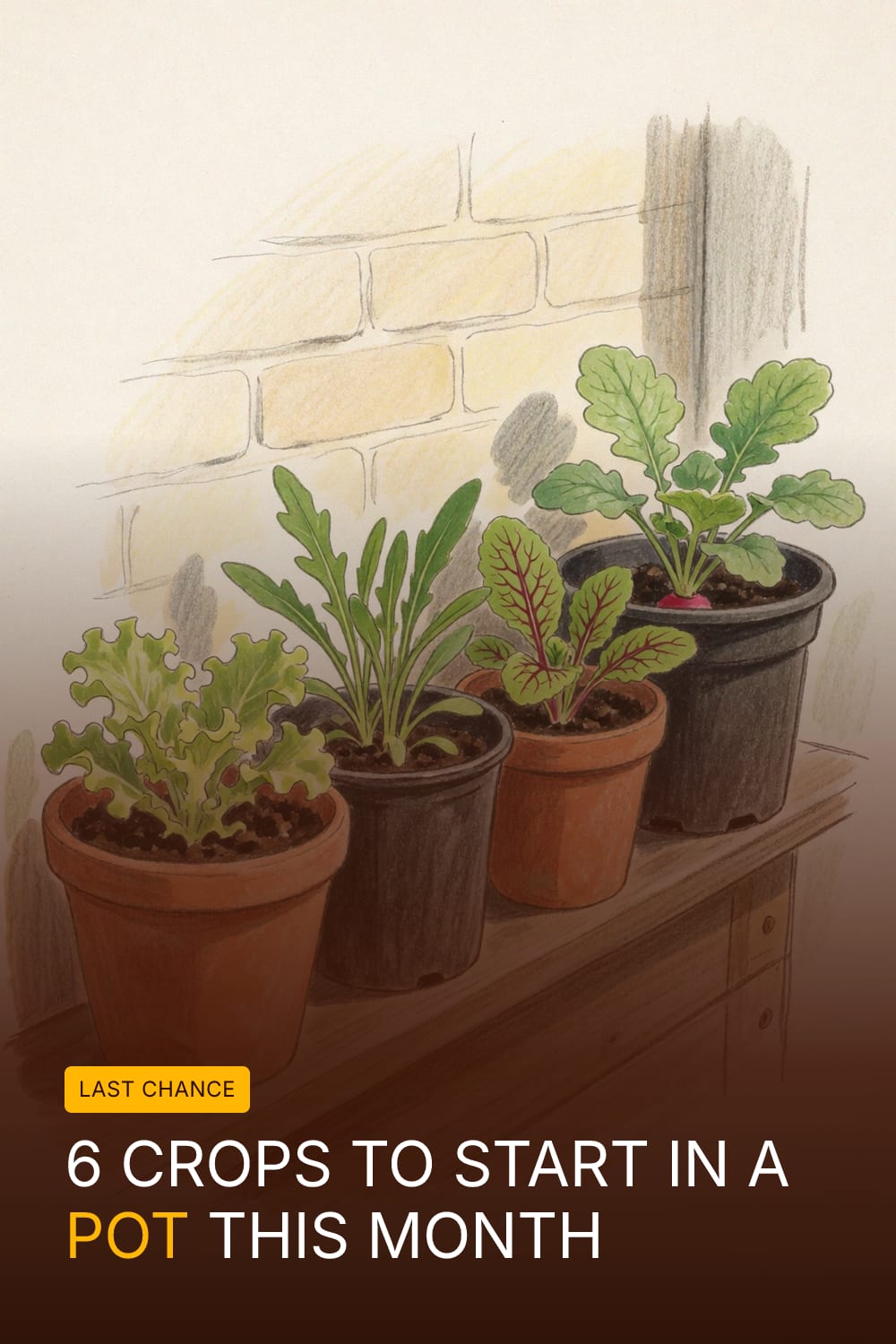
6 Crops You Can Still Start in a Pot This Month, Ranked by How Fast They Feed You
Most fall planting advice assumes you have ground. Beds to clear, rows to sow, a hoop to throw plastic over in November. If what you have is a balcony and four pots, the advice reads like it is for somebody else, and you end up doing nothing in September and starting again in April.
You have more time than you think, and less than the seed packet says. Both of those are true at once, and the reason is the same.
The deadline is daylight, not frost
Everybody counts back from first frost. That is the wrong number for a fall sowing, and it is why so many September pots end up as a tray of seedlings that just sit there looking sullen from November to February.
Plants need roughly ten hours of daylight to make meaningful growth. Below that they mostly hold rather than grow. Depending on how far north you are, you drop under ten hours somewhere between early November and mid December, and you do not climb back out until late January or February. Anything that has not reached a usable size before that happens is not going to, no matter how mild the weather stays.
So a fall sowing has two clocks running. Frost decides whether the plant survives. Daylight decides whether it grows. The second one arrives first, and it is the one nobody counts.
The practical version: take the days-to-maturity number on the packet, which was worked out for long summer days, and add somewhere between two and four weeks for a September sowing. Then check that it still lands before your ten-hour date. That sounds fussy and it takes about a minute, and it is the difference between eating and just watching.
Garden Pro Planner does this arithmetic against your own location rather than a general rule, which matters here more than usual — the gap between Boston and Atlanta on both of those clocks is enormous, and the seed packet knows about neither.
The six, fastest first
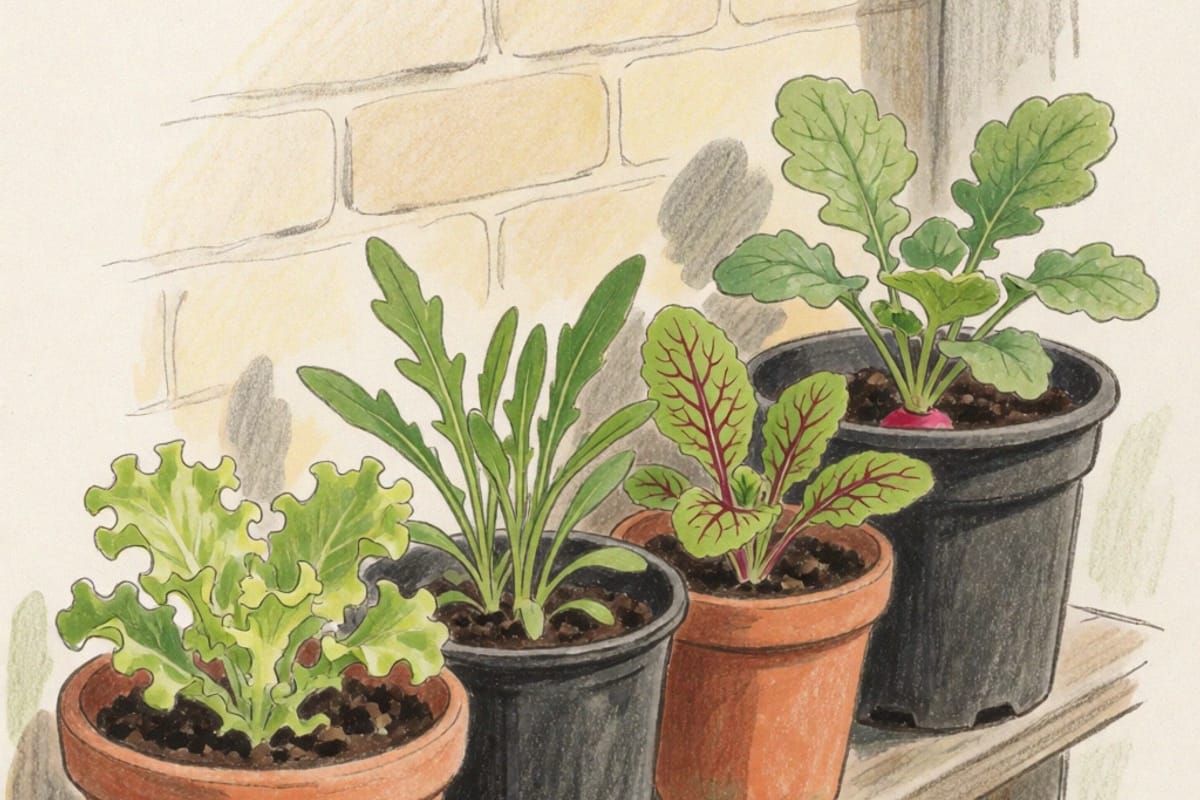
Every one of these tolerates cold, which is the other half of the requirement. The days-to-maturity figures below are the packet numbers, so add your two to four weeks on top.
1. Radish, about 25 days
The only thing on this list that can still go from seed to plate inside a month. Cherry Belle, French Breakfast, anything described as a spring radish rather than a winter one. Six inches of pot depth is plenty.
Radishes are also the crop that most rewards a fall sowing specifically. They bolt and go woody in heat, which is why the ones people grow in June are so often disappointing, and cool weather gives you the crisp mild version instead. If you have only ever grown a bad radish, grow one in October.
2. Arugula, about 30 days for baby leaf
Faster than lettuce, more interesting than lettuce, and it actively prefers this weather. The peppery bite gets stronger as it gets colder, which you will either love or find aggressive.
Sow it thickly across the surface of a wide shallow pot and cut it with scissors an inch above the potting mix. It will come again two or three times before it gives up.
3. Mustard greens, about 30 days for baby leaf
Same treatment as arugula and a similar timeline, with more color. The red-leaved varieties are genuinely handsome in a pot, which matters if the pot is on a balcony you look at every day rather than in a bed round the back.
Cut young. Full-size mustard leaves are a lot.
4. Leaf lettuce, about 35 days
Loose-leaf and cut-and-come-again types only. Do not sow a variety that has to form a heart, because that needs a good deal longer and you no longer have it.
Lettuce is the one on this list most likely to be ruined by heat and most likely to be saved by a pot, because you can move it. A September afternoon can still cook a shallow container.
5. Spinach, about 40 days
The best value on the list if you get it in this week rather than next. It is the most cold-tolerant thing here by a distance, and it will sit through hard frost, hold all winter, and then grow away in February the moment the light comes back.
That is the real trick with spinach and it is worth planning around: you are not only growing a September crop, you are parking a March one.
6. Bok choy, about 45 days for the baby types
The slowest thing I would still risk, and only the small varieties. Full-size bok choy is out. It is fast for a brassica, it handles cold well, and it is the one crop here that makes an actual dinner rather than a side salad.
Watch for slugs, which love it and which are having an excellent autumn.
The pot is the advantage, not the handicap
This is the part fall container growing quietly wins on.
A pot can be moved. When the forecast says thirty-four on Thursday night, a bed is where it is, and your pots go against the wall of the house or inside the door and come back out on Friday. Masonry that has had sun on it all day radiates heat for hours after dark, and a row of pots pushed up against a south-facing wall sits several degrees warmer than the same pots four feet out.
Soil in a container also warms faster in the morning, which in September is straightforwardly good and stops being an advantage only when it gets cold enough that it cools faster too.
The one genuine disadvantage is the sun angle. A balcony that baked in July may be in shadow by mid October, because the sun is lower and the building opposite has not moved. Look at where the light actually falls this week rather than remembering where it fell in summer, and put the pots there.
What not to bother with
Anything that has to make a fruit. Tomatoes, peppers, zucchini, beans, cucumbers. All of it needs warmth and long days to set and ripen, and it has neither. You are growing leaves and roots now.
Carrots and beets are borderline and I would skip them in a pot this late. They will germinate happily and then run out of light halfway to a usable size, and a half-grown beet in a container in January is a sad object.
Herbs are a different case worth mentioning: cilantro sown now does far better than cilantro sown in June, because heat is what makes it bolt in two weeks.
Sow this weekend if you can. The two weeks between now and the end of the month are worth about a month of growing time at the other end, and that is entirely down to the light going rather than anything you did.