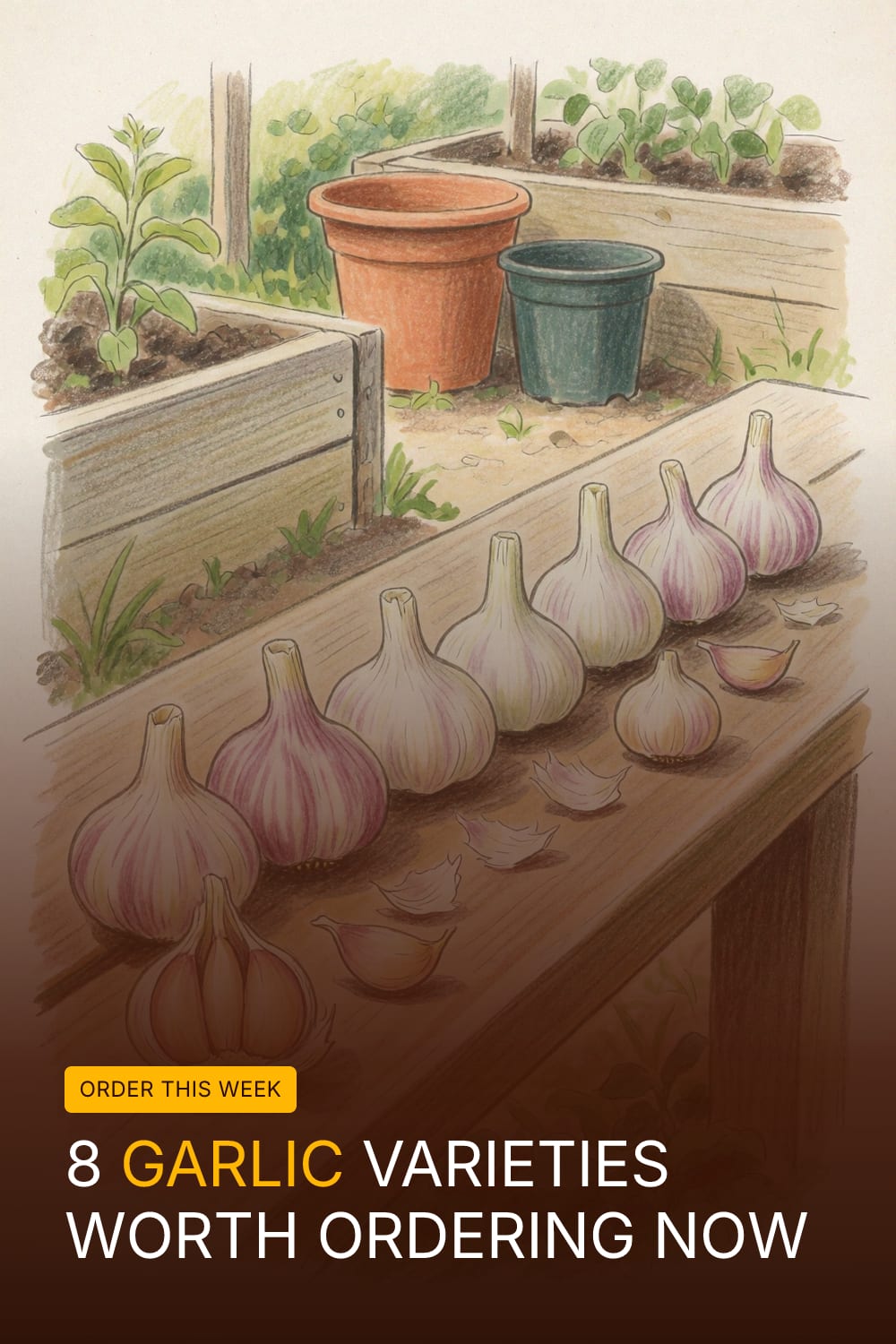
8 Garlic Varieties Worth Ordering This Week (And the One That Isn't Garlic)
Seed garlic is one of the few things in gardening with a genuine deadline on the buying end rather than the planting end. The good suppliers post their catalogs in late summer, the interesting varieties go through September, and by the time the weather feels like garlic weather in October you are choosing from whatever nobody else wanted. I have ordered in the third week of October twice. Both times I planted a variety I had not heard of and did not particularly like.
So the job this week is a browser tab, not a trowel.
The other thing worth saying before anything else: do not plant the bulb from the supermarket. It is usually a softneck grown somewhere with mild winters, it is often treated to stop it sprouting, which is the opposite of what you want, and it can carry disease into a bed you will be growing alliums in for years. Seed garlic costs more because it is grown to be planted rather than eaten. That is the whole difference and it is worth it.
The fork that matters more than flavor
Every variety below is either hardneck or softneck, and that choice changes more about your year than any tasting note.
Hardneck sends up a stiff central stalk and a scape in early summer. It produces fewer cloves per bulb, but they are big and easy to peel. It wants a real winter, it is the more cold-hardy of the two, and it generally stores for something like four to seven months depending on the type. Most of what people mean when they say garlic tastes better than the shop version is hardneck.
Softneck has no central stalk, which is why it braids. It makes more cloves per bulb, smaller and fiddlier to peel, and it stores much longer, often close to a year for the silverskins. It does better where winters are mild. Almost all supermarket garlic is softneck, which is why supermarket garlic is boring, and also why it is still fine in March.
If your ground freezes properly, lead with hardneck. If it barely does, lead with softneck. If you have room, plant both, because they come out of storage at different times and that is genuinely useful in a kitchen.
The eight
1. Music
A porcelain hardneck and the one I would tell anyone to start with. Four to six enormous cloves per bulb, thick skins that make it forgiving about curing, strong flavor that goes sweet rather than harsh when it is cooked. It is cold-hardy, it is widely available, and it is very hard to get a bad result out of it. Stores around six months.
2. German Extra Hardy
Another porcelain, and the one to order if your winter is the thing you worry about. It is grown commercially in places with brutal cold for exactly that reason. Big cloves, a hot bite raw, and it holds its shape in the pan better than most. Slightly longer storage than Music in my experience, though that has as much to do with how you cure it.
3. Spanish Roja
A rocambole, and the reason people get obsessive about growing their own. Deep, complex, genuinely different from anything you can buy. The cloves slip out of their skins almost on their own, which sounds like a small thing until you have peeled a head of it.
The catch is storage. Rocamboles are the shortest keepers of the lot, four or five months if you are careful. Order it knowing it is the one you eat first.
4. Chesnok Red
A purple stripe, and the roasting garlic. Whole heads go soft and sweet and spreadable in a way the porcelains do not quite manage. It looks beautiful, which matters if you are giving any of it away, and it keeps a bit better than the rocamboles at around six months.
5. Georgian Crystal
A porcelain again, but a mild one. Big pale cloves, low heat raw, which makes it the one to grow if you like raw garlic in dressings and salsas and find most varieties too aggressive there. Reliable and cold-hardy like the rest of its family.
6. Metechi
A marbled purple stripe and the hottest thing on this list by a distance. Raw, it is close to unpleasant. Cooked, it is superb, and it stores better than most hardnecks. Order this one if you already grow garlic and want something that surprises you.
7. Inchelium Red
The softneck to order if you are in a milder zone, or if you want something that will still be good next summer. Mild, faintly sweet, lots of cloves per bulb. It has done well in taste comparisons for years and it braids beautifully.
8. Nootka Rose
A silverskin, and the long-storage champion. Small cloves, a lot of them, strong flavor, and bulbs that will sit in a cool corner for nine months or more without complaint. This is the variety that means you are still eating your own garlic when the new crop goes in.
Elephant garlic isn’t garlic
It gets sold alongside all of the above, the bulbs are the size of a fist, and every year somebody plants it expecting garlic and gets something else. It is a leek. Botanically it is much closer to a leek than to garlic, it tastes mild and faintly oniony rather than sharp, and it does not behave like garlic in a recipe that was written for garlic.
Grow it if you want it. Plenty of people do, and roasted whole it is lovely. Just do not order it as your garlic and then wonder in July why your garlic tastes like nothing.
How much to order
Work backward from how you cook. A bulb of hardneck gives you four to six cloves, and every clove you plant becomes one bulb next summer. So if you use two heads a month, you want roughly twenty-four bulbs out of the bed, which is twenty-four cloves planted, which is about five bulbs of seed garlic plus a few spare for the ones that do not come up.
That is a smaller order than most people expect, and it is why ordering two or three varieties is realistic rather than greedy. A pound of seed garlic goes a long way.
The date it goes in the ground is the part worth getting right, and it is not a fixed one — it is two to four weeks before your ground freezes hard, which moves by hundreds of miles and by two weeks from one year to the next. Garden Planner Pro works it out from your own frost dates rather than from a general rule, and puts it on the calendar with everything else you are meant to be doing in October. If you want the rest of the growing side, how to grow garlic from a single bulb covers the planting depth, the scapes and the leaf signal that tells you when to lift.
Order this week. Plant in six. Then forget about it until spring, which is the best thing about the whole crop.