Don't Dump Your Pots Out This Fall. That Potting Mix Has Another Year in It.
Every autumn the same thing happens on balconies and back steps: the tomato comes out, the pot gets tipped onto the compost heap or into a bag for the tip, and in April three new bags of potting mix get carried up the stairs. If you grow in containers, that mix is one of the more expensive things you buy all year, and most of what gets thrown out was fine.
The advice to replace it annually is not made up. It comes from commercial growing, where a batch of infected mix can take out a greenhouse, and where the cost of the mix is trivial next to the cost of the crop. On a balcony with six pots the arithmetic runs the other way.
So: reuse it, for almost everything, with three exceptions and a refresh that takes about ten minutes a pot.
What actually changes in a used pot
Potting mix does not spoil. It changes, in ways that are worth knowing apart because two of them are fixable in an afternoon and one of them is not.
The structural change is the real one. Bagged mix is mostly peat or coir with something coarse for air, and the coarse part is what disappears first. A season of watering, root growth and settling leaves you with a denser material that holds more water and less air, and roots need air. That heavy, sodden feeling in a pot you have not watered in two days is the change you can feel with your hand.
The nutrition is a smaller problem than it sounds. The slow-release fertilizer blended into a bag of mix runs out somewhere around three or four months, which means it was already gone by July of the first year. A tired second-year plant is usually hungry rather than sitting in dead soil.
Salts build up in pots that never get properly leached, and you see it as a pale crust on the rim or on the surface of the mix. Pots out in the rain rarely have this. A pot under a balcony roof, watered with a can and never flushed, often does.
And then there is what moved in. Fungus gnat larvae in the top inch, and in a bad year vine weevil grubs, which are fat white commas with brown heads, curled up against the inside of the pot. Those are worth finding now rather than in May.
The three pots to empty anyway
Any pot whose plant died of something you could not identify. If a plant wilted from the bottom up and never came back, or the roots came out brown and soft, or a woody plant died in stages over a month, the mix goes. Root rot organisms, verticillium and fusarium all persist in it, and no amount of mixing in fresh material dilutes that reliably enough to be worth the risk.
Any pot you are going to start seeds in. Damping off kills seedlings at soil level in a day, and it is exactly the thing a used, dense, biologically busy mix is likely to carry. Fresh sterile seed compost for trays and modules, every time. Once a plant is up and potted on, used mix is fine.
Any pot with vine weevil grubs in it, unless you have the patience to sift the whole lot through a sieve by hand. They overwinter as grubs eating roots, and tipping a potful of them into a bed you care about is a bad trade.
Everything else, keep.
The ten-minute refresh
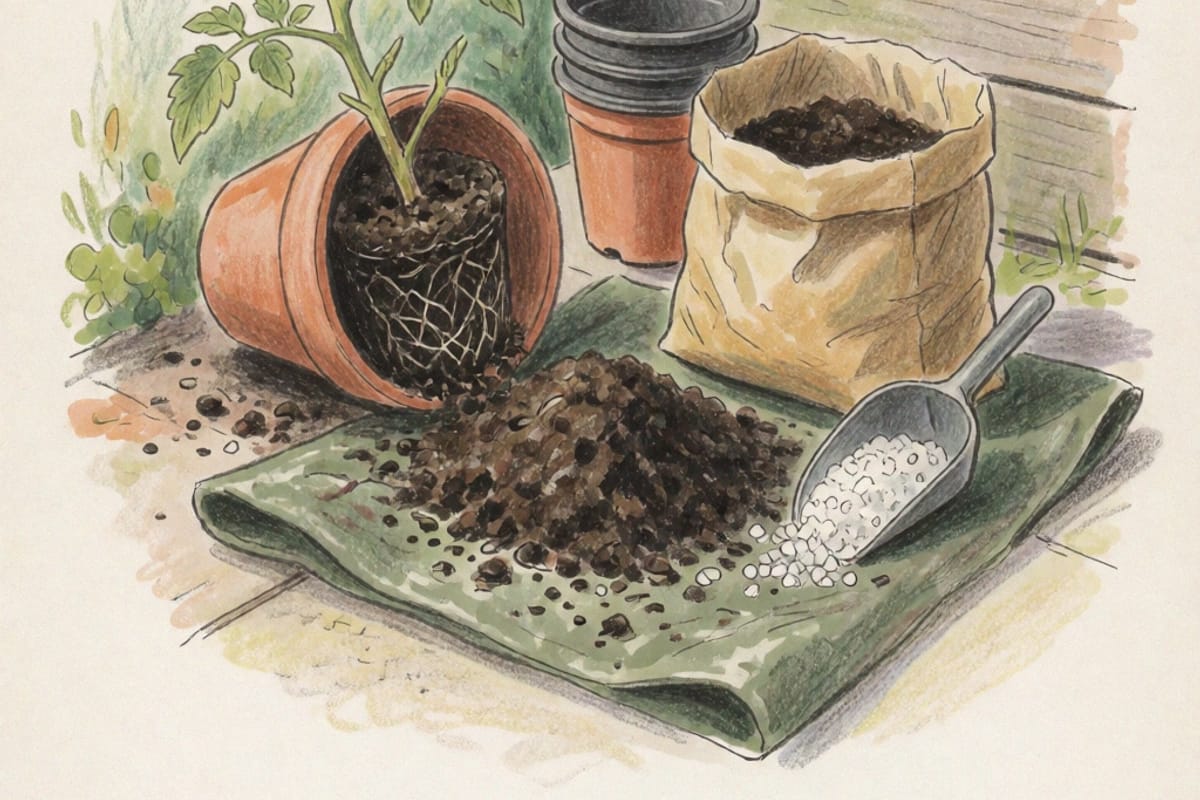
Tip the pot out onto a tarp or a wheelbarrow. Pull out the root plate, which usually comes away as one dense disc, and shake the loose mix off it. Break up the clods and pick out the thicker roots. Fine root threads can stay; they will break down.
Then rebuild what has gone. Roughly two parts old mix to one part fresh mix or good compost, and a couple of handfuls of perlite or fine bark for every large pot, because coarse material is precisely what a year of watering removed. If the crust of salts was bad, stand the pot somewhere it can be watered heavily and drain freely for a few days before you plant into it.
Add fertilizer at the start of the season, not now. A balanced slow-release at the rate on the label, worked through, because the original charge is long gone and second-year mix with nothing added is what gives reused soil its bad reputation.
One small thing that saves a lot of frustration: wet the mix before you plant into it. Dry peat-based mix repels water for a surprisingly long time, and a pot that looks watered but is dry an inch down is the standard reason a healthy transplant sulks for a fortnight.
Storing it through the winter
Mix left in pots outdoors, uncovered, sits sodden for five months and comes out in spring heavier and more compacted than it went in. It also makes an excellent slug hotel, and terracotta full of wet mix is what cracks in the first hard freeze.
Two options that both work. Empty the pots into old compost bags or a lidded tub, tie them loosely so they can breathe, and keep them somewhere out of the rain. Or leave the mix in the pots, cover them, and lift them off the ground on a couple of bricks so they drain. Either way the goal is the same: damp, not soaking.
Terracotta and any thin plastic that has been out for a few seasons is better off empty and upside down. Plastic goes brittle in cold sun and a pot that has been full and frozen splits along the rim.
What this is worth
A single large container holds a serious amount of mix, and a balcony with four or five of them is a bag or two of new mix every spring for no reason at all. Do the refresh and you buy the fresh third, not the whole thing.
Start with the pot you are least sure about. Tip it out, look at the roots, and if they are white and firm and smell of nothing much, that mix is fine and you have just saved yourself a trip up the stairs with a sack.