
How Many Plants Actually Fit in a 4x8 Bed? Almost Everyone Guesses High
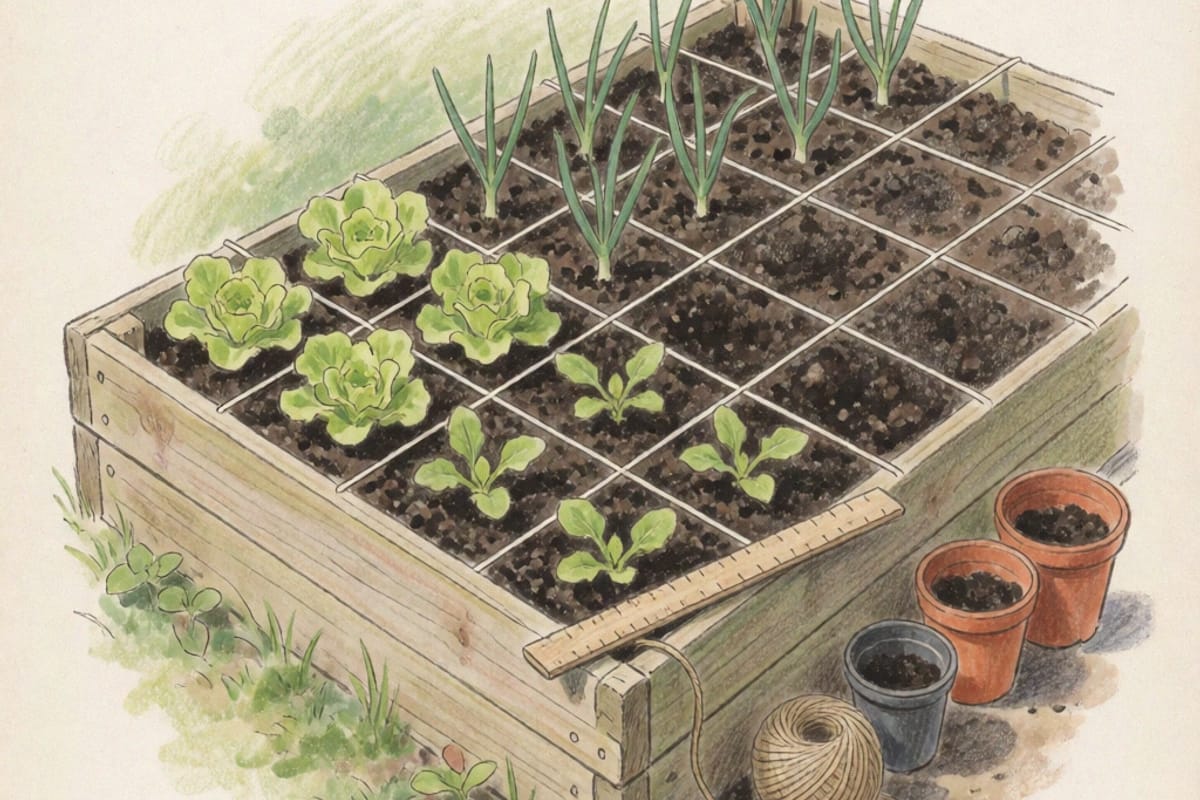
A four by eight foot bed is thirty-two square feet, and thirty-two square feet in early spring looks like a farm. It is bare, it is level, the soil is dark, and you have a seed order in front of you. That is the exact moment the bed gets oversold.
I am writing this in mid-September, with one bed that grew four good tomato plants and one that grew seven poor ones off the same compost and the same watering. The difference was decided in January, sitting at the kitchen table, being optimistic.
The counts
These assume a bed you can reach into from both long sides, so no path inside it and every square foot planted. That is the whole point of a bed over a row garden: the packet spacing includes room to walk between rows, and a bed does not need any.
| Crop | Spacing | Plants in a 4x8 bed |
|---|---|---|
| Radishes | 3 in | about 500 |
| Carrots (thinned) | 3 in | about 500 |
| Beets | 4 in | about 290 |
| Bush beans | 4 in | about 290 |
| Onions | 4 to 6 in | 130 to 290 |
| Garlic | 6 in | about 130 |
| Spinach | 6 in | about 130 |
| Leaf lettuce | 6 in | about 130 |
| Bush peas | 4 in, double row | about 100 |
| Head lettuce | 10 to 12 in | 24 to 32 |
| Kale | 15 to 18 in | 12 to 16 |
| Broccoli, cabbage, cauliflower | 18 in | 12 to 14 |
| Peppers | 18 in | about 12 |
| Cucumbers, trellised | 12 in along one edge | 8 |
| Tomatoes, determinate | 18 to 24 in | 8 to 10 |
| Tomatoes, indeterminate and staked | 24 in | 8 |
| Tomatoes, in cages, unpruned | 36 in | 4 |
| Summer squash | 24 to 36 in | 2 to 3 |
| Winter squash or pumpkin | one, and it leaves the bed | 1 |
Two rows in that table do most of the damage every year. The tomato line, because eight staked plants and four caged ones are both correct and people plant twelve. And the squash line, because a zucchini seedling is four inches across in May and four feet across in July, and nothing in the seed packet photograph prepares you for that.
Where crowding is free and where it costs you everything
Crowding is close to free on anything you harvest as leaves or as small roots. Cut-and-come-again salad, spinach, arugula, radishes, bush beans: pack them in, and if they get tight you thin them and eat the thinnings. The plant is not being asked to build one large finished thing, so a smaller plant is simply a smaller portion of the same harvest.
It is expensive on anything where the plant spends the whole season making one item. A cabbage at nine inches makes a cabbage the size of a fist. An onion at two inches makes a shallot. Bulb size in onions tracks spacing almost directly, which is why the same variety, same bed, same feeding gives you golf balls one year and softballs the next.
And it is worst of all on the crops that get sick in still air. Tomatoes, cucumbers, squash and zucchini all carry fungal problems that need leaves to stay wet to get going. Plants at half the recommended spacing hold a damp microclimate under the canopy all morning. You do not get twice the harvest and half the airflow, you get the same harvest and blight in August.
The reach rule, which nobody breaks twice
The bed is four feet wide because most people can reach comfortably about two feet without standing in it, and standing in it undoes the loose soil that made the bed worth building. If your bed is against a fence and you can only work from one side, treat it as a two-and-a-half-foot bed and cut every count above roughly in half.
The eight-foot length is arbitrary and mostly about what lumber comes in. Nothing in the spacing changes if your bed is six feet or ten.
Two things that beat squeezing more in
Go up. A trellis on the north edge holds cucumbers, pole beans, small winter squash and indeterminate tomatoes in a footprint of a few inches per plant, and the shade it casts falls outside the bed rather than across it. Vertical growing is the only honest way to raise the plant count without paying for it later.
Then go again. A bed that grows radishes in April, bush beans in June and spinach in September has grown three crops in the space people are trying to fit three crops into at once. Succession is what turns a small garden into a productive one, and it costs nothing but a note in a calendar.
Do this before you order, not after
Sketch the bed on paper in squares and write the plants into it. Every crop you want a place for has to have a square, and when you run out of squares you have found the real size of your seed order. It takes twenty minutes in January and it usually changes the order.
The failure mode is doing it in May with a tray of eleven tomato plants already in your hands, at which point the arithmetic loses to the fact that they are alive and they cost money. Nobody composts a healthy seedling. Everybody plants the extra one.
