The Fastest Crops to Grow Indoors This Winter, Ranked by Days to First Harvest
It’s the middle of November, the beds outside are put away, and it’s dark by the time you get home. Plenty of things will grow on a windowsill. If you want to eat something you grew this week rather than this spring, the useful question is which of them will be ready before you lose interest.
So here they are in order of how soon you get to eat, counted from the day you sow (or, for the scallions, the day you put them in water). The ranges are the usual ones you’ll see on packets and in growing guides. Winter light is weaker and your windowsill is cooler than a summer garden, so expect to land at the slow end of each range unless you’re growing under a light.
| Crop | Days to first harvest | Light it needs |
|---|---|---|
| Sprouts in a jar | about 3 to 7 | none to speak of |
| Scallions regrown in water | about 7 to 10 | a bright sill |
| Microgreens | about 7 to 21 | a bright sill, better under a light |
| Pea shoots | about 14 to 21 | a bright sill |
| Baby arugula and mustard | about 21 to 35 | bright sill or grow light |
| Baby lettuce leaves | about 28 to 42 | grow light, honestly |
| Radishes | about 30 to 45 | grow light, no way around it |
1. Sprouts in a jar
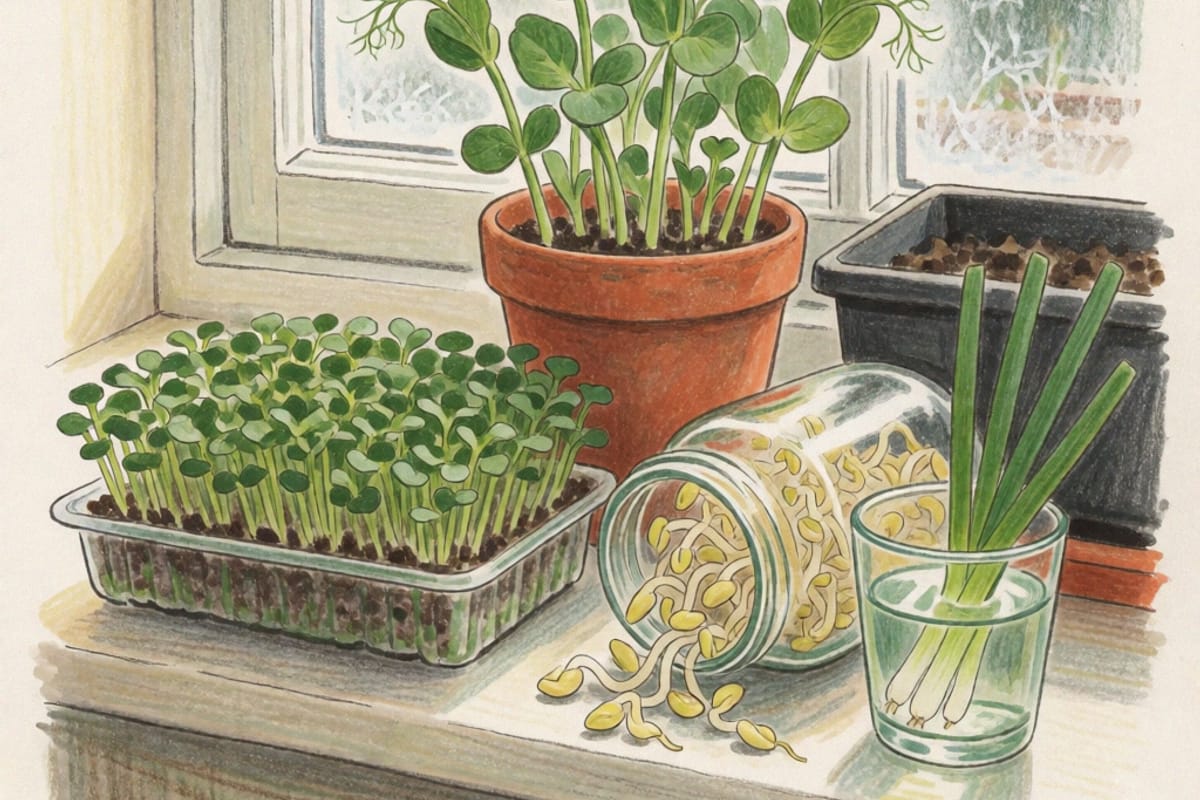
Nothing beats these for speed. Soak a spoonful of mung beans, lentils, alfalfa or broccoli seed overnight, drain it, and rinse and drain twice a day in a jar tipped on its side. Mung beans and lentils are often ready in three or four days. Alfalfa and broccoli take nearer a week.
They don’t need light, so a corner of the counter works. Buy seed sold for sprouting rather than garden seed, which may have been treated. And because sprouts grow in warm, wet conditions that suit bacteria too, keep the rinsing regular and the jar clean. People who are pregnant, elderly or have weakened immune systems are usually advised to cook sprouts rather than eat them raw.
2. Scallions from the root ends
Keep the white root end of a bunch of shop scallions, an inch or so with the roots attached, and stand it in a glass with water just covering the roots. Put it on the brightest sill you have and change the water every couple of days. You can usually snip green tops within about a week.
This is the one item on the list that isn’t really growing from scratch, which is why it’s so fast. You’ll get two or three cuttings before the new growth gets thin and pale. Potting the root ends into a pot of compost keeps them going longer than water does.
3. Microgreens
Microgreens are seedlings cut when they have their first leaves, and radish, mustard and cress are the sprinters. Sow them thickly on the surface of a shallow tray of moist compost, cover the tray for a day or two until they germinate, then give them all the light you can. Radish microgreens are often ready in a week to ten days. Broccoli, kale and most others take closer to two weeks, and sunflower and some of the slower kinds can push toward three.
On a dim winter sill they’ll stretch, lean toward the glass and go pale. They’re still edible like that, but they’re floppy. A cheap light a few inches above the tray makes a bigger difference to microgreens than to anything else here.
4. Pea shoots
Soak pea seeds overnight and sow them almost touching in a pot or tray. In two to three weeks you’re cutting the top few inches, tendrils and all, and they taste like the first peas of June.
Cut above a leaf joint and most plants will regrow for a second, smaller cutting. Any garden pea seed works, which makes the half-used packet from the spring a good place to start. Just keep it to vegetable peas. Sweet peas, the scented flowers, are a different plant and are poisonous, so their seed doesn’t belong in the tray.
5. Baby arugula and mustard
These are the fastest true leaf crops. Sown in a pot or window box and cut at a few inches tall, arugula and the small mustards are usually ready somewhere around three to five weeks, and both come back after cutting if you leave an inch of stem.
They put up with a cool sill better than lettuce does. What they won’t put up with is very low light, so if your only window faces north, this is where you need a light.
6. Baby lettuce leaves
Loose-leaf lettuce cut young is a reliable salad from a pot, but it’s slower than people expect indoors. Four to six weeks to the first decent bowl is normal, and in a dark December it can take longer. I’ve had more luck with it under a light than on any windowsill I’ve owned, including a south-facing one.
Sow a pot every two or three weeks rather than one big one, and pick the outer leaves so the middle keeps growing.
7. Radishes
Radishes are the classic “fast” garden crop, and outdoors in spring they earn it. Indoors in winter they’re the hardest thing on this list. Without strong light they grow tall and leafy and never swell a root at all, which is the most common indoor radish disappointment.
Under a proper grow light, kept close to the leaves for most of the day, a small round variety can be ready in five or six weeks. Give them a deep pot so the roots have room. On a windowsill alone I’d skip them and grow radish microgreens instead, which give you the same peppery bite in a week.
Staying at the fast end of the range
Most of what slows these down in winter is light, and the rest is temperature. A sill that’s bright at noon can be cold at night, especially behind a single pane, and seeds that sit in cold compost just wait. Pull the trays off the sill on the coldest nights, or start them somewhere warm and move them to the window once they’re up.
Days to harvest are only ever an estimate, and your own window will have its own numbers. Keep a note of when you sow and when you first cut, and by February you’ll know which of these your house is actually good at. If you use the garden journal in Garden Planner Pro, those notes are still there next November, next to this year’s.
If you only start one thing this weekend, start a jar of sprouts and a tray of radish microgreens on the same day. One will be ready before the other is up, and that’s about the right pace for a winter kitchen.