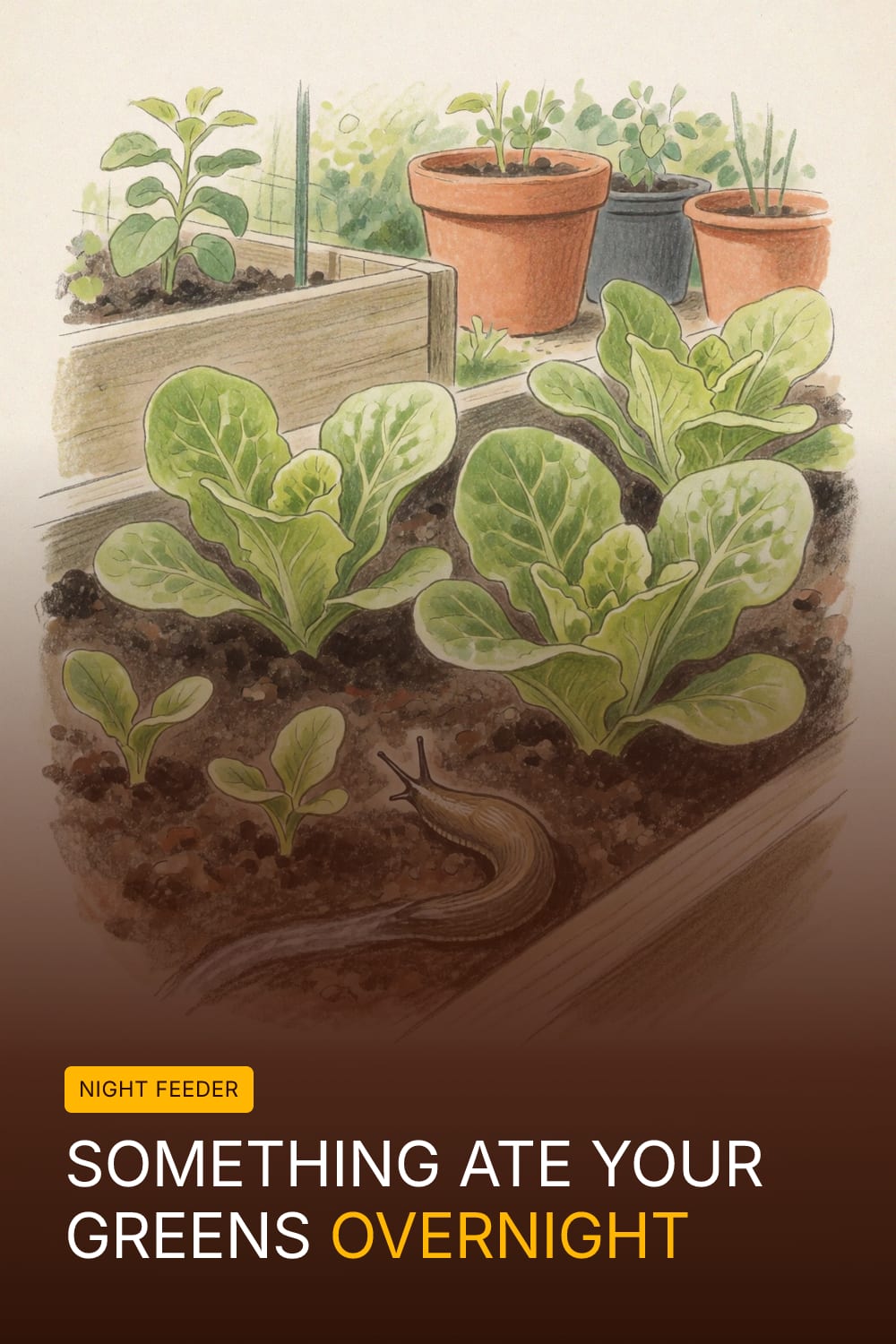
Your Fall Seedlings Vanished Overnight. Look for the Slime, Not the Bug.
You set out a tray of lettuce plugs on Saturday. By Wednesday morning four of them are green stumps and the rest have holes in them you could post a letter through. So you do the sensible thing and turn every leaf over looking for the caterpillar.
There is nothing there.
Damage with nothing attached to it, in September, after a wet week, is almost always slugs. They feed between dusk and dawn and they are back under a board or a pot rim well before you are outside with your coffee. Hunting for the animal in daylight is the wrong search. Look for what it left on the way home.
The trail is the tell
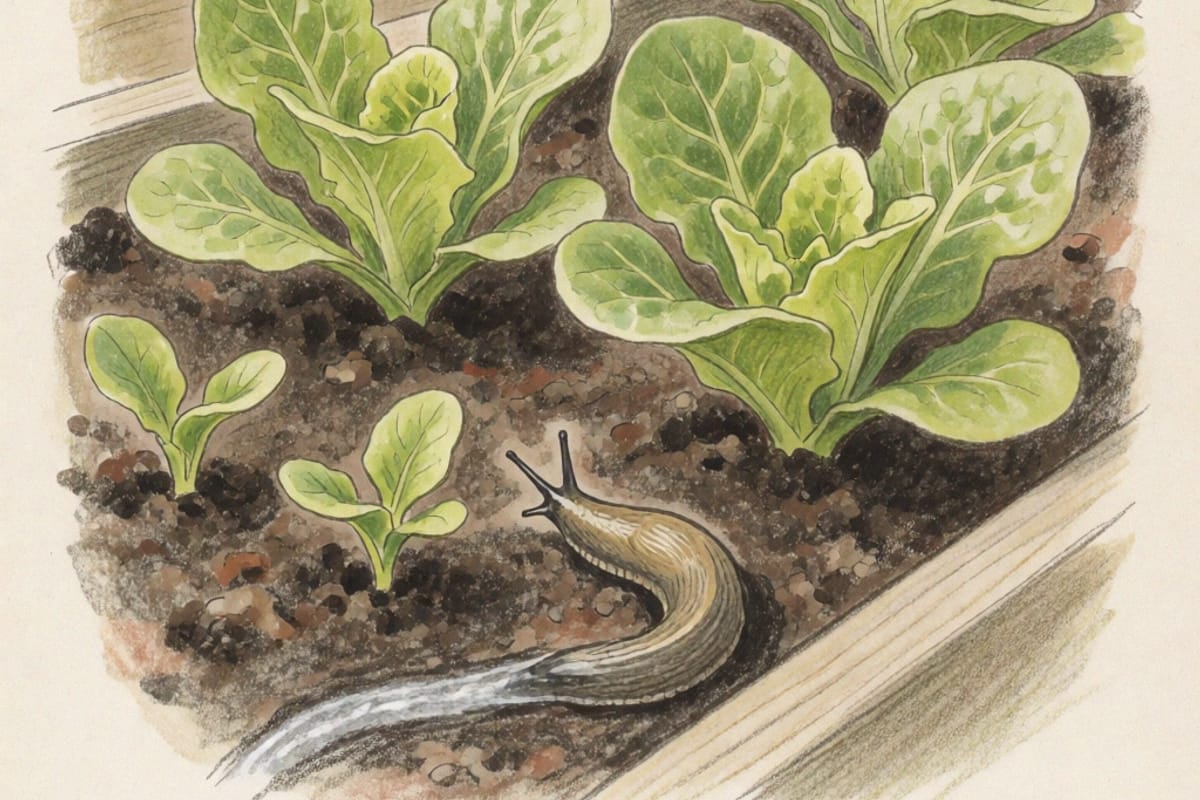
Dried slug mucus catches low light. Go out early, before the dew burns off and while the sun is still coming in sideways, and look at the soil around the damaged plants, the timber edge of the bed, the rim of any pot nearby. You are looking for a silvery track that wanders. It does not run in a straight line and it will often climb something.
Check the undersides of the damaged leaves too, and the crown of the plant where the leaves meet the stem. A trail on the plant itself settles it.
If there is no slime anywhere and the holes keep appearing, you have something else, and there are only a few candidates worth checking.
Ruling out the others
Caterpillars leave droppings, and that is the quickest way to rule them in. Cabbage worms and loopers are the other big chewer on fall brassicas, and they are messy eaters. Look in the crown of the plant and along the leaf midribs for small dark green pellets, about the size of a grain of coarse pepper. Where there is frass there is a caterpillar, usually a velvety green one lying along a midrib doing an extremely good impression of a leaf vein. Caterpillar damage also carries on through the day, so if you can watch a hole get bigger between breakfast and lunch, it is not a slug.
Flea beetles make a completely different mark: dozens of tiny round pits and pinholes, like someone fired birdshot at the leaf from very close range. They work in warm sun and scatter when your shadow lands on the plant. On September sowings they tend to be an early problem that fades as nights cool.
Earwigs are the genuinely confusing one. They feed at night like slugs, they chew ragged irregular holes like slugs, and they leave no slime. The difference is where they spend the day: something tight and dry rather than something damp and dark. A rolled leaf, the open end of a bamboo cane, the fold of a plastic plant label. If you suspect them, leave a loosely rolled piece of damp newspaper in the bed overnight and look inside it in the morning.
Birds and voles do not really look like any of this. Pigeons strip a brassica down to the ribs and leave the leaf shredded rather than perforated, and voles clip a seedling off at a clean angle right at soil level, like a tiny pair of secateurs went through it.
Why they take over in September specifically
The slugs did not arrive. They were here all August, sitting out the dry weather under the pots and the offcut of decking board, barely feeding. Cool damp nights bring them back to full activity, and autumn is when they lay, in small clusters of translucent eggs tucked under anything flat that sits on soil.
The timing is unlucky in a way that has nothing to do with your gardening. Everything left in a September vegetable garden is tough: leathery kale, finished bean plants, squash vines like rope. The only soft, sweet, thin-leaved thing in the whole plot is the row you sowed eleven days ago. You have laid out a very good table.
What to do tonight, and what to do tomorrow
The thing that works best costs nothing. Go out at ten with a torch and look at the plants that got hit, the soil right around the stems, and the pot rims and bed edges within a few feet. Take a tub of soapy water. Do it two nights running rather than one, because a single patrol tells you the population is there and a second one tells you whether you are making a dent. It is a grim twenty minutes and nothing else on this list works as fast.
In daylight, take away the daytime shelter. Upturned pots, the stack of empty modules, a leaning plank, weedy growth along the bed edge, and mulch heaped up against the stems of young plants. Mulch is worth keeping, but pull it back an inch or two from a seedling row for the first few weeks and you remove the commute.
Shift your watering to the morning. A bed that is drying off by dusk is a harder surface to cross than one you soaked at six in the evening, and on a dry night slugs travel less and feed less.
If you want a bait, use iron phosphate pellets, which are approved for organic growing and are the one bait that is safe around pets and hedgehogs. Scatter them thinly across the soil surface, and never in a little pile, because a pile is a feeding station with a queue at it. They need reapplying after heavy rain.
Beer traps genuinely catch slugs, but they also attract them from a small radius, so set them at the edges of the bed rather than in the middle of the row you are trying to save. They need emptying every couple of days and it is unpleasant. Copper tape does something real on a smooth, clean pot rim and almost nothing around a bed, where a slug just bridges across on a leaf.
Save your money on eggshells and coffee grounds. Salt kills the individual slug and does your soil no favors at all.
Three weeks, then you can relax
The reason this feels so much worse in fall than in June is that everything you are growing is at the seedling stage at once. A slug that takes a bite out of a mature kale leaf has cost you a leaf. The same slug at the two-leaf stage has cost you the plant, the three weeks it had grown for, and the slot in the bed.
So it is worth protecting hard and briefly. Patrol, clear the shelter, bait if you want to, and once the plants have five or six true leaves the same slug population stops being an emergency. Sowing a row denser than you need and thinning it later is the cheapest insurance in gardening, and September is the month to do it.
If you do nothing else after reading this: torch, ten o’clock, tonight. It ends the argument about what is actually eating them, which is worth more than everything else here put together.