Your Zucchini Plant Is Covered in Flowers and Still Growing Nothing - Here's the Real Reason
- Growing Squash
- Pollination
- Troubleshooting
For two entire summers I thought I was doing something wrong with zucchini.
The plants looked wonderful. Huge leaves, flowers constantly, the picture of health, and almost no squash. I fed them. I watered them differently. I moved them to a sunnier bed the second year and got the same result, which was somehow worse, because it meant it wasn’t the spot.
Nothing was wrong with the plants. I just didn’t know they grow two different kinds of flower, and I’d been looking at mostly one of them.
Your zucchini has male and female flowers
Zucchini is monoecious, which means one plant produces separate male and female flowers rather than one all-purpose flower that handles everything itself. All the summer and winter squash do this, along with cucumbers, melons and pumpkins.
Telling them apart takes about a second once you know:
Male flowers sit on a long, thin, plain stem. That’s it. Straight stem, flower on top. Their only job is producing pollen.
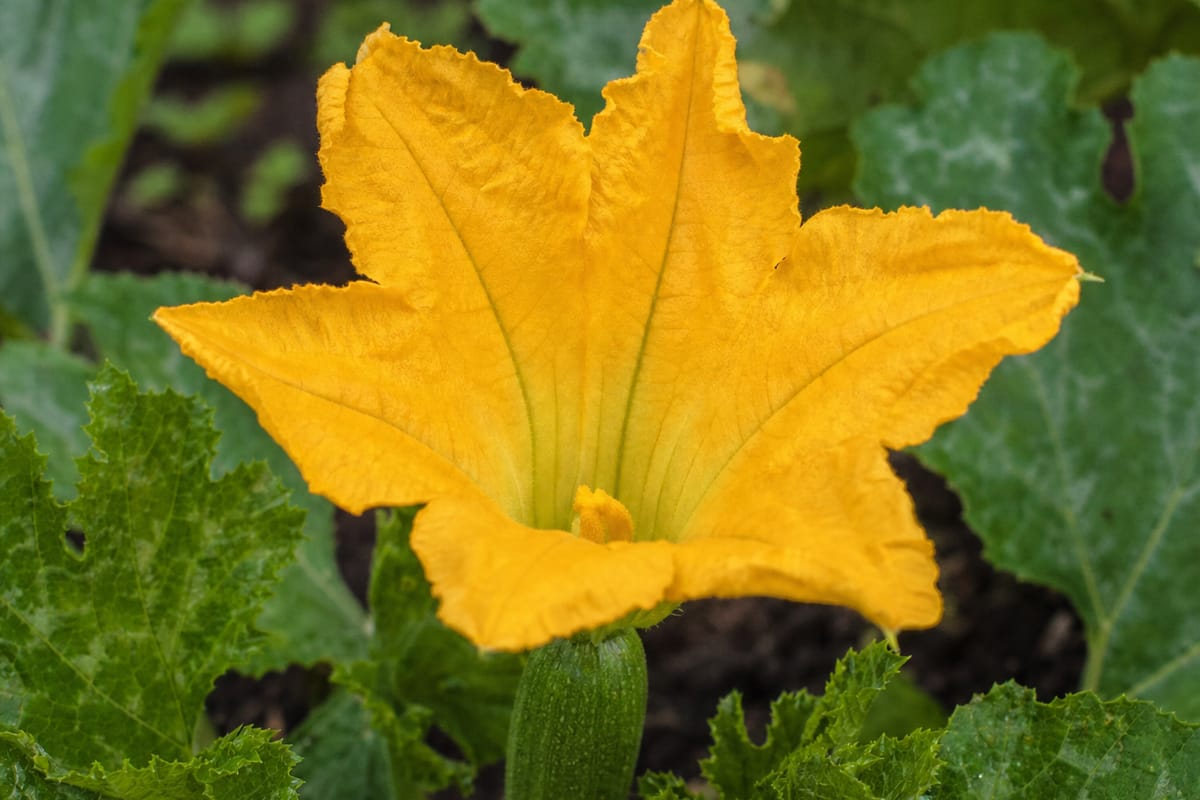
Female flowers sit on a short stem with a small swollen bulge right behind the petals. That bulge is a tiny unfertilized squash, and it’s there before the flower even opens.
Go look at your plant now, if it’s flowering. You’ll find both, and you’ll never need to be told again.
The timing is what fools everybody
Zucchini plants usually open a run of male flowers first, sometimes a week or two before a single female shows up. It’s completely normal and it isn’t a sign of anything.
But it means that during that stretch, a plant can be covered in blooms with genuinely nothing to pollinate. You see a flowering plant, you assume squash is imminent, and then nothing happens for two weeks. That was most of my first summer.
Then the females arrive and the second problem starts. Each flower opens for a single day, usually just the morning. If it isn’t pollinated in that window, the little squash behind it stops growing, turns yellow, and shrivels from the tip backward. That’s the classic complaint: tiny squash that rot and drop off. It isn’t disease and it isn’t a nutrient problem. It’s an unpollinated flower doing exactly what unpollinated flowers do.
Why pollination fails
Squash pollen is heavy and sticky, and it doesn’t blow around on the wind the way corn pollen does. It has to be physically carried from a male flower to a female one, and that’s almost entirely bees.
So it comes apart when the bees don’t fly. A cool, rainy or very windy morning covers the only hours the flowers are open. Heavy heat, up above the mid-90s, can also cause flowers to drop and makes pollen less viable, on top of slowing pollinators down. Pesticide use nearby thins out the bee population you’re relying on. And sometimes it’s just a mismatch, where the males and females aren’t open on the same morning.
Doing it yourself takes thirty seconds
This is the bit I wish I’d found in my first summer instead of my third.
- In the morning, while flowers are open, find a fresh male flower (long plain stem) and a fresh female (swollen base).
- Pick the male and peel the petals off to expose the pollen-covered center.
- Dab that center directly onto the center of the female flower. Be reasonably thorough about it.
- If you have a second male going spare, repeat. It improves the odds.
A small dry paintbrush works just as well if you’d rather not sacrifice the male flower, and it lets you work several females from one male.
Do this a few mornings in a row through a slow stretch and you’ll see the tiny squash behind the female start visibly swelling within a day or two. That’s how you know it took. There is something genuinely satisfying about it that I did not expect.
When it isn’t pollination
If you’ve got plenty of female flowers opening, bees are clearly working the garden, and fruit is still failing, then look at other things. Sustained extreme heat, inconsistent watering, or too much nitrogen (which pushes leaf growth at the expense of flowering) are the usual suspects.
But for the specific complaint of “endless flowers, tiny yellow squash that shrivel and drop,” it’s pollination the overwhelming majority of the time. Check for female flowers before you change anything else.
Garden Pro Planner’s plant library covers pollination needs crop by crop, so you can see ahead of time which of the things you’re growing depend on pollinator visits and which will fruit regardless. Squash, cucumbers and melons are the ones to watch.
The reason this is worth knowing before peak squash season is that it turns a mystery into a chore, and a chore you can actually do something about. Two summers of assuming my plants were broken, and the fix was a paintbrush and five minutes before breakfast.