Why Are My Overwintering Geraniums Leggy and Pale?
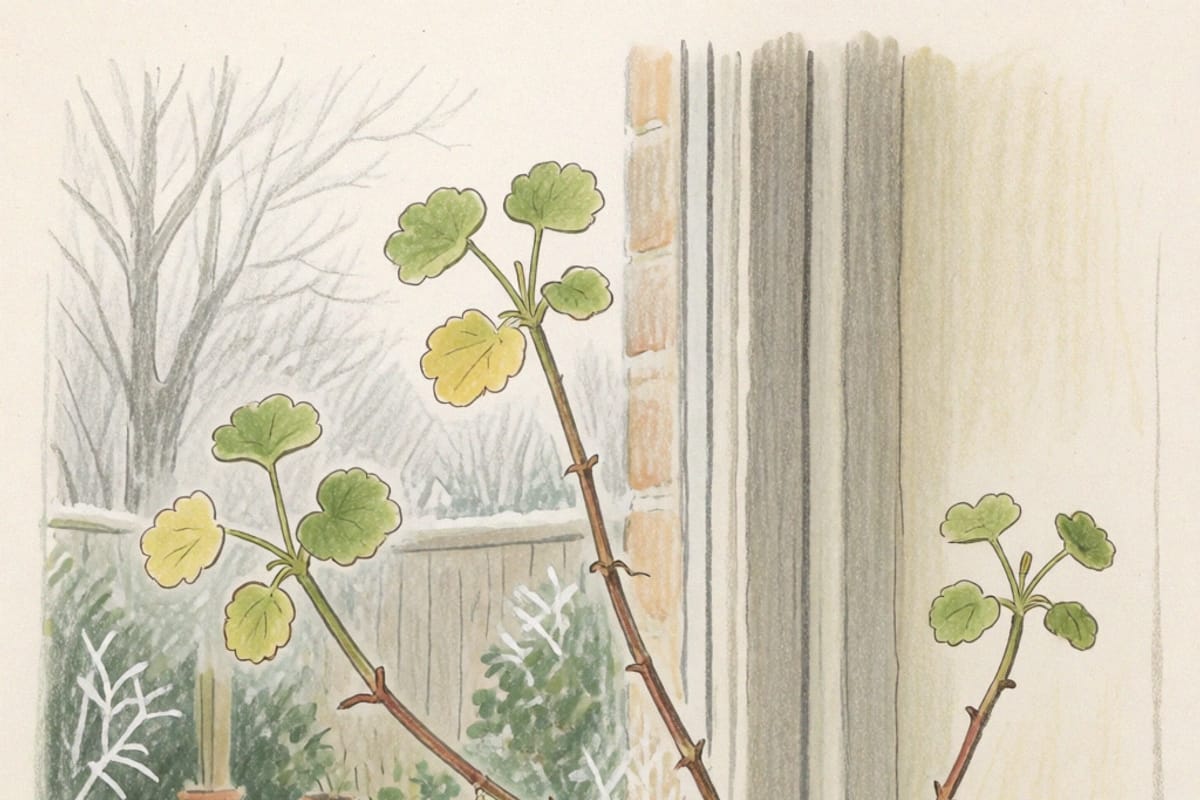
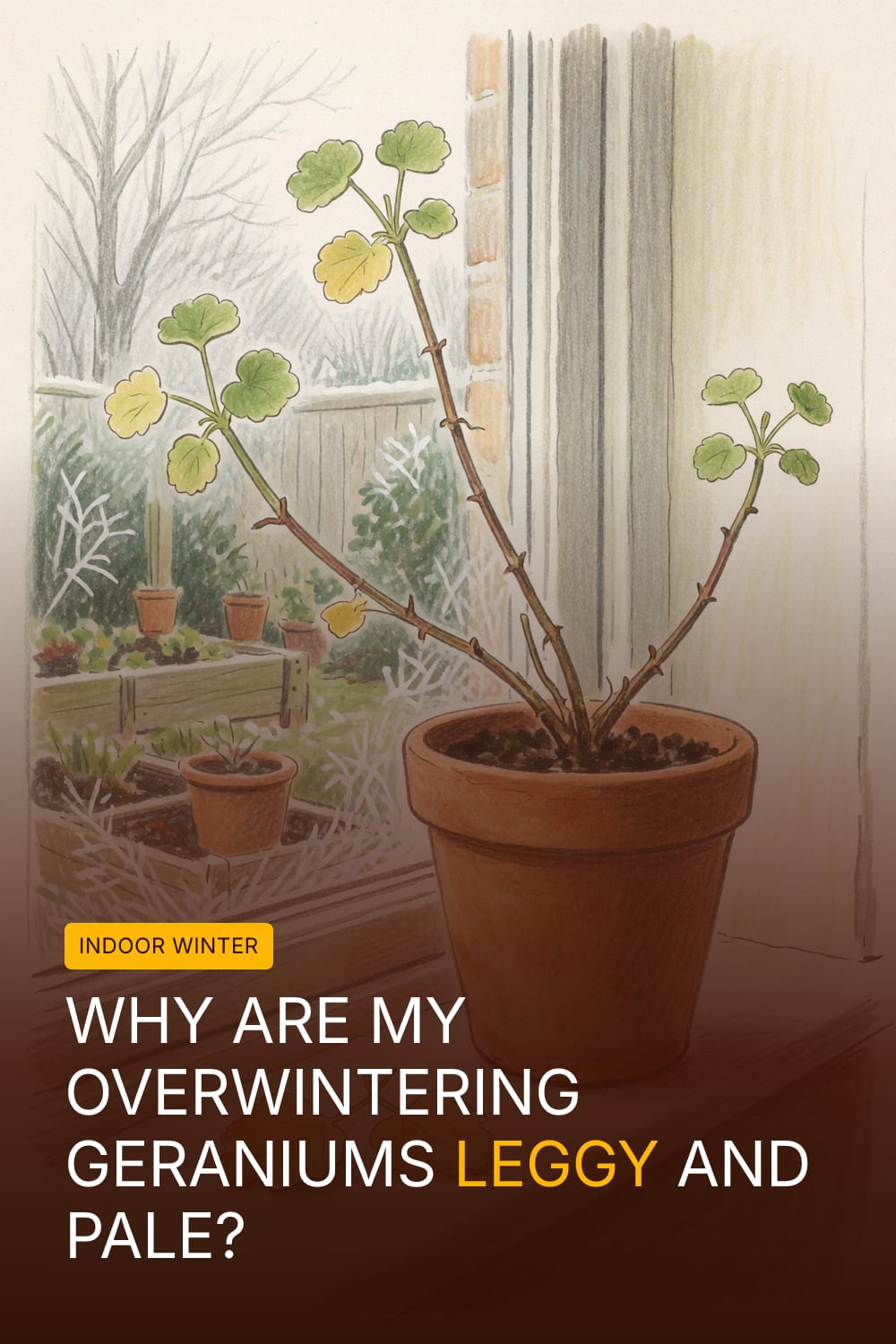
A month ago you carried the geraniums in before the first frost, and they looked great. Now the stems have stretched out toward the window, there’s a long bare gap between each leaf, the new leaves are small and a washed-out yellow-green, and the old ones at the bottom keep turning yellow and dropping on the sill.
Nothing is eating them and they’re not dying. They’re short of light, and almost always they’re also too warm, and the combination makes them grow faster than the light can support. That’s fixable, and the stretched growth you’ve already got can be cut off in late winter, so the plant you put out in spring needn’t look anything like the one on your windowsill today.
These are the zonal geraniums most of us grow in pots and window boxes, the ones with round, scalloped leaves (often with a darker band) and big clusters of red, pink or white flowers. Strictly speaking they’re pelargoniums, but everyone calls them geraniums.
Light is most of it
Indoor light in winter is far weaker than anything a geranium got outside over the summer, even on a sunny windowsill. The days are short and the sun sits low. Window glass takes a bit more. A geranium responds the way most plants do: it puts its energy into growing longer stems to reach the light, and it skimps on the leaves. The pale colour is the plant making new growth faster than it can make the green to go with it.
Look at which way the stems lean. If they’re all bent hard toward the glass, light is your main problem.
Warmth makes it worse
This is the half people miss. A warm room tells the plant to keep growing, but the light isn’t there to grow properly with, so you get more of that thin, stretched growth. In a cool room the plant slows right down and mostly waits for spring, which is what you want.
Geraniums overwinter best somewhere cool and bright, roughly in the 50s to low 60s °F (about 10 to 16 °C). A living room near a radiator or a heating vent is about the worst spot in the house for them, even though it feels like the kindest one.
Too much water and feed
Watering on the summer schedule is the other common cause. A slow-growing geranium in a cool room uses very little water, and soil that stays damp all the time leads to yellowing lower leaves and, at worst, a soft, black rot at the base of the stem. If a stem is black and squishy where it meets the soil, that one is gone. Cut it out, take a cutting from any healthy tip, and let the rest of the pot dry out properly.
Feeding pushes growth the plant can’t support in this light, so stop until spring.
What to do this week
Move the plants to your brightest window. In the Northern Hemisphere that’s usually one facing south. Get them right up close to the glass, since light drops off quickly as you move back into the room, but keep the leaves from touching a pane that gets icy.
Then find them a cooler spot if you can: an unheated spare room, a cool porch that doesn’t freeze, a bright window in a hallway. If the brightest window is in the warmest room, that’s a trade-off, and on balance I’d keep the light.
Turn the pots a quarter-turn every week or so, so they don’t all lean one way.
Water less. Push a finger into the soil, and water only when it’s dry an inch or so down, then water through and let the pot drain. In a cool room that might be every couple of weeks.
If you have a seedling light, a geranium under it for the winter will stay far more compact. I don’t bother for mine, because I’m cutting them back anyway, but it’s the one thing that would stop the stretching outright.
Pick off the yellow leaves as they go. A few lower leaves dropping over winter is normal and not worth worrying about. Check the leaf undersides while you’re there, because whiteflies sometimes ride indoors on geraniums, and a cloud of tiny white specks when you brush the plant means you’ve got them.
Pinch back in late winter
Don’t try to cut the plant into shape now. In this light it will only grow back stretched. Wait until late winter, around February or early March, when the days are noticeably longer.
Then cut each leggy stem back hard, by about half or more, to just above a leaf joint (the slightly swollen node where a leaf grows or grew). New shoots come from those nodes, so a stem cut low gives you a bushy plant instead of a tall one. It looks brutal. I hesitated over it for years, and every year the plants I cut hardest were the best ones on the balcony in June.
Once you see new growth, you can start watering a bit more and give a dilute feed every few weeks.
Take cuttings from what you cut off
The tips you cut off are free plants. Take a piece three or four inches long with a couple of leaves at the top, strip off the lower leaves, and leave it on the counter for a few hours so the cut end can dry. Then push it into a small pot of gritty, free-draining mix and keep it on a bright windowsill.
Don’t cover geranium cuttings with a plastic bag the way you would for a lot of plants. They rot easily in humid air, and they root fine without it. Water lightly and wait. There’s more detail on the method in the cuttings guide.
A cutting rooted in March is often a better-looking plant by May than the leggy old one it came from.
Water less than feels right
If you change only one thing, water less. Light is hard to fix in winter and warmth often is too, but water is entirely up to you. The watering reminders in Garden Planner Pro are handy for this: set one to remind you to check the pots, then only water the ones that are dry.
And if the stems are already long and pale, leave them be. They’re doing no harm, and in February they’re the cuttings.