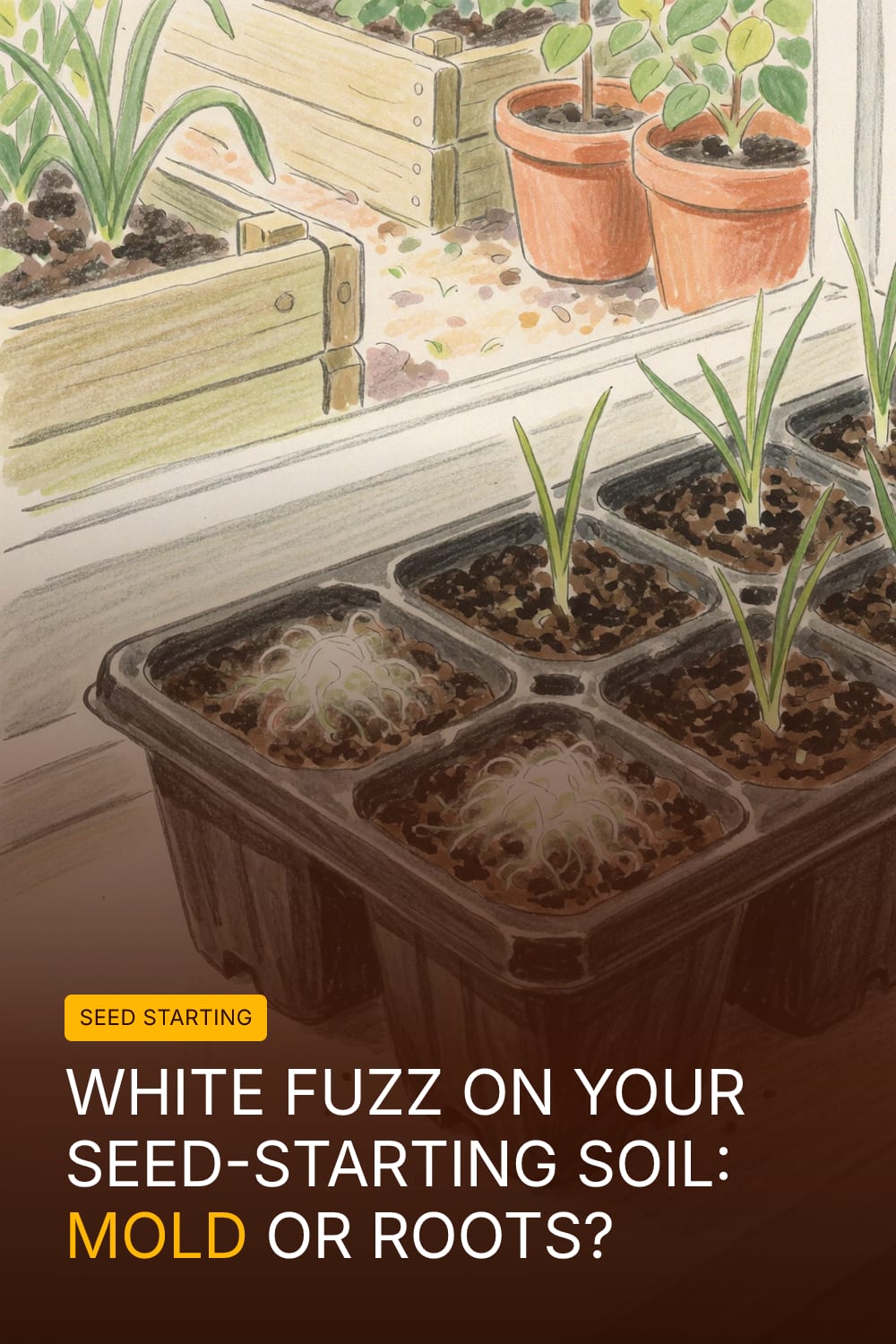
White Fuzz on Your Seed-Starting Soil: Mold or Roots?
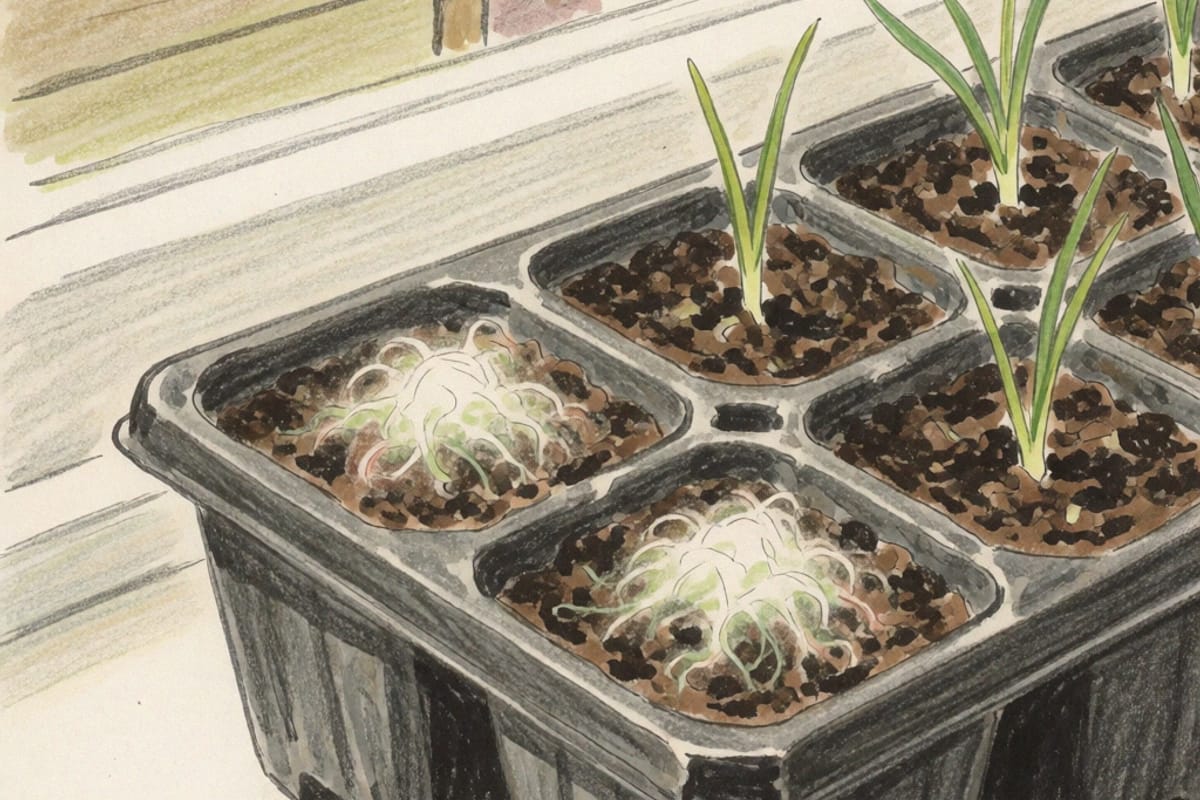
You lift the dome off the seed tray to check on the onions and there’s a white, cobwebby fuzz spread across the top of the soil. It’s an unsettling thing to find in a tray you’ve been fussing over for a week.
Take a breath. It’s almost always one of three things, and two of them are harmless. Most often it’s a surface mold that lives on the organic matter in the mix and is a sign the tray is too wet and too still. Sometimes it’s the fine root hairs of seeds that have just sprouted, which is good news. And sometimes what looks like fuzz turns out to be a crust of mineral salts. A minute with a magnifying glass, or your phone’s camera zoomed in, will tell you which.
This tends to turn up in winter, when the first onions and leeks go into trays under a dome on a cool windowsill. That’s the perfect setup for it.
Fuzz that spreads across the soil: mold
Mold looks like cotton wool pulled very thin, or a spider’s web lying flat on the soil. It spreads outward across the surface, sometimes from one cell into the next, and it grows over bare soil and unsprouted seeds alike. Touch it and it collapses to almost nothing. It often appears in the first week, while the dome is still on and the mix is staying wet.
Most of these molds feed on dead organic matter in the mix, not on your plants. On their own they rarely hurt seedlings. What they tell you is that the surface of the tray is staying wet, the air above it is still and humid, and the room is probably on the cool side. The same conditions suit damping off, the disease that rots seedlings at the base, and that’s why the fuzz is worth acting on even though it isn’t the problem itself.
Fuzz on the seed itself: root hairs
When a seed sprouts, the first root comes out covered in very fine white hairs. On a seed sown near the surface, or one that’s been washed up by watering, those hairs can look exactly like a tiny tuft of mold.
The difference is where it sits. Root hairs form a neat halo around the young root, close to the seed, and stop there. They don’t spread across the soil and they don’t jump to the next cell. Look closely and you’ll see a white root coming out of the seed with the fuzz on it. Leave it alone. Within a day or two the root heads down into the mix and the fuzz disappears with it.
The one exception: a seed that’s soft and swollen with fuzz on it but no root coming out is a seed that has rotted. Pick it out and throw it away.
A white crust: salts
Mineral salts look different once you get close. They’re dry, flat and crusty, more like frost on a window than cotton, and they’re often off-white or a bit yellow. You’ll see them on the soil surface and around the rims of pots and cells. They come from fertilizer and from minerals in hard tap water, left behind as the water evaporates.
Bottom watering makes this more likely, because water wicks up through the mix and leaves its minerals at the top. A light crust does no immediate harm. Every so often, water from the top with plain water until some drains out of the bottom, and ease off on feeding if you’ve been heavy-handed. If your tap water is very hard, rainwater or filtered water for seedlings is worth the bother.
While you’re looking, check that the white specks scattered through the mix aren’t perlite. Plenty of people panic about perlite. It’s hard, white and crumbly, like tiny bits of polystyrene, and it’s supposed to be there.
Getting rid of the mold
Take the dome off as soon as most of the seeds are up. The dome is there to keep moisture in while seeds germinate, and once they have, it’s doing more harm than good. For trays where only a few have sprouted, prop the lid open a crack for a few days.
Let the surface dry slightly between waterings. Water from below, by setting the tray in a shallow tray of water for twenty minutes or so and then pouring off what’s left, so the top of the mix can dry while the roots below stay moist. That alone clears up most mold. The salt trouble above is the price, which is why the occasional top watering helps.
Get some air moving. A small fan on its lowest setting, nearby and pointed across the tray rather than straight at it, keeps the air above the soil from sitting damp and still. I resisted a fan for years because it felt like overdoing it, and the mold problems stopped the winter I gave in.
Scrape off what’s there with a plant label, then scatter a thin layer of dry sand or fine vermiculite over the surface. It stays drier than the mix below and gives the mold less to grow in.
If the tray sits on a cold windowsill, move it somewhere a little warmer, or put it on a heat mat until the seeds are up.
When it matters
The mold is a symptom. The thing to watch for is the seedlings themselves. If one goes thin and dark, as if it’s been pinched at the soil line, and then falls over, that’s damping off, and it can move through a tray quickly. Why seedlings fall over covers what to do then, and most of it is the same list: less water, more air, no dome.
If the fuzz is spreading and the seedlings are standing up green and firm, you have time. Lift the dome, let the top dry a little, and turn on the fan. The onions won’t mind.
Once those seedlings are out in the garden in spring and something starts chewing them, Garden Planner Pro has pest guides with treatment tips for the common problems, so the next mystery doesn’t take a week of searching to name.