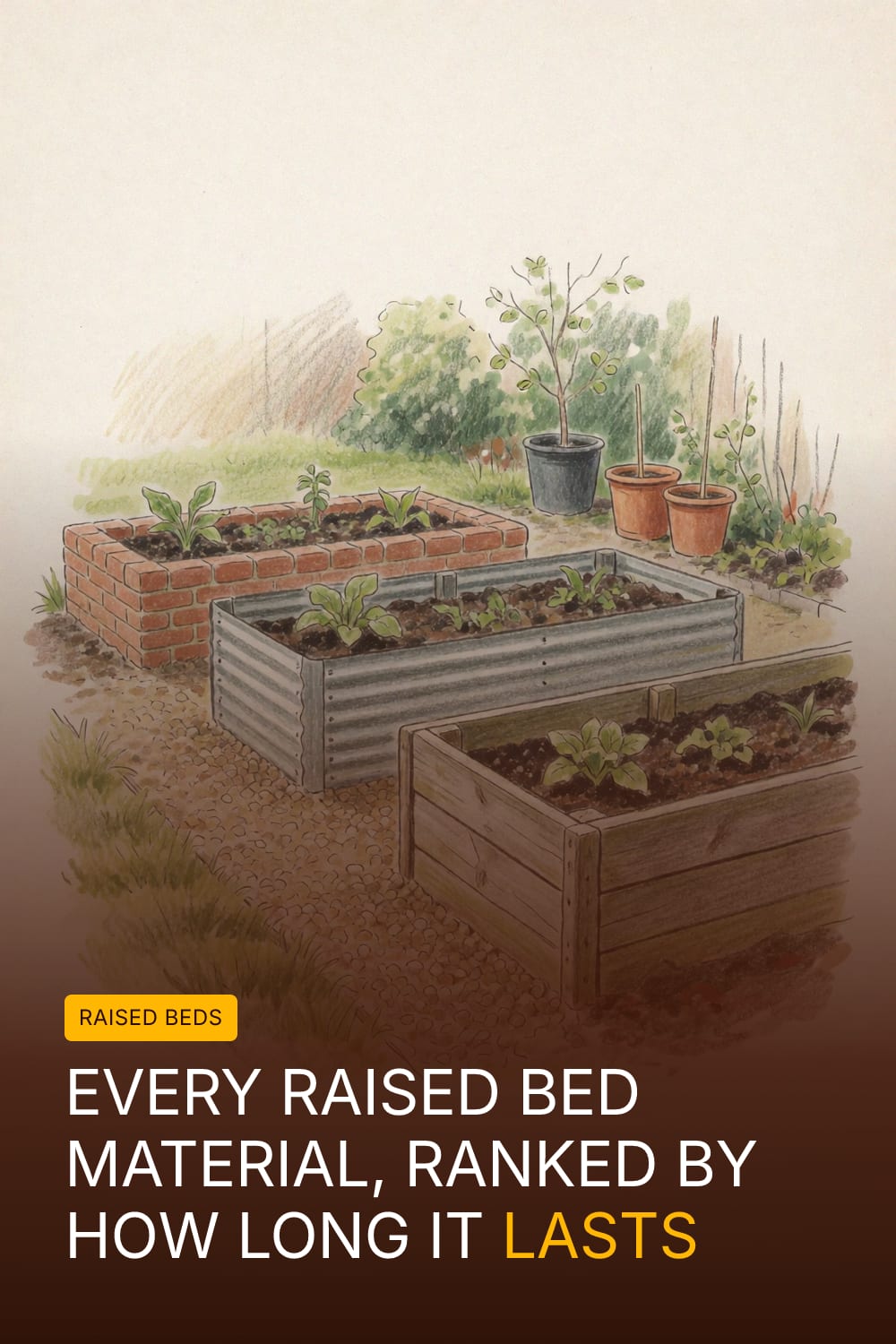
Every Raised Bed Material, Ranked by How Long It Lasts
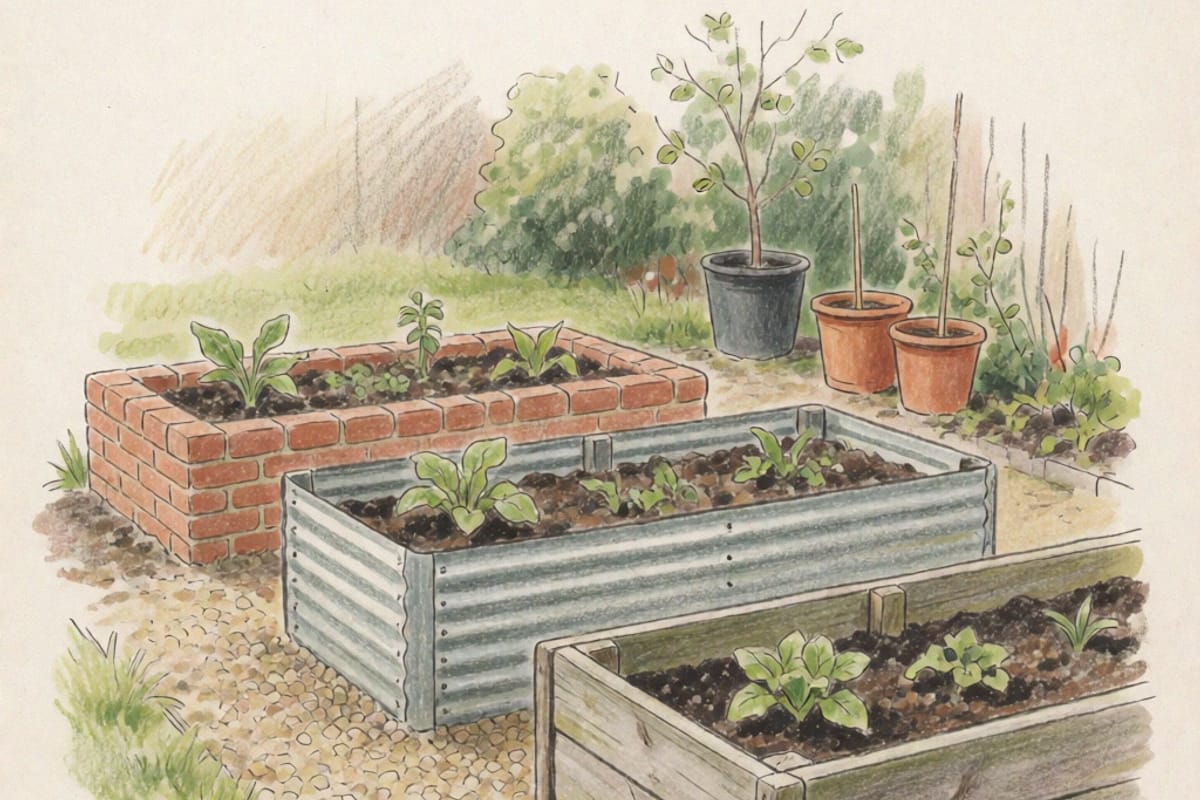
If you’re building raised beds this winter, the material decides one thing above everything else: how soon you’ll be doing it again. Below is every common option, longest-lasting first. The years are rough. A board’s life depends on how thick it is, how wet your climate is, and whether termites live near you, so treat the numbers as the shape of the ranking rather than a promise.
| Rank | Material | Roughly how long it lasts |
|---|---|---|
| 1 | Stone, brick or concrete block | Decades; effectively permanent |
| 2 | Galvanised steel | Well over a decade |
| 3 | Composite or recycled plastic | Many years; doesn’t rot |
| 4 | Modern pressure-treated lumber | Often ten years or more |
| 5 | Cedar, larch or other rot-resistant wood | Around a decade, sometimes much longer |
| 6 | Untreated pine or other softwood | A few years |
| 7 | Fabric beds | A few seasons |
1. Stone, brick or concrete block
Masonry doesn’t rot or rust, and a well-built stone or brick bed will outlast you. The trade is everything else. It’s the slowest to build, the hardest to change your mind about, and usually the most expensive unless you already have a pile of reclaimed brick behind the shed.
Dry-stacked concrete blocks are the cheap way in. They go up in an afternoon, and the hollow cores will hold a bit of soil for herbs or marigolds. Frost can shift a dry-stacked wall over a few winters, so expect to nudge the odd block back in line.
2. Galvanised steel
Corrugated steel beds, sold as kits or made from roofing panel and a timber frame, last a long time. The zinc coating is what keeps the steel from rusting, and once it wears through, usually at cut edges and scratches, rust starts there. Kits with a coated or capped top edge tend to hold up better and are kinder to your forearms.
Metal does get hot in full sun. In a deep bed full of damp soil I’ve never noticed it matter much, but in a shallow one against a south-facing wall I’d keep an eye on how fast the edges dry out.
3. Composite or recycled plastic
Boards made from recycled plastic, or plastic mixed with wood fibre, don’t rot and insects ignore them. They cost more than timber up front, and I don’t have a confident number for how long they last, since most of them haven’t been in gardens long enough to wear out. The weaknesses I’ve seen are sagging and bowing. A long board with soil pushing on it from inside can belly outward over a hot summer, so these beds want corner posts and a brace in the middle of any long side.
4. Modern pressure-treated lumber
This is the one people ask about, so plainly: modern treated lumber is generally considered fine for growing vegetables. The old arsenic-based treatment (CCA) stopped being sold for residential use in the US at the end of 2003, and current treatments are copper-based. In the UK the equivalent is usually sold as tanalised timber. Old railway sleepers and reclaimed timber of unknown history are a different matter. Keep those out of food beds.
Some people still prefer to line the inside walls with heavy plastic sheeting so soil never touches the wood. That’s a reasonable choice if it gives you peace of mind. Line the sides only and leave the bottom open, or you’ve built a large pot with no drainage.
Buy boards rated for ground contact, not the cheaper above-ground grade. The ground-contact rating is what gets you the longer life.
5. Cedar, larch and other rot-resistant wood
Western red cedar in the US, larch in the UK and plenty of places in between, and redwood or oak where you can get them. The heartwood of these trees resists rot without any treatment, which is why they’re the default for people who want wood and don’t want treated lumber.
How long they last depends a great deal on the boards. Thick boards last much longer than thin ones, and heartwood lasts much longer than the paler sapwood near the bark. A bed of thin, sappy cedar fence pickets can be soft at the corners in a handful of years. I built a bed like that once to save money and learned that lesson exactly.
6. Untreated pine or other softwood
The cheapest timber and the shortest-lived. In a wet climate, or wherever termites are busy, the boards can start to go within a few years, usually at the corners and along the bottom edge where they sit on wet soil. In a dry climate they can last a good deal longer.
For a first bed, a cheap pine box isn’t a bad idea. You find out whether you like the spot, the width and the height before spending on something permanent. Just go in knowing you’re renting it.
7. Fabric beds
Fabric raised beds and big grow bags are light, cheap and fold away. Sun breaks the fabric down, so they’re a few-seasons product, and the sides are soft, so they dry out faster than any rigid bed. They’re good for a balcony, a rented garden or a trial year. They’re a poor choice for anything you’d like to still be there in five years.
What shortens any bed’s life
Contact with wet soil is what kills wood, so the bottom board goes first. Setting a timber bed on a course of bricks or gravel, so it isn’t sitting in mud, buys it years. Thicker boards last longer than thin ones in every material. Corners are where every kind of bed fails, because that’s where the soil pushes hardest and where water collects, so solid corner posts are worth more than fancy boards.
If you’re the sort who works out cost per year, the cheap options look less cheap. A pine bed you rebuild twice in the life of one cedar bed is three builds, three lots of screws, and three weekends of shovelling soil out and back in. That’s the part that makes me pay more for the long-lasting ones now.
Whatever you choose, the dimensions matter more than the material for how well the bed grows; how to build a raised bed covers width and depth, and every way to fill one covers what goes inside. Once the boxes exist, the square-foot bed grid in Garden Planner Pro lets you draw each bed at its real size and lay out spring’s planting with companion scoring before the soil has even thawed.