Your Amaryllis Grew Leaves but No Flower Stalk. Don't Throw It Out.
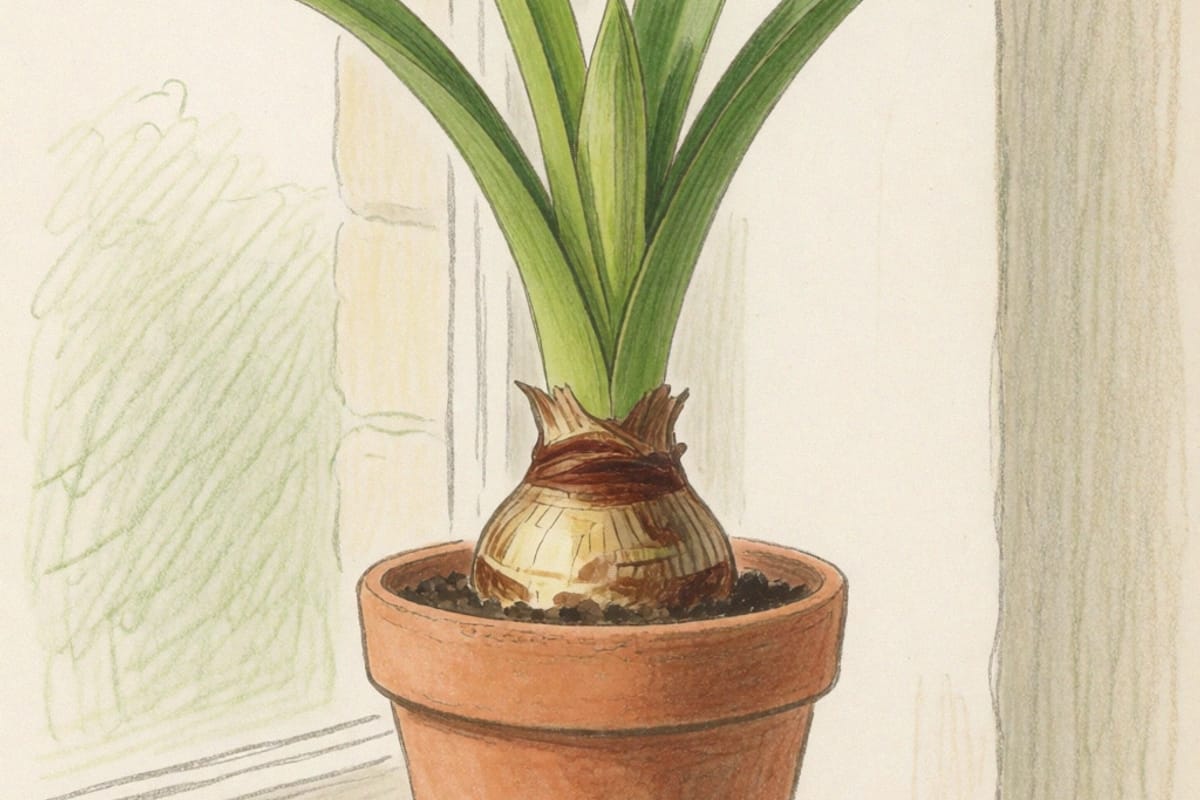
You potted the amaryllis at the start of November, put it somewhere bright, and waited for the fat stalk you saw on the box. What came up instead was a fan of long green leaves. They’re healthy, they’re growing well, and there’s no sign of a flower.
Don’t throw it out. There’s a fair chance the stalk is still on its way, and if it isn’t, those leaves are exactly what the bulb needs to flower next winter. The first job is to find out which situation you’re in.
Look at the side of the bulb first
The flower stalk doesn’t always lead. On a lot of bulbs it comes up first, a thick green spear well ahead of the leaves, and that’s the picture everybody expects. But some bulbs put up leaves first and the stalk follows a few weeks later, and on others they come up together.
So look closely at the neck of the bulb and down its sides, just above the soil. A flower stalk starts out quite different from a leaf. Leaves are flat and thin from the beginning. A flower bud is thick, round in section and blunt at the tip, like a stubby green thumb pushing out from beside the leaves or from the side of the bulb itself. Some bulbs produce two, often one after the other.
If you find one, keep going as you are. The bulb is warming up to it, and a stalk usually grows quickly once it starts. If the room is cool, moving the pot somewhere warmer can speed things up.
If there’s nothing there, and the leaves are long and well grown, this bulb probably isn’t flowering this year. That’s disappointing, and it’s also fixable.
Why a bulb skips a year
An amaryllis forms its flower buds inside the bulb, during the previous season’s growth. Whatever the bulb is doing now was mostly decided last year, which is worth knowing because it tells you where to look.
If this is a bulb you kept from last winter, the usual reason is that it didn’t build up enough reserves after it flowered. The leaves are what feed the bulb. If they were cut off early, or the pot spent the summer in a dim corner without much water or fertiliser, the bulb went into its rest smaller and weaker than it came out, and it had nothing to spare for a flower. This is by far the most common story, and I’ve done it myself: one year I let a bulb dry off in August because the leaves looked untidy, and it gave me nothing but leaves the following winter.
If it’s a new bulb, size is the likely culprit. Big bulbs carry more flower buds than small ones, and a small or bargain bulb may simply not be large enough to flower yet. It will grow leaves and bulk itself up instead.
The other possibility is damage. Squeeze the bulb gently. It should feel firm, like a good onion. If it’s soft, hollow or squashy at the base, or the roots have rotted away, the bulb is struggling, and leaves may be all it can manage. A bulb that’s rotting at the base usually won’t recover, though one with a few soft outer layers often does.
And sometimes nobody can tell you why. Bulbs are living things and some years one just doesn’t flower.
A word about cats and dogs
Amaryllis is toxic to cats and dogs, and the bulb is the most toxic part. Eating it can cause vomiting, drooling and stomach upset, and worse in larger amounts. A leafy pot on a low windowsill is more tempting to a bored cat than a tall flower stalk, so it’s worth moving the pot up out of reach for the winter. If you think a pet has chewed it, call your vet.
When the next bulb comes home, the pet-safe plant filtering in Garden Planner Pro will flag the plants that aren’t safe around animals before they go on the windowsill.
What to do with it this winter
Treat it as a houseplant that happens to be building next year’s flowers. Put it in the brightest window you have, at ordinary room warmth. Water when the top inch of potting mix is dry, and empty the saucer afterwards, because a bulb sitting in water rots. Feed with a general houseplant fertiliser at the strength on the label every couple of weeks while it’s growing.
Don’t cut the leaves off, however untidy they get. Every one of them is making food for the bulb.
Getting it to flower next year
When your last spring frost has passed, the pot can go outside for the summer in a bright spot that gets some shade in the hottest part of the day. Keep watering and feeding it all summer. This is when the bulb grows, and a summer of good light and regular feeding is what makes the difference between leaves and flowers next winter.
In late summer or early autumn, well before your first frost, bring it in and stop watering. Let the leaves yellow and wither on their own, then cut them off. Put the bulb, still in its pot, somewhere cool, dark and dry for around eight to ten weeks. Many growers rest their bulbs this way because it gives a predictable flowering time; some in warm climates skip the rest and still get flowers, so don’t panic if you miss it.
After the rest, replace the top inch or so of potting mix with fresh, water it once, and bring it back into warmth and light. Then wait. A well-fed bulb will often send up the stalk before the leaves this time.
And if you only get leaves again, give it one more summer outside before you give up on it. A bulb that had a bad year will often come back once it has been fed properly.