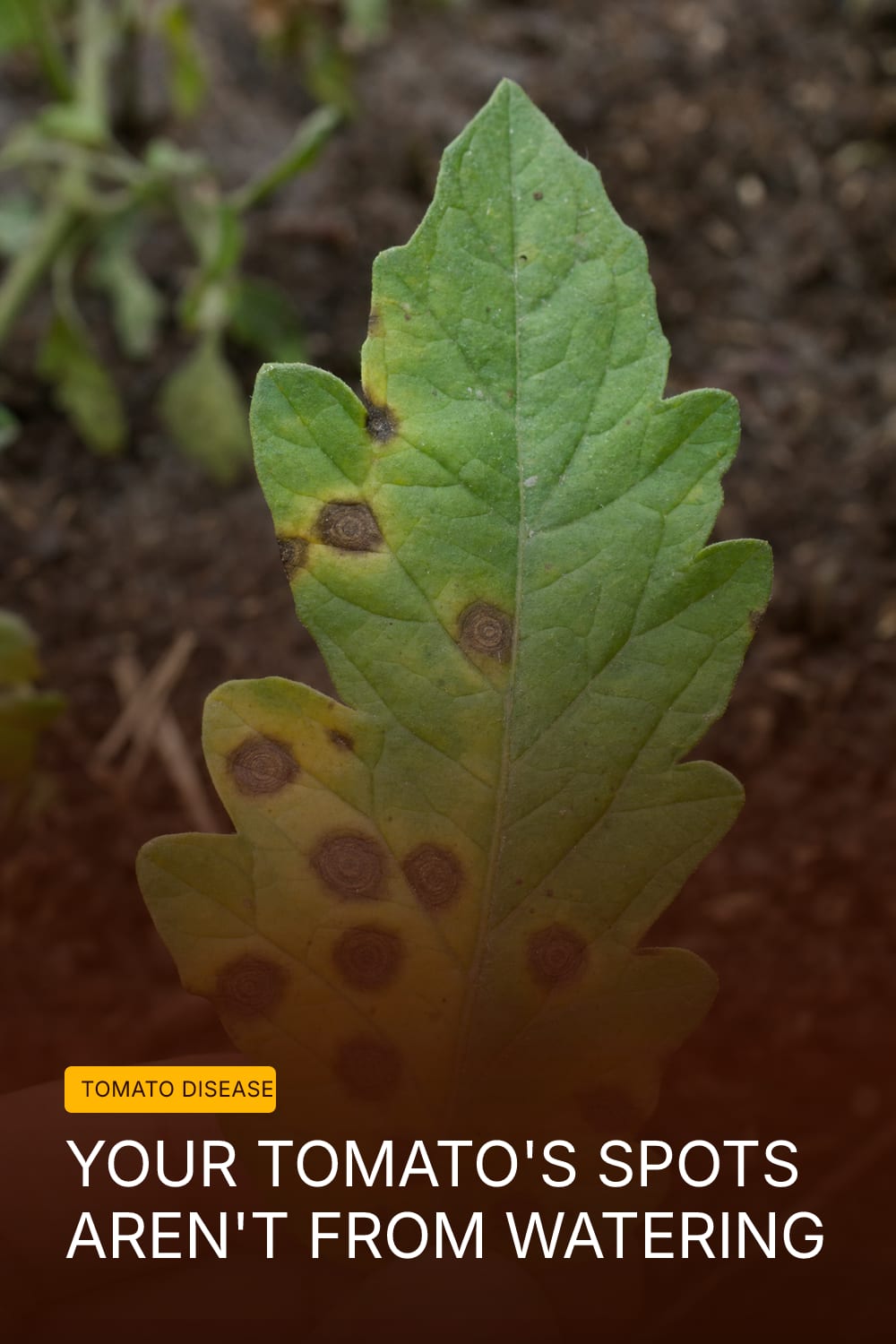
Those Brown Spots Climbing Your Tomato Plant Aren't From Watering
Every August I get the same message from someone whose tomato plant looked perfect three weeks ago. The bottom leaves have gone yellow, there are dark spots ringed like a target on some of them, and the whole lower third of the plant looks like it’s dying from the ground up. Their first guess is always watering. Too much, not enough, inconsistent, whatever. It is almost never watering.
What’s climbing that plant is early blight, and by the time you’ve noticed it, it has usually already been there a couple of weeks.
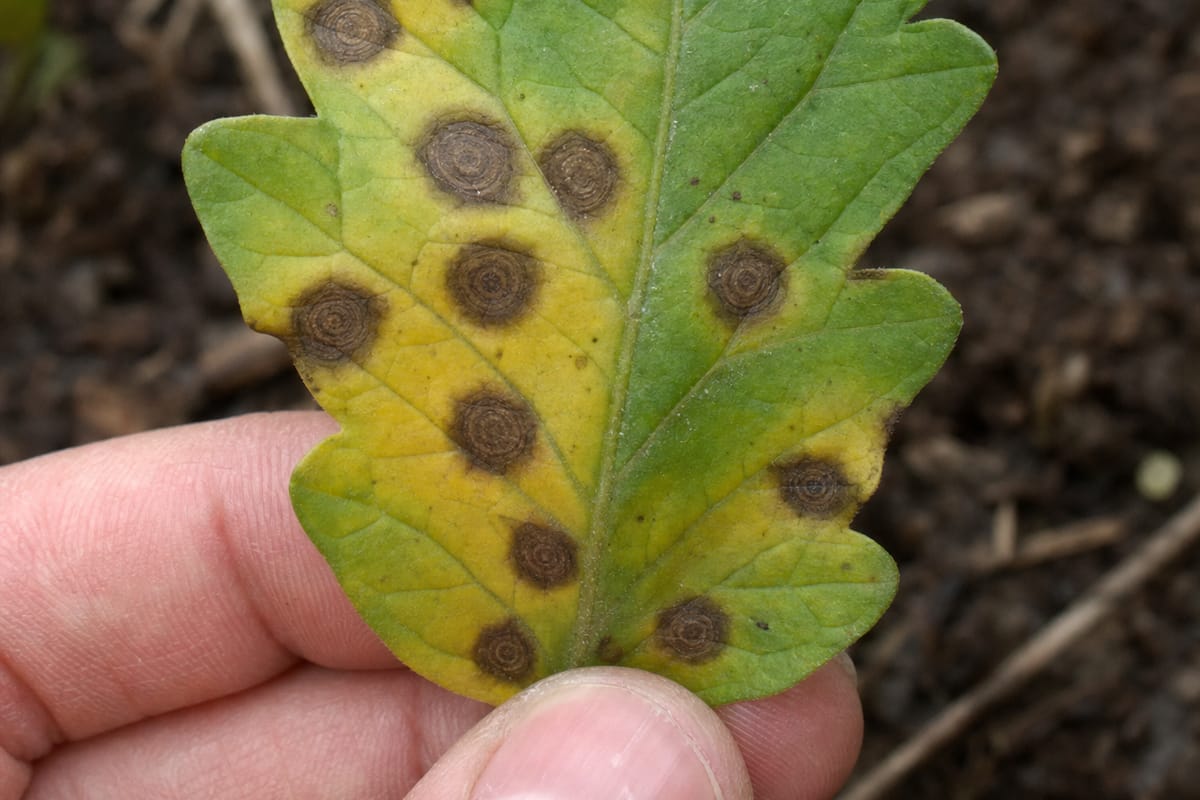
The difference is easy to spot once you know where to look. Watering stress tends to show up plant-wide and fairly uniform, leaves curling or going pale all over rather than a clean line starting at the soil and working up. Early blight does the opposite. It starts on the oldest leaves nearest the ground, because that’s the tissue closest to the soil it splashed up from, and it moves upward from there. Look closely at one of the brown spots and you’ll usually see faint concentric rings inside it, almost like a tree’s growth rings, with a yellow halo around the outside. Nothing about a watering problem looks like that. A fungus does.
I used to lose the argument with myself over this every year, convinced I’d just been careless with the hose, and I’d correct my watering schedule while the disease kept climbing regardless. It wasn’t until I actually got down on my knees and looked at one spot with a hand lens that I believed it.
The fungus, Alternaria solani, lives in soil and in old plant debris, and it needs almost nothing to get going: warm days, a little humidity, and a leaf wet long enough for spores to germinate on it. Late July into August delivers exactly that most years, warm nights, dew that sits until midmorning, the occasional thunderstorm that leaves everything damp. Rain, or a sprinkler, splashes spores up from the soil surface onto the lowest leaves, and once a leaf is infected it produces more spores that spread to the leaf above it. A plant that looked fine on Sunday can have half its lower canopy gone by the following weekend.
You are not going to cure the leaves that already have it. What you’re managing is how far it climbs and whether it reaches the fruit-bearing part of the plant before the season ends. Pull off the worst leaves as soon as you spot them, cutting rather than tearing so you don’t wound the stem, and get them in the trash, not the compost pile, since home compost rarely gets hot enough to kill the spores. Water the soil directly instead of the leaves if you can manage it, and do it in the morning so anything that does get wet has all day to dry. A layer of mulch under the plant, straw or shredded leaves, does more than almost anything else here, because it physically blocks the splash path between soil and leaf. If you’re feeding with a copper fungicide or a similar organic spray, it’s a preventive on the leaves that are still clean, not a cure for the ones that already have spots.
One thing worth knowing before you panic and pull the whole plant: a little bit of lower-leaf yellowing on an otherwise loaded, productive plant in late summer is close to normal. The plant is old, it’s carrying a lot of fruit, and it’s reallocating resources away from leaves it doesn’t strictly need anymore. What separates ordinary end-of-season fatigue from early blight is that ring pattern in the spot itself, and how fast the line is moving up the plant. Fatigue is slow and even. Blight has a leading edge you can watch move week to week.
If you’re not sure what you’re looking at, Garden Planner Pro’s pest and disease guides have photos next to the exact ring-and-halo pattern I’m describing, which is a lot more useful than trying to match it against a description from memory while you’re standing in the garden with dirt on your knees.
Next year, the fix starts before you ever plant: rotate where your tomatoes go if you have the space, since the fungus overwinters in the soil where infected plants grew. It’s a small thing to remember in October, and it’s the difference between fighting this in July or not fighting it at all.