
How to Protect Plants from Frost: A Beginner's Guide in 8 Steps
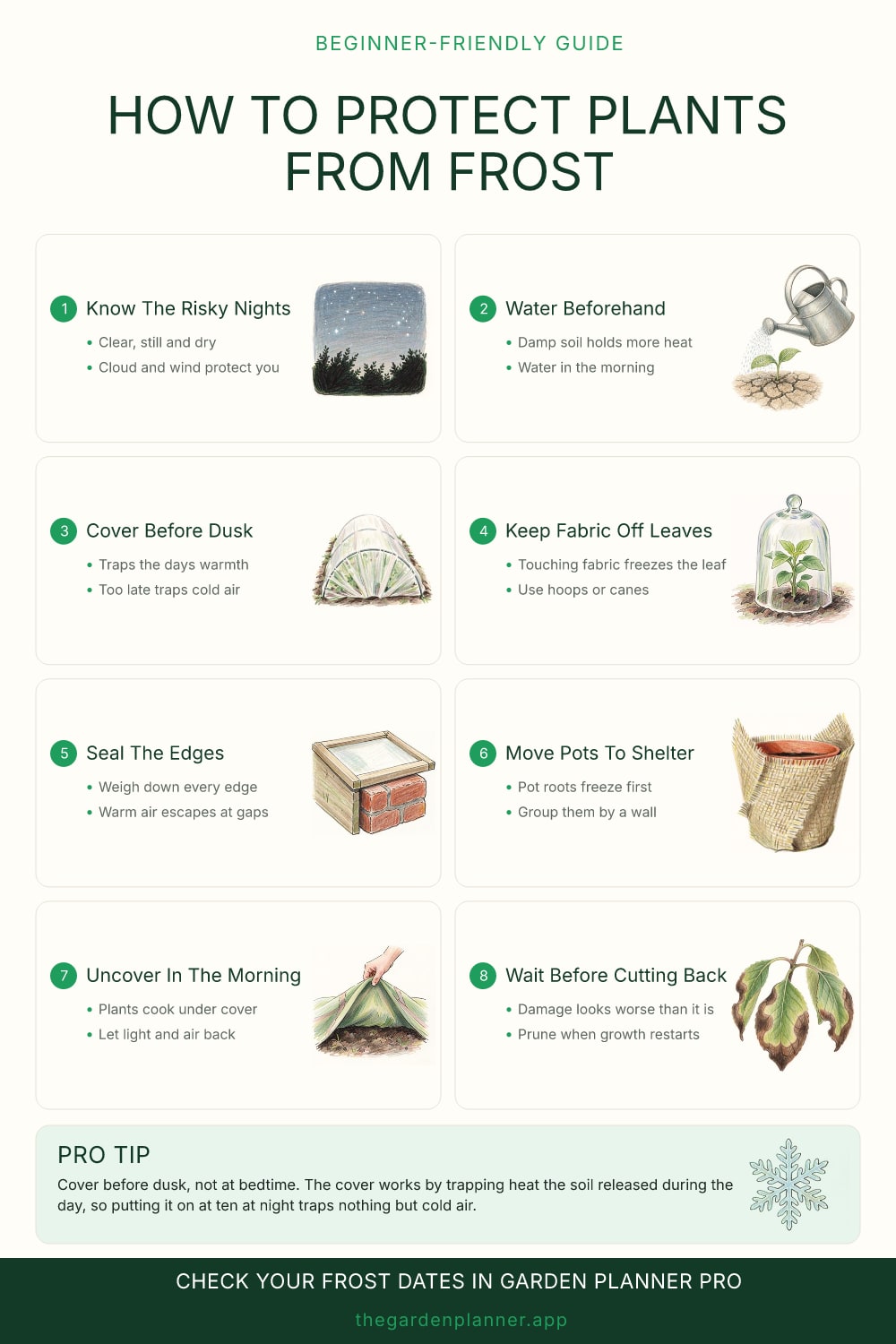
Frost protection is mostly about two things people get wrong: which nights actually matter, and what time of day you put the cover on.
Get those right and a sheet of fleece will carry a tender plant through a night that would otherwise have finished it.
The dangerous night is the beautiful one
A still, clear, dry evening after a bright day is the frost risk. With no cloud to hold it in, the heat the ground absorbed radiates straight up into the sky, and with no wind to mix the air, cold air pools at ground level.
A cloudy or breezy night at the same forecast temperature is usually fine. This is why a frost can hit one part of a garden and not another: cold air flows downhill and settles in dips and against solid fences, which is what people mean by a frost pocket.
The air temperature is measured at head height, so ground level can be two or three degrees colder than the forecast number. A forecast of two degrees above freezing is still a frost night for anything tender.
How a cover actually works
A fleece or a cloche generates no heat. All it does is trap warmth that the soil absorbed during the day and slow its escape overnight.
That single fact settles the timing: the cover has to go on in the late afternoon or at dusk, while there is still warmth in the ground to trap. Going out at bedtime and throwing fleece over cold plants achieves very little.
It also explains two details. Water the soil in the morning if frost is forecast, because damp soil stores more heat than dry and releases it slowly overnight. And seal the cover to the ground, weighted with stones or bricks all the way round, because the warm air you are trying to keep will leak out of any gap at the edge.
Keep the fabric off the foliage on hoops or canes. Wherever a cover rests directly on a leaf it conducts the cold straight through, and you get a frost burn in the exact shape of the fabric.
Pots, and what to prioritise
Plants in containers are far more exposed than the same plants in the ground, because the roots are surrounded by cold air rather than insulated by soil. A plant that is hardy in a border can be killed in a pot in the same garden.
So move pots against a house wall, which stays warmer, and group them together so they shelter one another. Wrap the pots rather than the plants, with bubble wrap or hessian, and lift them off cold paving onto pot feet or a bit of wood.
In the vegetable garden, the priorities are anything tender that has just gone out and anything in flower. A frost on open blossom on fruit trees is what costs you the crop, even when the tree itself is untouched.
The morning after
Take covers off in the morning. Fleece left on through a sunny day cooks the plants underneath and holds damp air around them, and plastic cloches heat up alarmingly fast.
If something has been caught, leave it alone for a while. Frosted foliage looks dreadful, blackened and limp, and a surprising amount of it recovers from buds lower down. Cutting it off straight away removes the damaged growth that is sheltering the live parts underneath, and exposes them to the next cold night.
Wait until growth restarts, then cut back to where you can see green. Some plants surprise you weeks later. The exception is anything mushy and rotting, which should come off promptly before it spreads.
Pro tip. Cover before dusk, not at bedtime. The cover works by trapping heat the soil released during the day, so putting it on at ten at night traps nothing but cold air.