
How to Plan Crop Rotation: A Beginner's Guide in 8 Steps
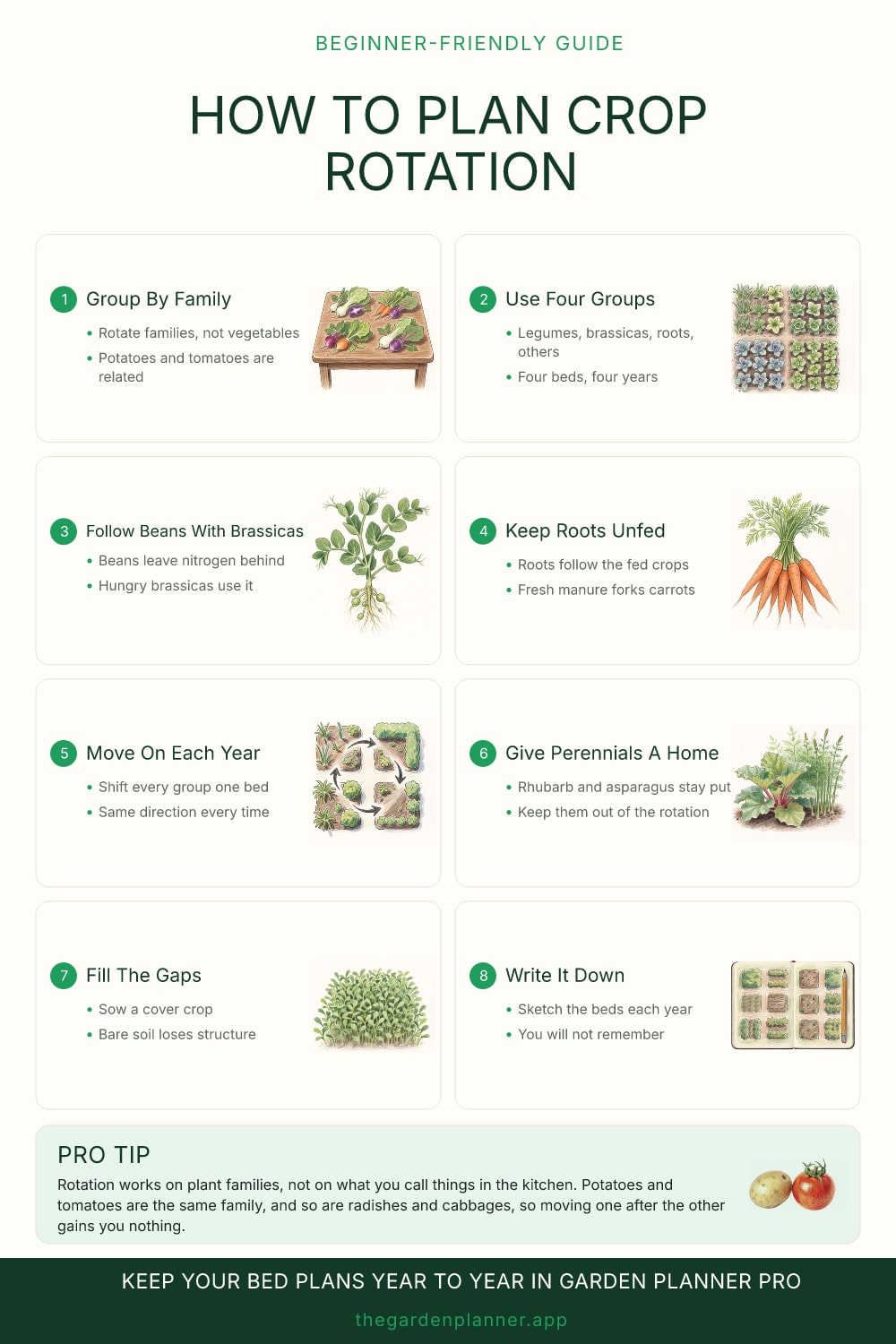
Crop rotation sounds like something for people with allotments and clipboards. It is simply not growing the same thing in the same place every year, and the payoff is fewer soil pests and better use of what you put into the ground.
It is also the one garden system that fails not because it is hard but because nobody writes it down.
Families, not vegetables
The pests and diseases you are rotating away from live on a plant family, not on a particular vegetable. So the grouping has to follow botany rather than the supermarket aisle, and that is where most rotations quietly break.
Potatoes and tomatoes are the same family, and both get blight. Radishes, turnips, swedes, kale, cabbage, broccoli and cauliflower are all brassicas, and all get clubroot. Onions, garlic and leeks go together. Beans and peas are legumes. Carrots, parsnips, celery and parsley are another group.
Following potatoes with tomatoes, or radishes with cabbage, looks like a rotation and achieves nothing at all.
The four bed version
The classic scheme splits everything into four groups and four beds: legumes, brassicas, roots, and everything else, which is mostly the potato family plus squashes, sweetcorn and salads.
Each year every group moves on one bed, always in the same direction, so anything comes back to where it started after four years. That is long enough to starve out most of the soil borne problems that build up under a repeated crop.
The order is not arbitrary. Legumes fix nitrogen and leave the roots in the ground, so brassicas, which are greedy for nitrogen, follow them and get the benefit. Roots follow the brassicas, on ground that was manured a year or two earlier rather than freshly, because fresh manure makes carrots and parsnips fork. Manure and compost go on for the hungry groups, and the roots take what is left over.
When to bend the rules
A small garden cannot always manage four separate beds, and a rotation that is too rigid to follow is worse than a loose one you actually keep to. Even a two or three year shuffle is far better than growing the same thing in the same spot forever.
Some crops sit outside the system. Rhubarb, asparagus and fruit are perennial and stay where they are, so give them their own permanent ground rather than trying to fit them in. Courgettes, squash and sweetcorn are fairly relaxed about where they go and are useful for filling whichever bed has a gap.
If you have clubroot or potato eelworm already, rotation alone will not clear it. Those need a longer break, resistant varieties, and in the case of clubroot, liming to raise the pH.
The record is the whole system
Every rotation that has ever collapsed collapsed for the same reason: by the following March nobody could remember what was in which bed.
So sketch it. A rough plan of the beds with what went where, dated, kept somewhere you will find it again. It takes five minutes in autumn and it is the only part of this that is genuinely essential. Photographs of the plot in midsummer work almost as well and take no effort at all.
While you are at it, note what did badly and why, because that is the information that changes next years plan. Then plan to fill the gaps: ground that comes empty in autumn does better under a cover crop or a mulch than sitting bare all winter, where rain compacts the surface and washes nutrients straight through it.
Pro tip. Rotation works on plant families, not on what you call things in the kitchen. Potatoes and tomatoes are the same family, and so are radishes and cabbages, so moving one after the other gains you nothing.