
How to Plan a Seed Order: A Beginner's Guide in 8 Steps
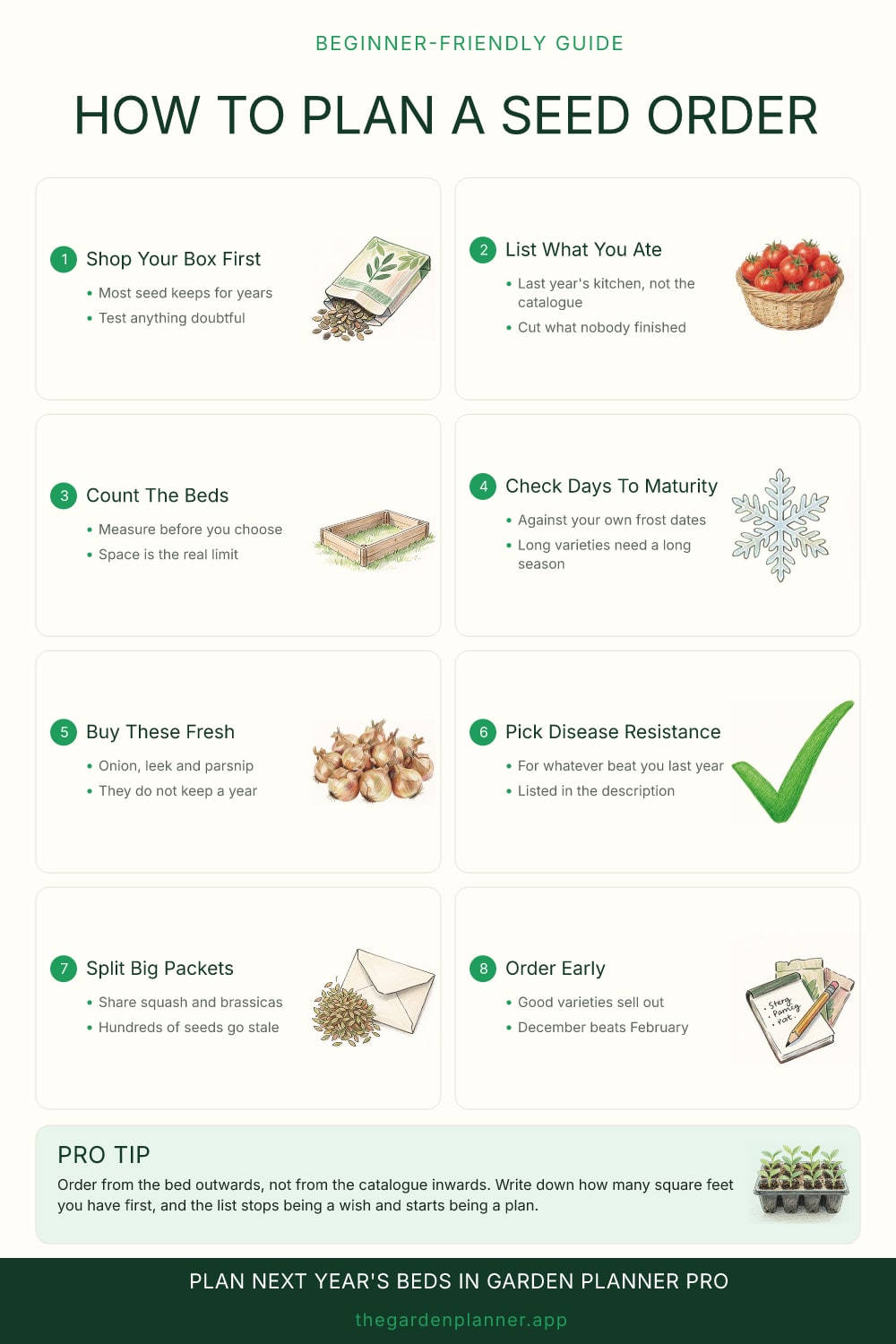
The seed order is the cheapest part of a garden and the one that quietly decides most of the year. It is also where nearly everybody overspends, because a catalogue in January is designed to be read by somebody who is bored of winter.
The cure is doing three things before you open it.
Start with the box you already own
Before anything else, tip the seed box out on the table and sort it. Most vegetable seed keeps far longer than the packet date implies: tomatoes, squash, cucumbers, beans, peas, brassicas and lettuce will usually be fine for years.
The genuinely short-lived ones are a small list. Onion, leek and chive fade within a year or two, and parsnip is the worst of all and is worth buying fresh every single year. Those go on the order automatically.
For anything you are unsure about, run a germination test now rather than finding out in April. Ten seeds on a damp paper towel in a bag somewhere warm, counted after that crop’s usual germination time. Seven or more up and you sow it as normal; four or five and you sow thicker; one or two and it goes on the list.
This single step usually cuts an order by a third, and it is the difference between a seed drawer that works and one that is mostly archaeology.
Then work out what you have room for
The second discipline is arithmetic. Measure the beds, write the number down, and only then start choosing.
It is astonishing how fast a wish list outgrows a garden. A packet of squash is thirty seeds and a suburban bed has room for two plants. Four tomato varieties sounds modest until you count that it is sixteen plants and you have space for six.
Work out roughly how many plants of each thing you want in the ground, and buy for that plus a small margin for failures. Where a packet is far bigger than you need, which is most of the cucurbits and brassicas, split it with someone. Two gardeners buying four packets between them and halving each is a better outcome than two gardeners buying four packets each and binning most of it in three years.
And be honest about last year. If nobody in the house ate the kohlrabi, the answer is not a different variety of kohlrabi.
The two numbers on the packet that matter
Days to maturity is the one people skip. It is a rough guide rather than a promise, and it is usually counted from transplanting rather than from sowing for things that get started indoors, but it tells you whether a variety fits your season at all.
Count the weeks between your last frost and your first frost, and be suspicious of anything whose days to maturity eats most of that window, especially the long-season peppers and melons and the big winter squashes. In a short season those are the varieties that produce beautifully in photographs and green fruit in your garden.
The second is disease resistance, which is listed in the small print of most descriptions as a string of letters. If something specific beat you last year, blight, wilt, mildew, this is the cheapest possible response to it: pick a variety bred to resist that one thing and change nothing else.
When to press the button
Earlier than feels necessary. The interesting varieties, and particularly anything that had a good year in the seed press, sell out in January and February, and a substitution chosen for you by a supplier is rarely the one you wanted.
Ordering in December also means the packets are on the shelf before the first sowings come round, which for onions and leeks in many places is January itself.
Write the final order down somewhere that survives the year, with the varieties and the supplier. Next December the most useful document you can have is last year’s list with notes scribbled on it about what worked, and it takes two minutes to start.
Pro tip. Order from the bed outwards, not from the catalogue inwards. Write down how many square feet you have first, and the list stops being a wish and starts being a plan.