
How to Overwinter Herbs: A Beginner's Guide in 8 Steps
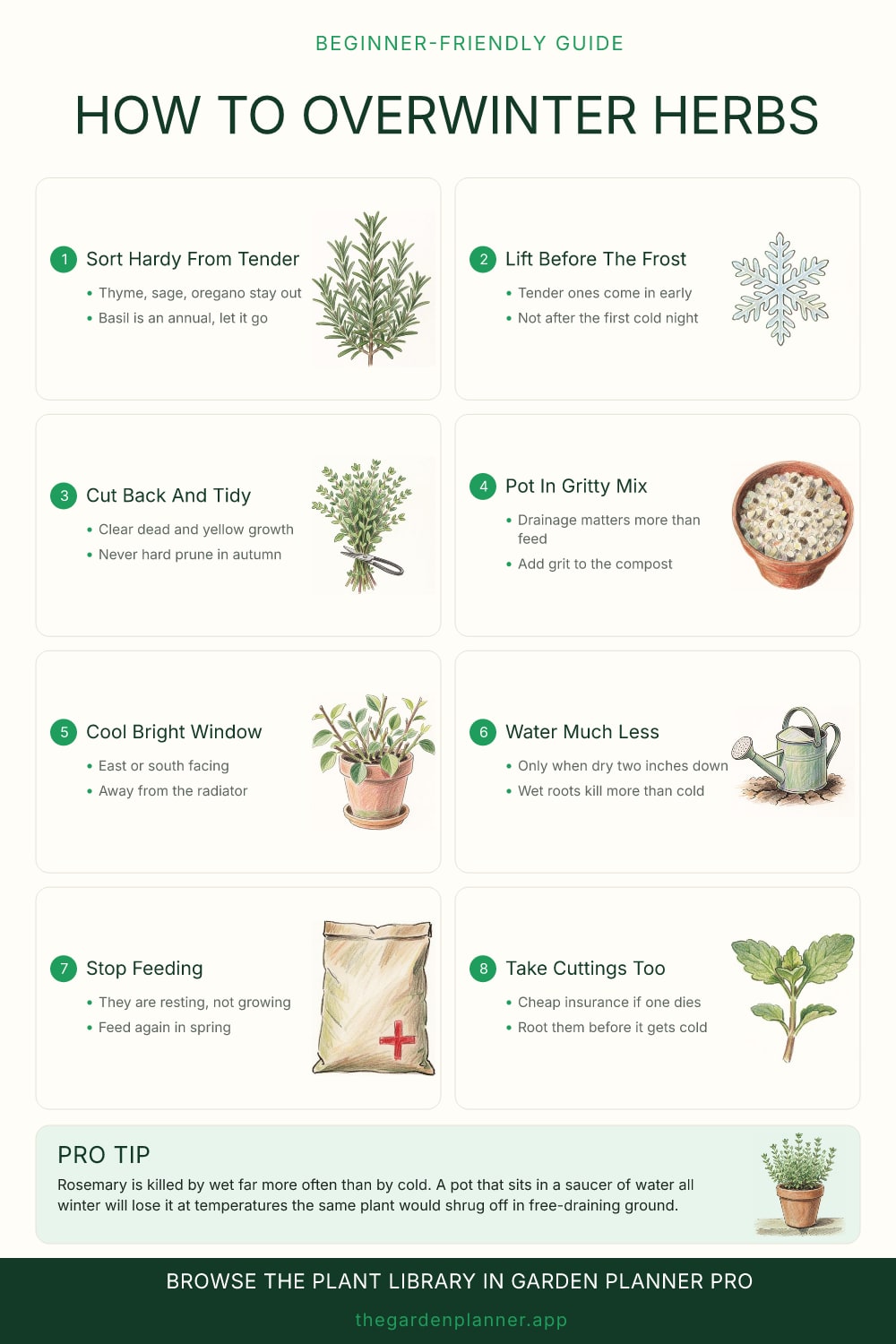
Most of the herbs in a garden do not need overwintering at all. They are hardy, they have done this before, and the kindest thing is to stop fussing and leave them where they are.
The work is in telling those apart from the few that genuinely will not survive, and then not killing those indoors.
The three groups
The hardy perennials stay outside and need almost nothing: thyme, sage, oregano, chives, mint, winter savory. Cut off anything dead or slimy, make sure pots are not sitting in puddles, and that is the job. Chives die right back to nothing and look finished; they are not.
The tender ones will not survive a frost and have to come indoors or be given up on: lemon verbena, tender basils, scented pelargoniums, and bay in a cold area or an exposed spot.
Then the borderline group, which is where people lose plants. Rosemary, French tarragon and bay are hardy enough in many places but hate a cold wet winter. They are often fine in the ground in a sheltered, free-draining spot and die in a pot that stays sodden. Move those pots to the driest, most sheltered place you have, raise them off the ground on feet or bricks so water runs out, and leave them there.
Basil is worth being blunt about. It is an annual, it is going to die, and no amount of windowsill will change that. Use it up.
Bringing them in, which is mostly about timing
Do it earlier than feels necessary, while nights are merely cool rather than freezing. A plant moved indoors before the shock of a first frost adjusts to the change far better than one rescued the morning after.
Check it over on the way in. Look under the leaves for aphids, whitefly and the fine webbing of spider mite, because a warm dry house in December is the ideal conditions for all three and one infested plant becomes five. Rinse the foliage, knock off what you find, and keep new arrivals apart from your houseplants for a week or two.
Tidy rather than prune. Take off dead, yellow and damaged growth, but resist cutting a plant hard back now. A hard autumn prune pushes out soft new shoots at exactly the moment the plant cannot support them, and on woody herbs that growth is what the cold kills. Save real pruning for spring.
Why indoor herbs die, and it is almost never cold
It is water. A herb indoors in December is barely growing, so it uses a fraction of what it drank in July, and people keep watering on the summer schedule. The roots sit wet, they rot, and the plant collapses from below in a way that looks like it dried out.
So water only when the compost is dry a couple of inches down, and empty the saucer afterwards every time. Pot into a gritty free-draining mix rather than a moisture-retentive one, in a pot with real drainage holes.
Light is the other half. The brightest windowsill you have, ideally cool rather than beside a radiator, because warmth without light makes pale floppy growth that then does not survive going back outside. A cool bright hall or porch beats a warm dark kitchen.
And stop feeding. Feeding something that is resting pushes weak growth it cannot hold.
The insurance policy
Take cuttings in early autumn of anything borderline, before it gets cold. Rosemary, sage, thyme and bay all root readily from short non-flowering shoots, and a few small rooted plants on a windowsill cost nothing and cover you if the parent plant does not make it.
It is also the honest answer for old woody herbs. A sage or a thyme that has gone leggy and bare in the middle is near the end of its useful life whatever you do this winter, and replacing it from a cutting is better than nursing it through another year.
Pro tip. Rosemary is killed by wet far more often than by cold. A pot that sits in a saucer of water all winter will lose it at temperatures the same plant would shrug off in free-draining ground.