
How to Grow Sweet Corn: A Beginner's Guide in 8 Steps
Sweet corn is the crop where the layout of the bed matters more than anything you do to the plants. Get that right and the rest is watering.
It is also the crop with the shortest gap between perfect and disappointing, measured in hours rather than days, which is the real argument for growing your own.
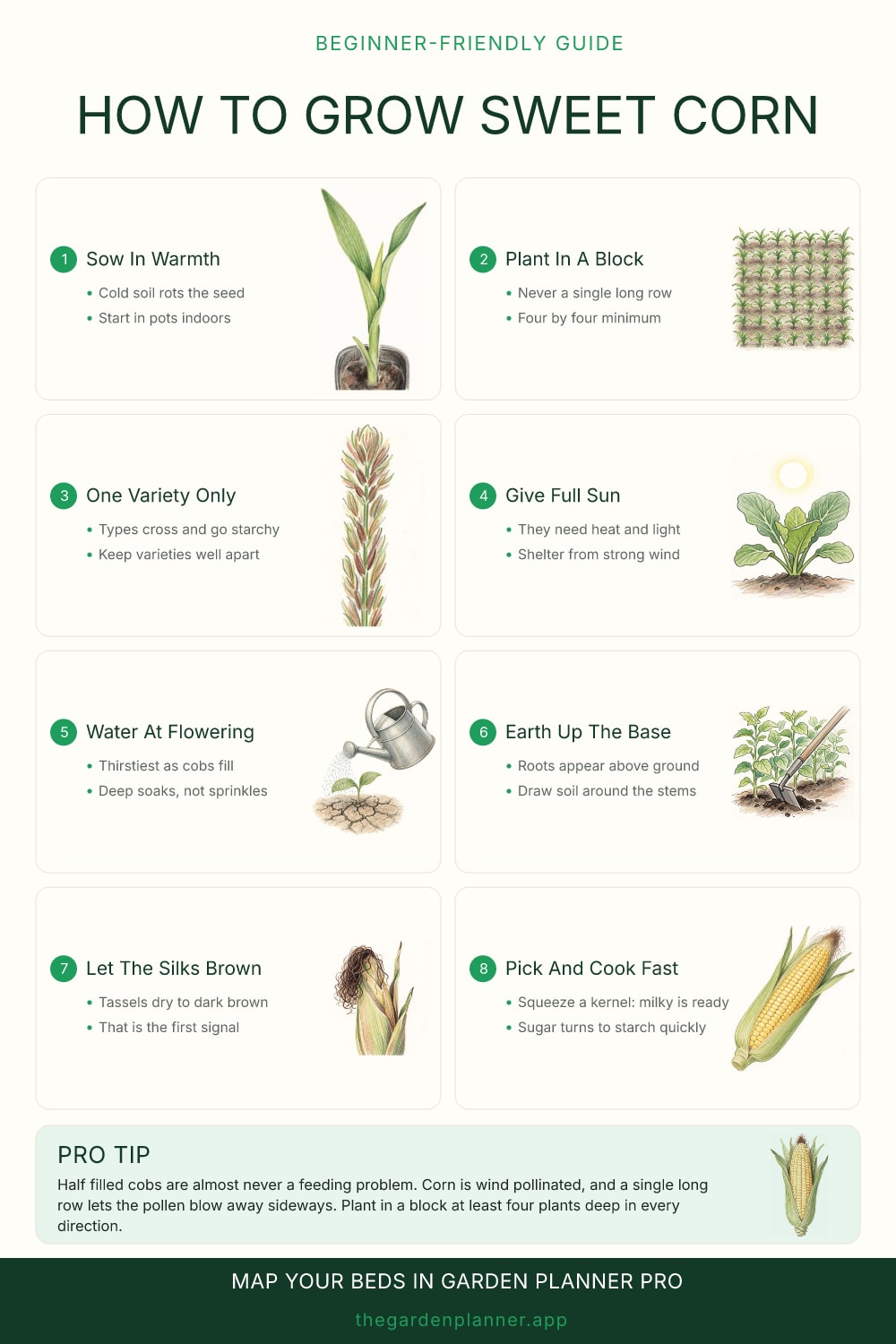
Plant a block, not a row
Corn is pollinated by wind. The tassel at the top of the plant sheds pollen, and it has to land on the silks coming out of the top of each cob lower down. Every silk connects to one kernel, and a silk that catches no pollen is a gap in the cob.
A single long row is the worst possible arrangement, because the pollen blows off sideways into the next bed. A square block gives the pollen somewhere to land no matter which way the wind is going. Four plants by four is the practical minimum, and more is better.
If you have a small patch and want to help it along, tap the stems on a dry still morning when the tassels are shedding. You can see the pollen come off as a fine dust.
Do not mix varieties
This one surprises people, because it works differently from every other crop. Corn kernels are the seed, and the seed is affected directly by whose pollen reaches it in the same season.
So a supersweet variety pollinated by an ordinary sweet variety, or by a maize grown for animal feed or popcorn, produces starchy, tough kernels on the cob you eat this year. Not next year. This year.
Grow one variety per garden, or separate them properly, or pick types that are compatible. If a neighbour on the next plot has corn, that matters too, which is why allotments often agree on a single variety.
Warmth to start, water to finish
Corn seed rots in cold wet soil, so in most gardens it pays to start it in pots or deep modules under cover and plant out after the last frost. Use deep containers, because the roots go down fast and a checked corn plant is a small corn plant.
Once it is away, the important watering happens later than you would think. The plants can look after themselves for weeks, and then become very thirsty from the moment the tassels appear until the cobs have filled. Dry weather at that point is what gives you short cobs with poor tips.
Stilt roots will push out of the stem above soil level as the plants get tall. Draw a little soil up around them. It anchors a plant that is otherwise easy for a summer storm to flatten.
Picking, and the hour that matters
The first sign is the silks at the top of the cob turning dark brown and dry. Then peel back a small window in the husk, press a kernel with a thumbnail, and look at what comes out. Clear watery juice means wait. A thick milky liquid means pick it now. No juice at all, and a doughy kernel, means you are a few days late and it is headed for the soup pot.
In the older varieties the sugar starts converting to starch within hours of picking, which is why shop bought corn tastes flat and why the standard advice is to have the water boiling before you go out to cut it. Modern supersweet types hold their sugar for days, so if you are not going to eat it straight away, grow one of those.
One cob per stem is normal, two on a strong plant. Anything more is unusual and the second cob is often smaller.
Pro tip. Half filled cobs are almost never a feeding problem. Corn is wind pollinated, and a single long row lets the pollen blow away sideways. Plant in a block at least four plants deep in every direction.