
How to Grow Sage: A Beginner's Guide in 8 Steps
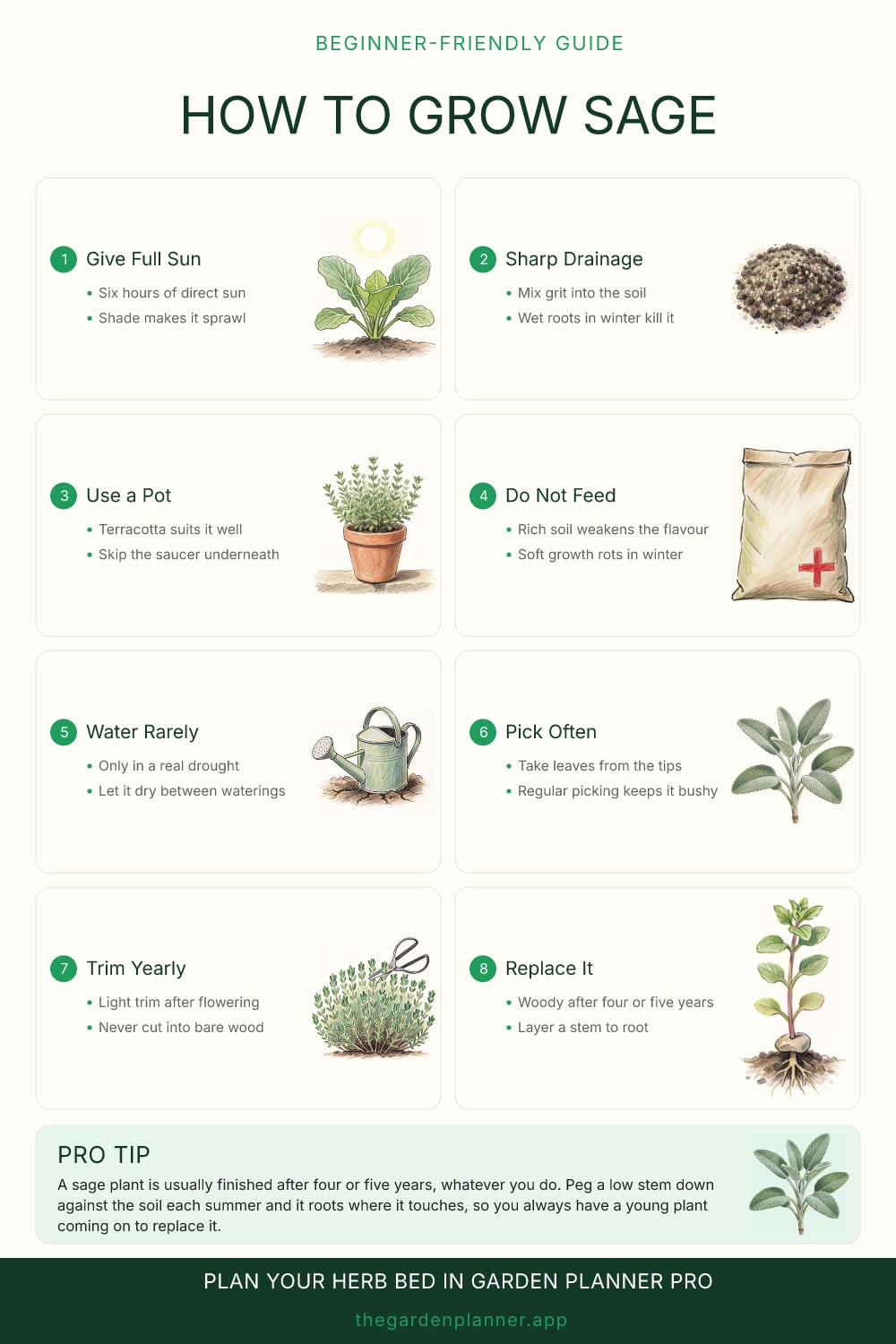
Sage is one of those plants that dies of kindness. It comes from dry, sunny, stony ground where nothing feeds it and nothing waters it, and a gardener who does both is the main threat to its life.
The good news is that the care it wants is almost entirely negative. Give it a sunny spot with soil that drains, then leave it alone. That is most of the job.
Winter wet is what actually kills it
Sage handles cold far better than people expect. What it cannot handle is cold and wet at the same time. Roots sitting in sodden soil through January rot, and in spring the plant either fails to come back or comes back on one sad branch.
So before you worry about anything else, sort out drainage. Mix grit or coarse sand into the planting hole. Put it at the top of a slope, along the edge of a raised bed, or against a wall where the ground stays drier. In heavy clay, a terracotta pot is a far better bet than trying to improve a whole bed for one plant.
If you do grow it in a pot, take the saucer away. A saucer holds a reservoir of water against the drainage holes, which is exactly the condition you are trying to avoid.
Feeding it makes it worse
Rich soil and fertiliser push sage into fast, soft, leafy growth. That sounds like what you want and it is not. The leaves get larger and blander, the stems get floppy, and the whole plant goes into winter full of soft tissue that rots.
The aromatic oils that make sage worth growing concentrate in plants grown slightly hard. A sage in poor gritty soil has smaller leaves that taste of considerably more.
So plant it, water it while it settles in over the first few weeks, and then step back. An established sage in the ground needs watering only in a genuinely long dry spell.
Trim it every year, but stay in the green
Left alone, sage gets tall and leggy, splits open in the middle, and turns into a ring of growth around a patch of bare grey wood. Once it reaches that state it does not really recover.
The way to hold it off is a light trim each year, straight after it flowers. Take off the spent flower stems and an inch or two of growth, shaping the plant into a low dome.
The rule that matters is to always leave green leaves below your cut. Sage is unreliable at reshooting from bare old wood, so the hard renovation prune that works on lavender or rosemary can simply kill it. If you are unsure, cut less.
Plan to replace it before you need to
Even a well kept sage is usually past its best after four or five years. The centre goes bare, the yield drops, and no amount of pruning brings it back.
Rather than being caught out, start a replacement early. In summer, bend a low flexible stem down to the soil, scrape a little bark off the underside where it touches, and pin it there with a stone or a wire staple. Leave it. By the following spring it will have rooted at that point, and you can cut it free from the parent and move it.
It costs nothing and takes about a minute, and it means the day the old plant gives up you already have its replacement half grown.
Pro tip. A sage plant is usually finished after four or five years, whatever you do. Peg a low stem down against the soil each summer and it roots where it touches, so you always have a young plant coming on to replace it.