
How to Grow Rosemary: Almost Everyone Waters It Too Much
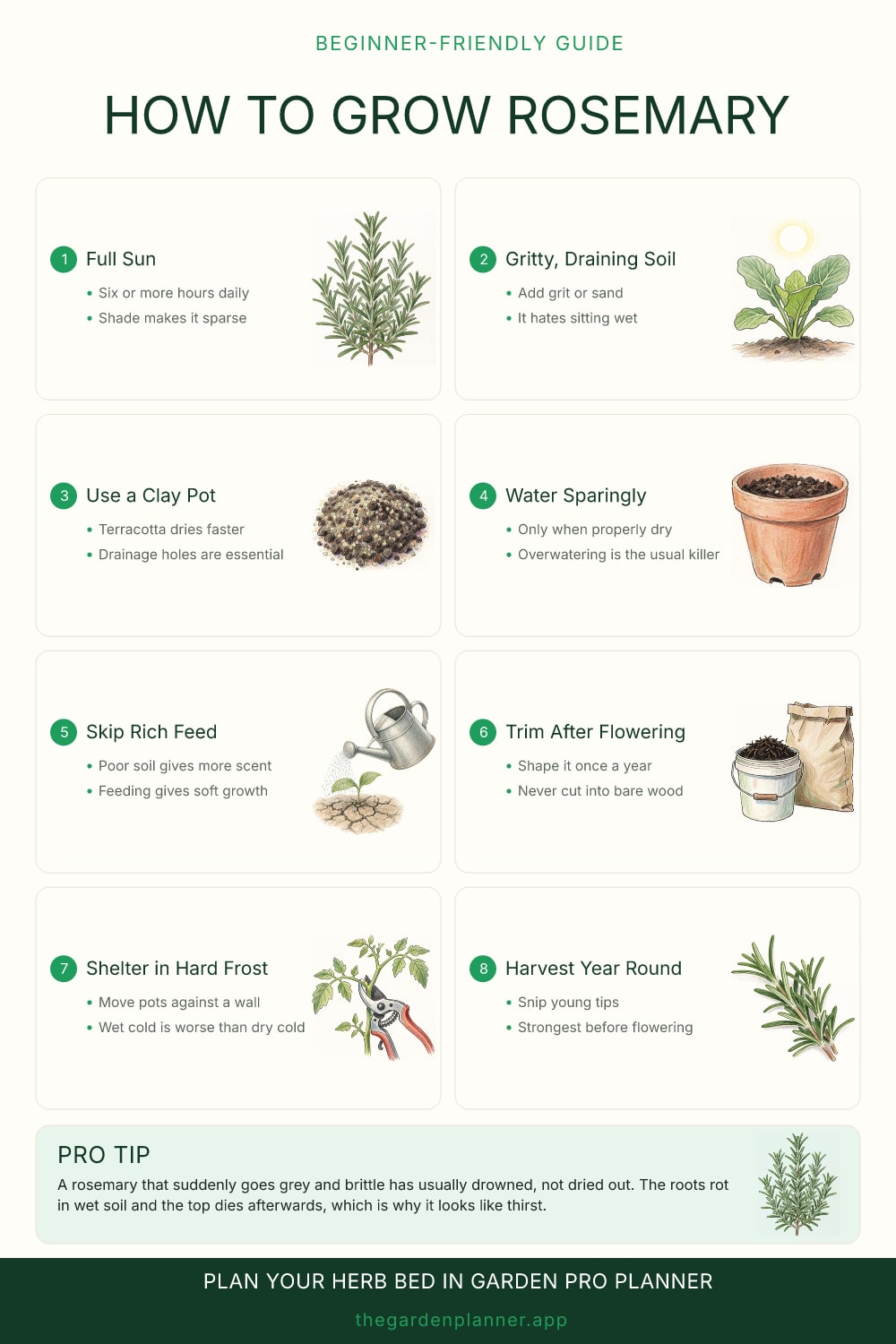
Rosemary is a shrub from dry, rocky, sun-baked ground, and it is one of the few garden plants that is genuinely easier to kill with care than with neglect.
The plant that goes grey and crisp in a pot on a patio has usually drowned. That sounds backwards, because the symptoms look exactly like thirst, and the natural response is to water it more.
Why a drowned rosemary looks thirsty
When rosemary roots sit in wet soil they rot. Once a meaningful part of the root system has gone, the plant can no longer draw water up, even though it is surrounded by it. So the foliage does what foliage does when it cannot get water: it goes grey, dull and brittle from the tips inward.
Every instinct says water it. That finishes the job. The test is to push a finger into the compost a couple of inches down before reaching for the can. If it is damp down there, the problem is not thirst, and more water will make it worse. A rosemary in the ground in reasonable soil essentially never needs watering once it has been in a year or two.
Drainage, and why terracotta earns its place
Everything about growing rosemary well comes back to getting water away from the roots quickly. Mix grit, coarse sand or fine gravel through the planting hole. Plant it slightly proud of the surrounding soil rather than in a dip, so water runs away from the crown instead of collecting around it.
In a container, a terracotta pot is genuinely better than a plastic one. Unglazed clay is porous, so moisture moves out through the walls and the compost dries faster and more evenly. Plastic holds water at the base, which is the last place you want it. Whatever the pot, it needs open drainage holes and no saucer underneath. A saucer of standing water in winter will kill a rosemary more reliably than frost will.
Feeding makes it weaker and blander
The aromatic oils in rosemary are strongest in plants grown hard: full sun, thin soil, not much water. Feed it and you get fast soft growth with less scent, and soft growth is also the growth that suffers in a cold wet winter.
So skip the fertiliser almost entirely. A container plant that has been in the same compost for two or three years may want a light feed in spring, or better, repotting into fresh gritty compost. In the ground it wants nothing at all. This is the same principle behind thyme, oregano and lavender, which is why all four do well together in the same neglected sunny corner.
Pruning, and the line you cannot cross
Rosemary that is never pruned goes leggy, opens out at the base and eventually splits under its own weight. A light trim once a year after it flowers keeps it dense and prolongs its life considerably.
The rule that matters is never to cut back into bare brown wood. Rosemary does not reliably produce new shoots from old wood, so a hard cut into a bare stem often just kills that stem outright. Always leave green growth below your cut. If a plant has already gone woody and bare at the base, you cannot renovate it the way you might a hedge. Take cuttings from the soft tips in early summer, root them, and replace the plant. Cuttings root easily, which makes rosemary one of the cheapest shrubs in the garden to keep going indefinitely.
Pro tip. A rosemary that suddenly goes grey and brittle has usually drowned, not dried out. The roots rot in wet soil and the top dies afterwards, which is why it looks like thirst.