
How to Grow Peas That Actually Fill Their Pods
Peas are one of the few crops where the homegrown version is not just better than the shop version but a different vegetable entirely, because the sugars start converting to starch within hours of picking.
They are also easy, with two exceptions that account for most disappointing rows: rotting in cold wet soil at the start, and empty flat pods at the end.
Sowing into cold wet soil
Peas want a cool start, which people take to mean the earliest possible sowing. But a pea seed sitting in cold waterlogged ground will simply rot before it germinates, and a whole row failing to come up is nearly always this rather than bad seed.
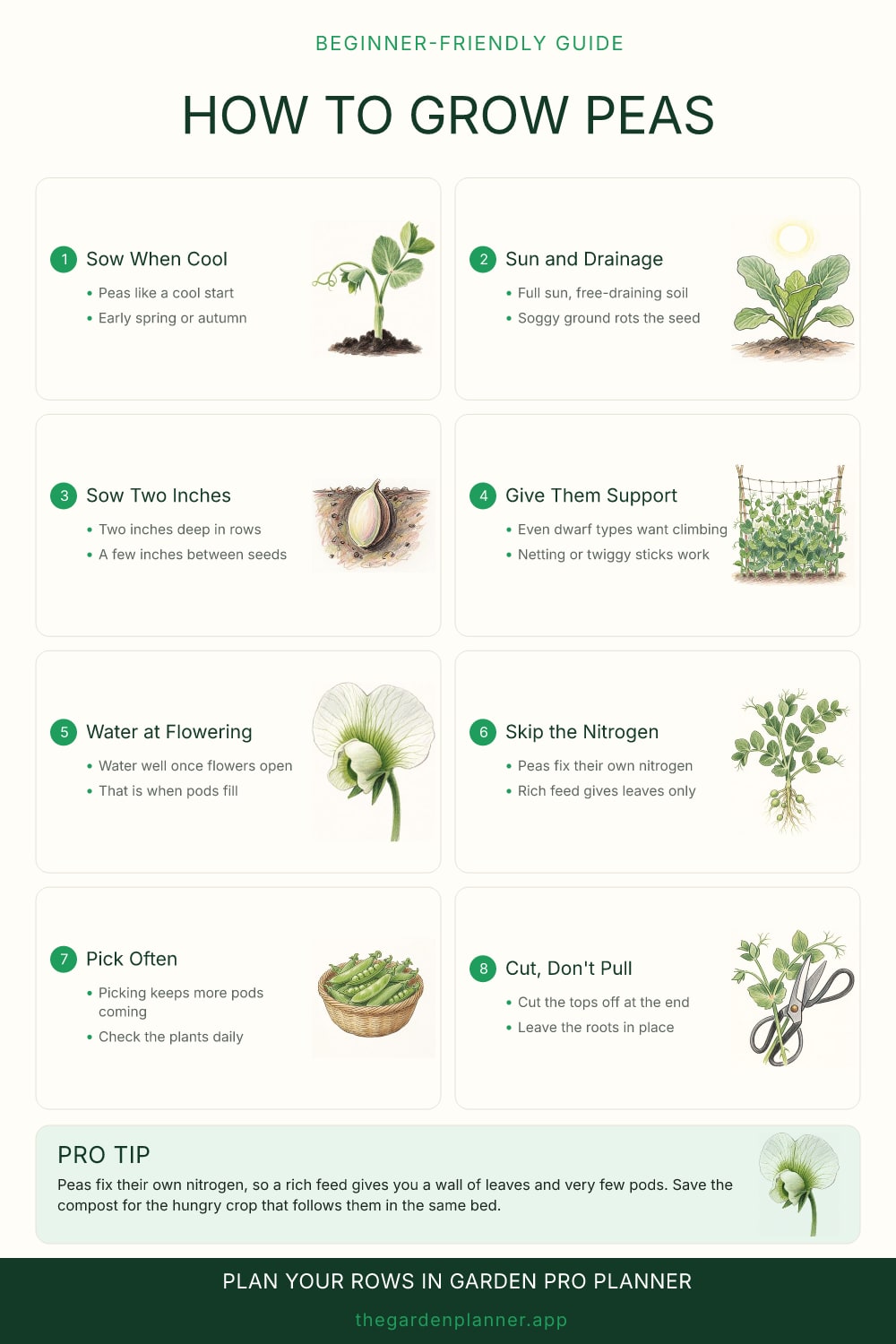
The practical answer is to wait for the soil to be workable rather than to hit a calendar date, and to improve drainage where you can. If you want a genuinely early crop, start them under cover: a length of guttering filled with compost, sown thickly, is the traditional trick. When the seedlings are a few inches tall you slide the whole thing into a prepared shallow trench without disturbing the roots. Mice are the other early hazard, and they will take a newly sown row systematically. Starting under cover solves that too.
Support even the dwarf varieties
Varieties sold as dwarf or self-supporting still do better with something to climb. Left flat they sprawl on the soil, the lower pods sit in the wet and rot, picking becomes miserable, and mildew moves in because air cannot circulate.
Support does not need to be elaborate. Netting stretched between canes works, and so do the traditional twiggy prunings, pushed in along the row while the plants are still small. Getting it in early matters, because peas grab on with tendrils as they grow and a plant that has already flopped is hard to persuade upright afterwards. Tall varieties want proper height, up to six feet for some, and they will find it if you give it to them.
The watering that fills the pods
Peas are reasonably tolerant of dry spells while they are growing leaves, which misleads people into treating them as undemanding throughout. The critical period is from the moment flowers open until the pods have filled.
That is when water shortage does visible damage, producing pods that are flat, poorly filled, or set and then abort. A thorough soak once or twice a week during flowering makes a straightforward difference to the crop. Mulching along the row before flowering starts holds that moisture in and saves a good deal of watering later.
Do not feed them, and leave the roots
Peas fix nitrogen from the air through bacteria in nodules on their roots, so they supply their own. A generous nitrogen feed produces a mass of lush foliage and noticeably fewer pods, which is a frustrating way to lose a crop through kindness.
When the row is finished, resist pulling the plants up. Cut the tops off at soil level for the compost heap and leave the roots in the ground. Those nodules break down and release nitrogen where the next crop can reach it, which is why peas and beans traditionally precede hungry leafy crops like brassicas in a rotation. It costs nothing and it is the closest thing to free fertiliser a vegetable garden produces.
Pro tip. Peas fix their own nitrogen, so a rich feed gives you a wall of leaves and very few pods. Save the compost for the hungry crop that follows them in the same bed.