
How to Grow Onions Big Enough to Bother Storing
Onions are undemanding to grow and easy to grow badly, in the sense that you end up with a perfectly healthy crop of very small onions.
Size is decided by two things that both happen before midsummer: how much room each plant has, and how long the leaves have to grow before the bulb starts swelling. Almost nothing you do afterwards changes the outcome much.
Every leaf is a layer
This is the thing that makes sense of everything else. Each leaf an onion produces corresponds to a ring inside the finished bulb. The plant grows leaves through spring, then, triggered by day length, it stops making leaves and starts moving everything it has into the bulb.
So the number of leaves it managed to produce before that switch sets the maximum size the bulb can reach. That is why anything holding a plant back early, whether that is crowding, weed competition, drought or poor soil, produces a small onion, and why feeding heavily in late summer does not rescue it. The growing that mattered has already happened. Plant early, keep the plants moving, and the bulb takes care of itself.
Sets, seed, and spacing
Sets are small immature bulbs and they are much the easier option: quicker, more forgiving, and less trouble in a cold spring. Seed gives you a wider choice of variety and often better keeping quality, but needs starting early under cover.
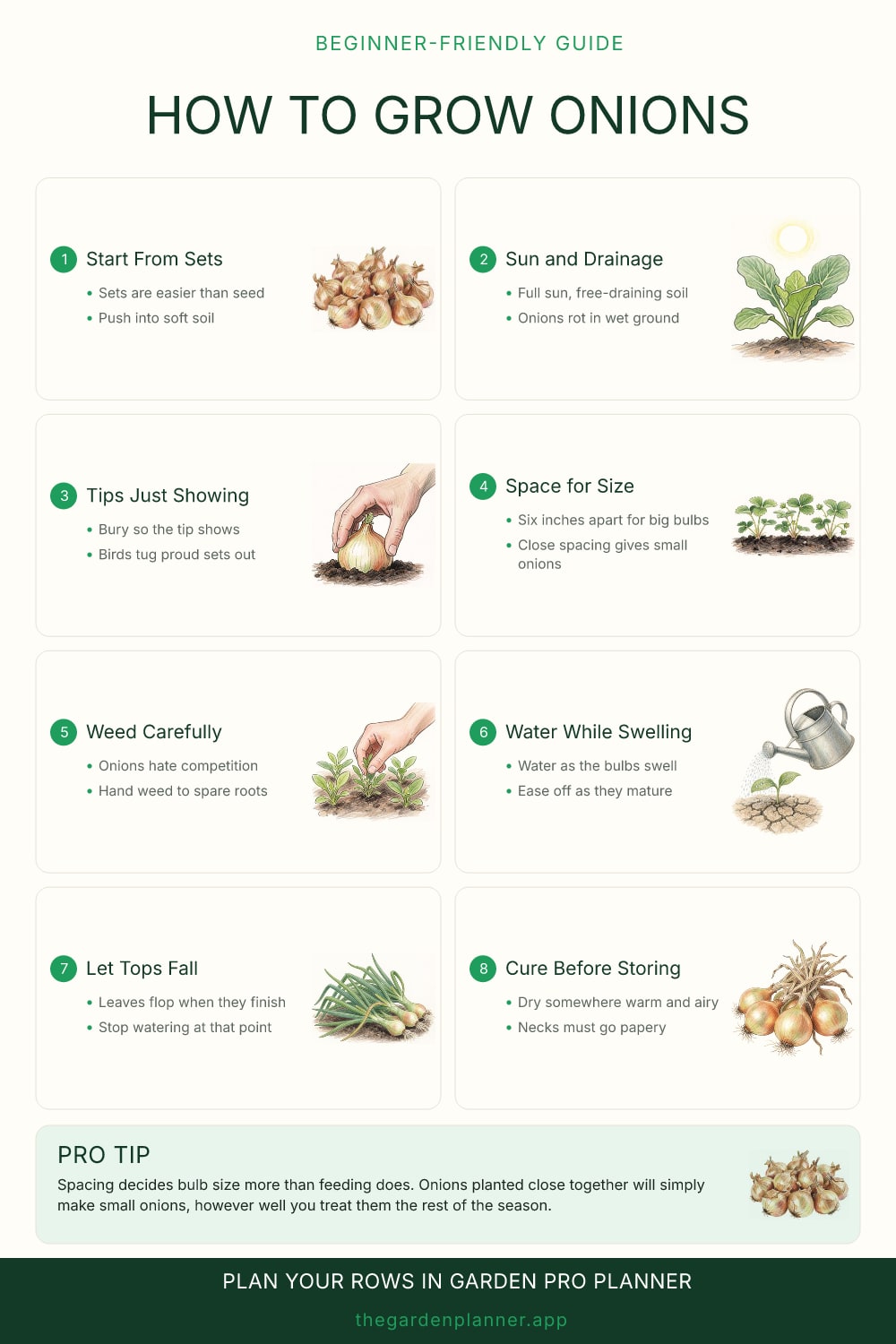
Whichever you use, spacing is the lever that controls size. Close spacing gives lots of small onions; generous spacing gives fewer, larger ones. Around six inches apart is a reasonable target for a decent all-round bulb. It is entirely legitimate to plant closer on purpose if small onions are what you want, but it should be a decision rather than an accident.
When planting sets, push them into soft soil so just the tip shows and firm around them. Sets planted proud get pulled out by birds who mistake the papery tip for a worm, and it is worth walking the row a few days later to push back any that have been lifted.
Weeds do more damage than they look like they should
Onions have thin upright leaves and shallow roots, and they cast almost no shade, so weeds have an easy time between them. And because onions cannot shade competition out, they lose more to it than most crops.
Keep the bed clean from the start, and weed by hand or with a very shallow hoe. Onion roots run close to the surface, and deep hoeing damages them and checks the plant just when it needs to be growing leaves. This is one of the crops where a mulch between the rows genuinely pays for itself, though keep it clear of the bulbs themselves.
Stopping at the right moment, and curing
When the leaves flop over at the neck, the plant has finished. Growth has stopped and the bulb will not get bigger. Stop watering at that point, and if the weather is wet it is worth lifting them rather than leaving them sitting in damp soil where they will start to rot.
Then cure them, which is what determines whether they store for months or weeks. Lay them out somewhere dry and airy, in the sun if you have it, until the outer skins are papery and the necks are completely dry and tight. A thick or soft neck is where rot gets in, so any onion with a stubbornly fleshy neck should go to the kitchen first rather than into store. Onions that flowered during the season also will not keep, so use those early.
Pro tip. Spacing decides bulb size more than feeding does. Onions planted close together will simply make small onions, however well you treat them the rest of the season.