
How to Grow Nasturtiums: A Beginner's Guide in 8 Steps
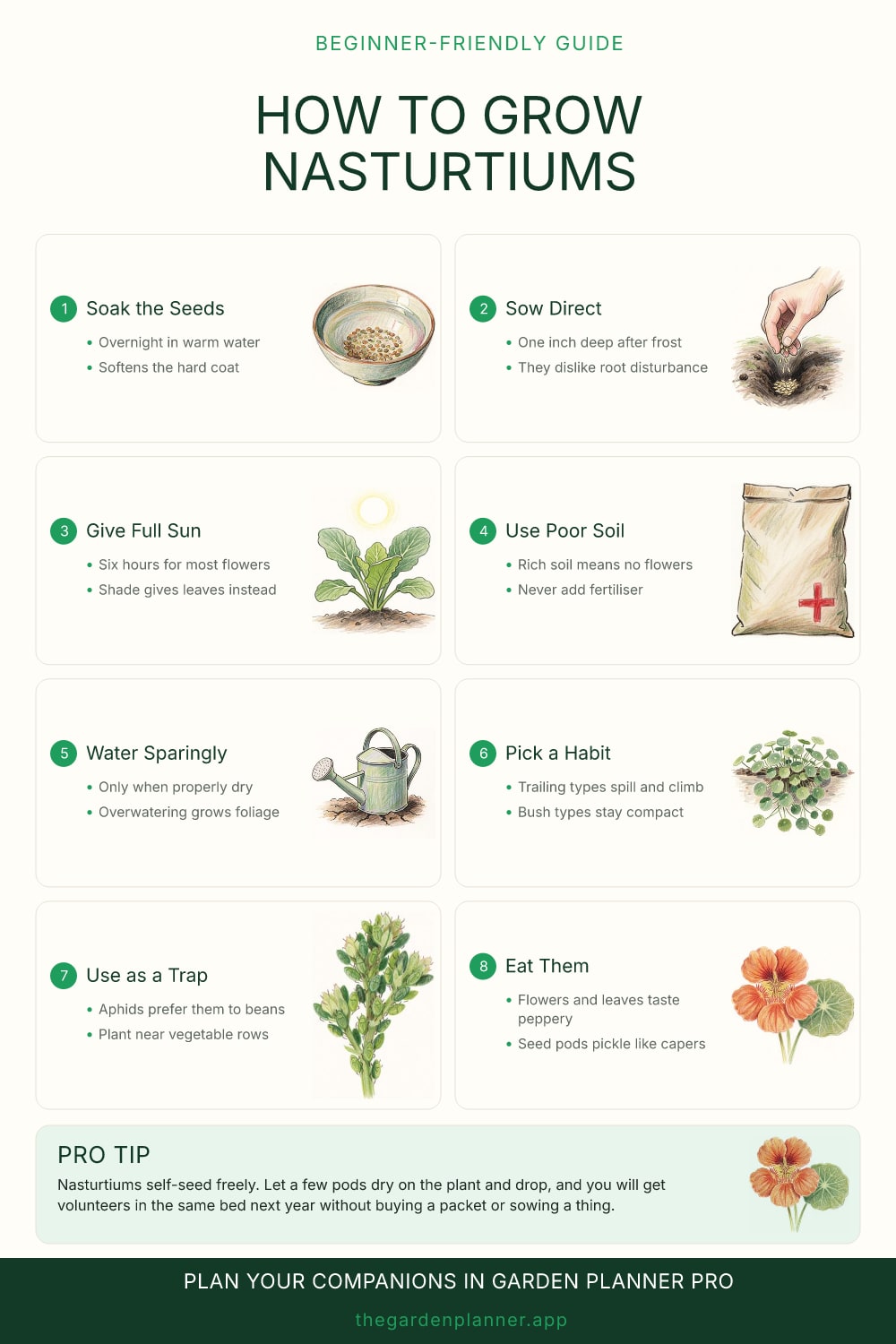
Nasturtiums are the plant I hand to people who say they cannot grow anything. The seeds are big enough to pick up one at a time, they go straight in the ground, and the main way to fail is to look after them too well.
That last part catches nearly everyone. A nasturtium in good soil, watered often and given a bit of feed, grows into a magnificent mound of round leaves the size of a dinner plate and produces almost no flowers at all.
Poor soil is the whole trick
Most flowering plants are pushed into bloom by being comfortable. Nasturtiums are the opposite. Give them nitrogen and they read it as a good year for growing leaves and put everything into foliage.
So put them in the spot you would not waste a real crop on. Thin soil at the edge of a path, a gap in a gravel bed, the poor dry corner along a fence. Do not dig compost in and do not feed them at any point in the season.
If you are growing them in a pot, use ordinary potting compost and nothing more. And if you inherit a nasturtium that is all leaf and no flower, the fix is to stop watering it so much and wait. They come round once conditions get harder.
Sow them where they are going to stay
The seeds are large and wrinkled, and soaking them overnight in warm water softens the coat and speeds germination up by several days. It is not essential but it is worth doing.
Sow them about an inch deep, straight into the ground, once the risk of frost is past. Nasturtiums have a coarse root system that resents being moved, so raising them in modules and transplanting usually gives you a sulky plant that takes weeks to recover. Direct sowing is genuinely easier and gives a better plant.
Check the packet for the habit you are buying. Trailing types will run several feet and look best tumbling off a wall, over the edge of a raised bed, or up a low support. Bush types stay in a neat mound and are the ones for pots and windowboxes.
The aphid thing is real, with a catch
Nasturtiums are genuinely attractive to blackfly and other aphids, often more so than the beans and brassicas growing nearby. Planted at the end of a row they will draw a good share of the aphids onto themselves and away from the crop.
The catch is that this only helps if you then do something about it. A trap plant left alone becomes a nursery, and you have concentrated a population rather than removed one. Once the nasturtiums are thick with aphids, either hose them off hard, or pull the worst affected stems out and get rid of them.
They also pull in hoverflies and bees, whose larvae eat aphids, so a patch near the vegetables earns its space either way.
All of it is edible
The flowers and the young leaves both have a hot peppery bite, close to watercress, and a handful scattered over a salad looks better than anything you can buy. Pick the flowers in the morning and use them the same day, because they wilt within hours.
The green seed pods, picked while soft, can be salted and pickled in vinegar and used the way you would use capers. Leave a few pods on the plant to ripen and drop instead, and next spring you will find seedlings coming up around the same spot on their own.
Pro tip. Nasturtiums self-seed freely. Let a few pods dry on the plant and drop, and you will get volunteers in the same bed next year without buying a packet or sowing a thing.