
How to Grow Leeks: A Beginner's Guide in 8 Steps
Leeks are the crop that keeps a vegetable garden useful in February. They stand in frozen ground for months, they do not rot, they do not need storing, and you lift them the day you want them.
The only technique worth learning is the planting, and it is a strange one the first time you do it.
The hole is the whole method
The white part of a leek is white because it grew in the dark. Everything else follows from that.
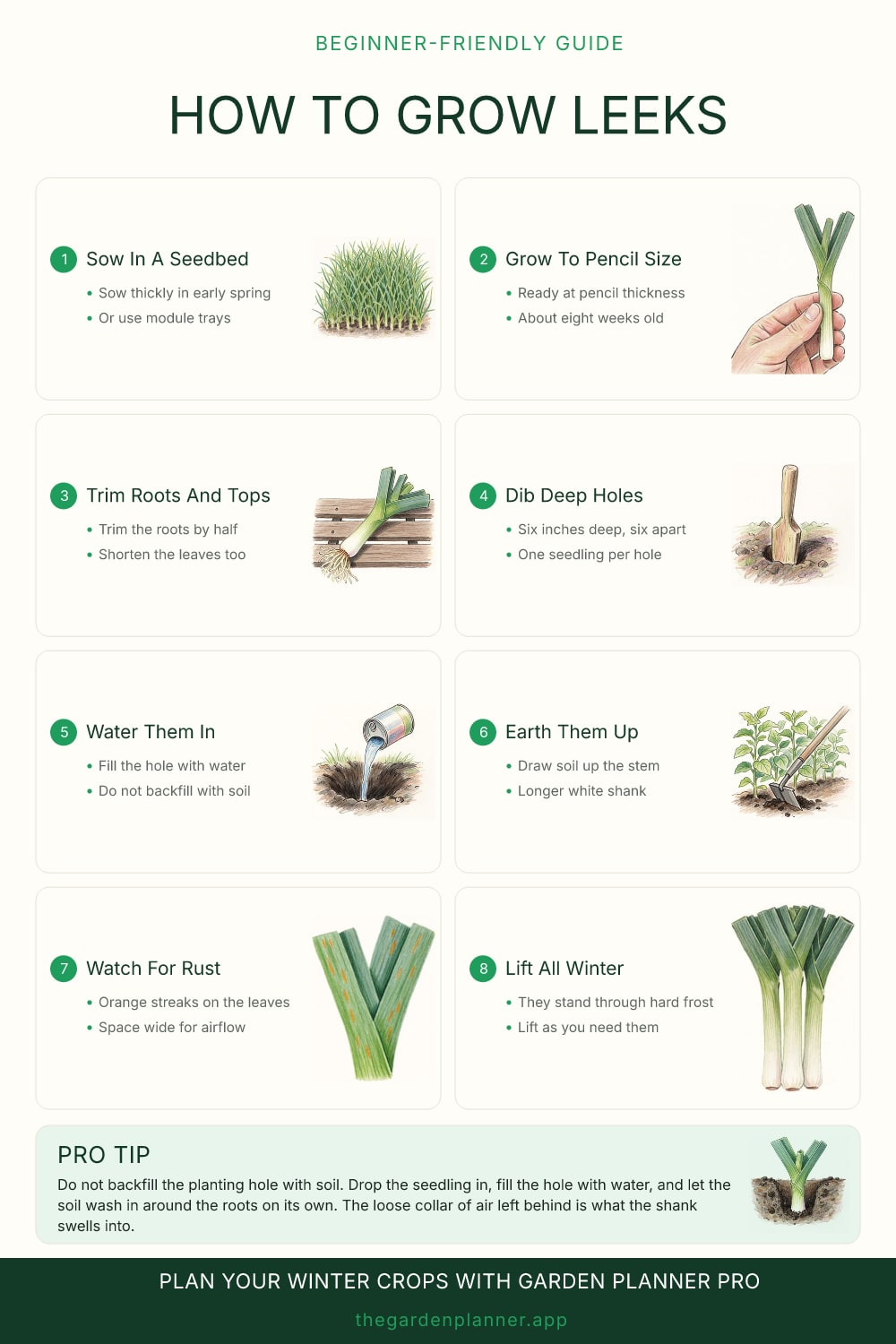
So you raise seedlings until they are about as thick as a pencil, lift them, trim the straggly roots back by half and take a couple of inches off the leaf tips so they do not flop. Then make a hole with a dibber, six inches deep and an inch or two wide, drop one seedling to the bottom, and stop there.
Do not fill it in. Pour water into the hole instead. The water settles the seedling and washes just enough soil down over the roots to hold it, and the rest of the hole stays open. The plant swells to fill that space over the season, and what you lift in winter is a long pale shank rather than a green onion.
Backfilling with soil gives you a leek that is a third the length and a good deal grittier.
Raising the seedlings
Leeks are slow at the start and you can afford to be casual about it. Sow thickly in a corner of a bed in early spring, or in modules with several seeds per cell, and let them grow on for a couple of months while the ground they will eventually occupy is still busy with something else.
That overlap is the practical reason leeks work so well in a small garden. They go out in early summer, after the broad beans or the first potatoes come out, and they use ground that would otherwise sit empty into winter.
If you sow in modules and plant the whole cell without separating them, you get a clump of three or four slimmer leeks, which is fine for a kitchen even if it is not what a show grower would do.
Earthing up, and how far to go
Beyond the deep hole, you can lengthen the white further by drawing soil up around the stems once or twice in late summer, the same way you would earth up potatoes.
Go gently and go a little at a time. Soil tipped into the top of a leek sits between the leaves and stays there, and grit in the middle of a leek is very hard to wash out later. Some gardeners slip a cardboard tube over the stem instead, which does the same job with none of the grit.
Spacing is the other decision. Six inches apart gives you supermarket sized leeks. Four inches gives you more, slimmer ones from the same bed, and slimmer leeks cook faster and taste no different.
Rust, and lifting through winter
The one common problem is leek rust, which shows as bright orange streaks on the leaves in late summer. It looks alarming and is usually survivable: the plants keep growing, and you can strip the worst leaves off and still get a decent crop.
It spreads worst in crowded, damp, over fed plantings, so wide spacing and going easy on the nitrogen do more than any treatment. Do not compost badly affected leaves, and grow leeks and onions somewhere different next year.
Then leave them in the ground. Frost does not hurt them, and lifting a leek from frozen soil in January is one of the genuine pleasures of a winter garden. Get them out before they start to run to seed in spring, because once a hard flower stem forms in the middle the leek is finished for the kitchen.
Pro tip. Do not backfill the planting hole with soil. Drop the seedling in, fill the hole with water, and let the soil wash in around the roots on its own. The loose collar of air left behind is what the shank swells into.