
How to Grow Lavender That Comes Back Year After Year
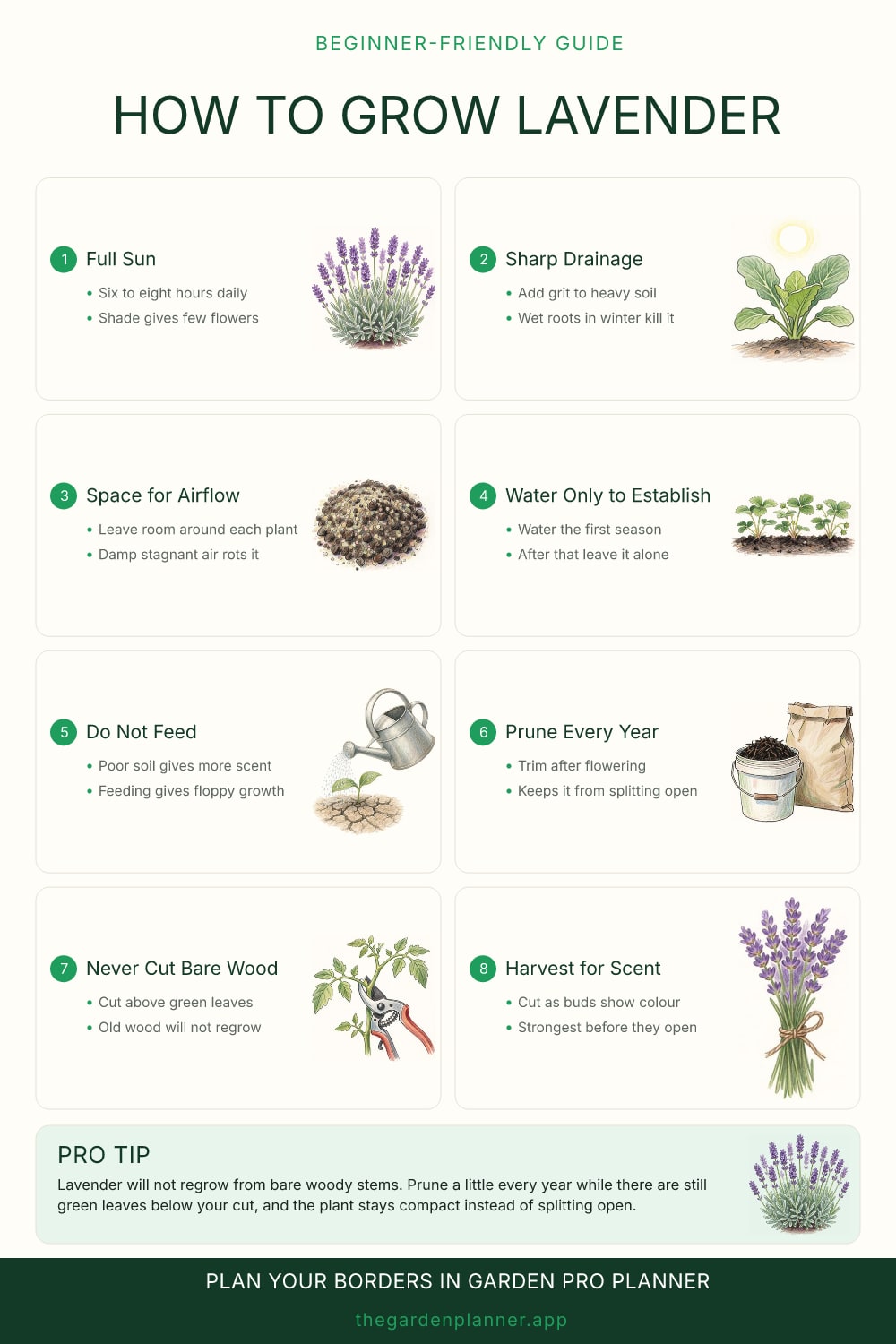
Lavender is sold as an easy plant and then dies in a great many gardens within three years. Usually it has not been killed by anything dramatic. It has been slowly finished off by wet feet in winter and by never being pruned.
Both are avoidable, and the pruning one in particular decides whether you get three years out of a plant or ten.
Winter wet kills more lavender than winter cold
Lavender is far hardier than most people assume. What it cannot survive is cold combined with wet, which is the standard winter in a great many gardens with heavy soil. Roots sitting in cold waterlogged ground rot, and the plant goes grey and dies from the base up, usually becoming obvious in early spring.
So the planting decisions matter more than anything you do later. Work grit or coarse sand generously into the planting hole on any soil that holds water. Plant on a slope, a bank, the edge of a raised bed, or the top of a wall if you have one. Plant slightly high so water drains away from the crown. And if your soil is genuinely heavy clay, grow it in a large terracotta pot instead, where you control the compost completely.
Airflow and spacing
Lavender wants air moving around it. Planted too close together, or crowded by larger perennials that flop over it in summer, the centre of the plant stays damp and stagnant and starts to rot from the inside.
Give each plant enough room that it is not touching its neighbours at full size, which for a common lavender means a good arm’s length. This is also why lavender does so well as a low hedge along a path, where it gets sun and moving air on both sides, and much less well tucked into the middle of a crowded mixed border. If an established plant is looking tired and dark in the middle, thinning whatever is leaning on it is often the whole fix.
The prune that decides its lifespan
This is the important one. Lavender does not produce new shoots from old bare wood. Once a stem has gone brown and leafless, that stem is finished, and no amount of cutting will make it sprout.
So the plant has to be kept compact from the beginning. Prune every year, right after flowering, taking off the spent flower stems and roughly the top third of the soft growth, shaping the plant into a tight dome. Always leave green leaves below every cut. Do this from its first year and it stays dense and lasts for many years. Skip it for two or three years and the plant opens out, splits down the middle under snow or rain, and exposes the bare wood inside, at which point it cannot be brought back. A neglected split lavender is a replacement rather than a rescue, though it is worth taking cuttings from it first.
Harvest before the flowers open
If you want lavender for scent, for drying, or for cooking, the timing of the cut matters. The aromatic oils are at their strongest when the flower buds have coloured up but have not yet opened. Once the flowers are fully open and the bees are working them, the scent has already started to fade and the dried flowers will drop off the stem more readily.
Cut whole stems long, well down into the leafy growth, tie them into small bunches and hang them upside down somewhere dark, dry and airy. Small bunches dry faster and do not go musty in the middle. Cutting for the house also doubles as part of the annual prune, so a plant you harvest properly often needs very little extra work afterwards.
Pro tip. Lavender will not regrow from bare woody stems. Prune a little every year while there are still green leaves below your cut, and the plant stays compact instead of splitting open.