
How to Grow Garlic From a Single Bulb
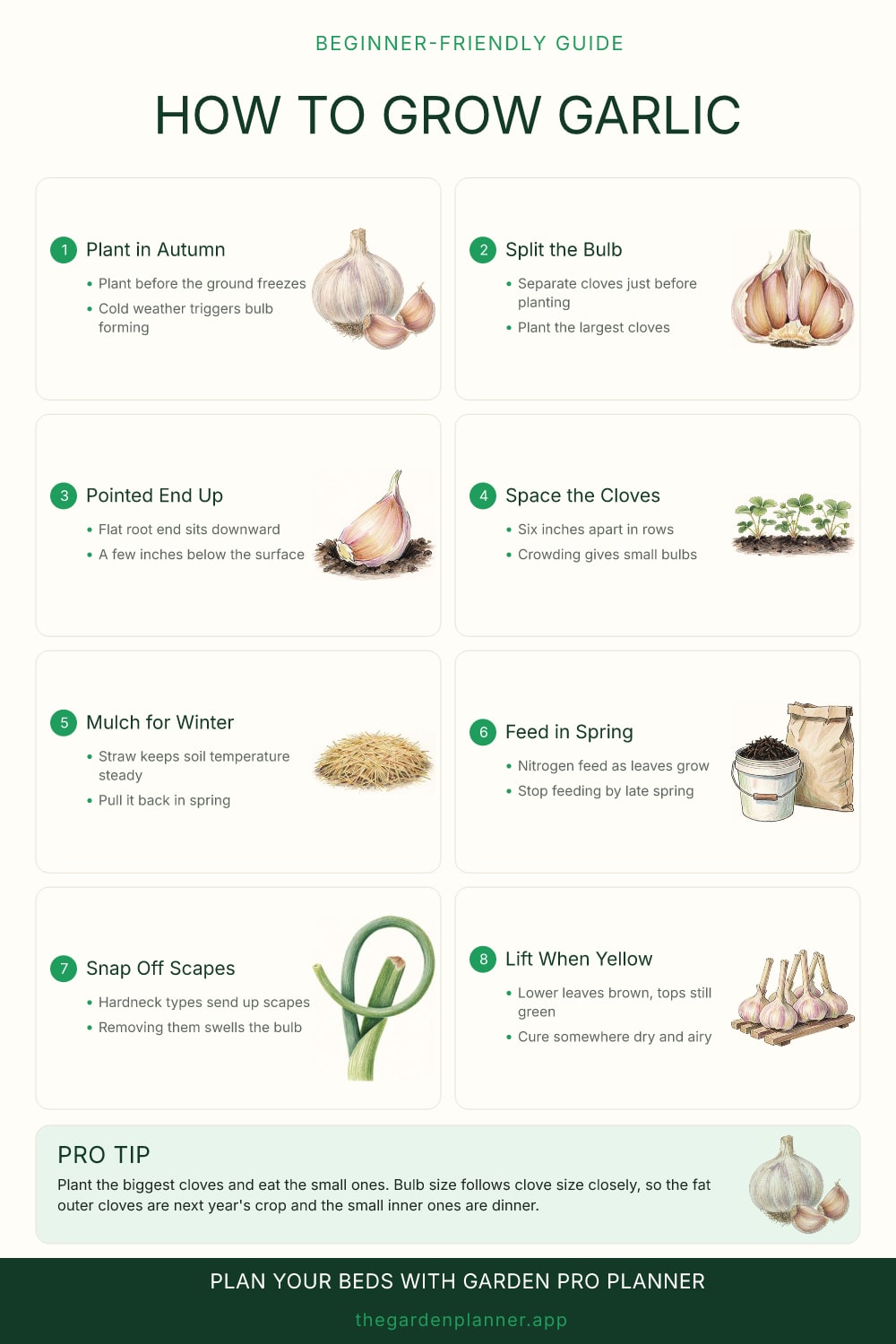
Garlic is planted in autumn, sits in cold wet ground doing apparently nothing all winter, and is harvested the following summer. It occupies a bed for the better part of nine months, which puts people off, and it is still one of the most reliable things you can grow.
It also fails in one specific and avoidable way: planted at the wrong time, it makes a single round bulb instead of a head of cloves.
The cold is doing the work
Garlic needs a sustained cold period to divide into separate cloves. Without it, the plant grows perfectly happily and produces one solid round bulb the size of a small onion, sometimes called a round. It is edible and it is not what you wanted.
That cold requirement is why garlic goes in during autumn, before the ground freezes hard, and why spring-planted garlic is a gamble in a mild area. If you have missed autumn, some varieties are sold specifically for spring planting and cope better, and you can also give cloves several weeks in a fridge before planting to imitate winter. Autumn planting is still the straightforward option. Get the cloves in and let the weather handle the rest.
Big cloves make big bulbs
Break the head apart only when you are ready to plant, because cloves separated weeks in advance dry out at the exposed base. Then sort them by size and plant the largest.
The relationship between clove size and final bulb size is direct and quite strong. A fat outer clove has more stored energy to establish roots before winter, and that head start carries all the way through to harvest. The small inner cloves are not worth a season of bed space, so they go in the kitchen. This is also the argument for keeping back your own best heads each year rather than always buying new: you are selecting for what does well in your garden. Just avoid planting supermarket garlic, which is often a variety unsuited to your climate and sometimes treated to suppress sprouting.
Scapes, and why to snap them off
Hardneck varieties send up a stiff flower stem in early summer that curls into a loop before straightening. That is the scape, and it is worth removing.
A plant that carries its scape through to flowering spends a meaningful amount of energy on it, and that energy comes out of the bulb. Snapping them off while they are still curled and tender reliably produces larger heads. The scapes themselves are one of the better things to come out of a garden, with a mild garlic flavour, good chopped into eggs or blitzed into a pesto, and they only exist for a week or two. Softneck varieties, which are the ones usually sold for braiding and long storage, do not produce scapes at all, so if nothing appears there is nothing wrong.
Knowing when to lift, and curing properly
The harvest signal is in the leaves. Each leaf corresponds to a papery wrapper around the bulb, and as the lower leaves brown off, those wrappers are being used up. Lift when roughly the bottom third of the leaves have gone brown while the top ones are still green.
Leave it too long and the wrappers break down in the soil, the head starts to split into separate cloves, and it will not store for more than a few weeks. Lift too early and the bulbs are small and immature. When in doubt, dig one and look.
Then cure it. Lay the whole plants somewhere dry, airy and out of direct sun for two or three weeks until the necks are papery and the outer skins rustle. This is what turns a fresh bulb into one that keeps for months. Skipping the cure is the most common reason homegrown garlic goes soft in storage by autumn.
Pro tip. Plant the biggest cloves and eat the small ones. Bulb size follows clove size closely, so the fat outer cloves are next year’s crop and the small inner ones are dinner.