
How to Grow Cilantro That Does Not Bolt in Three Weeks
Cilantro is the herb people most often decide they are bad at growing. You buy a pot, it looks fine for two weeks, then it shoots up a flower stem and the leaves go feathery and thin and taste of nothing much.
That is not a growing mistake. That is what the plant does. Understanding that changes how you handle it, and it is the difference between a constant supply and a running argument with a plant.
It is an annual in a hurry
Cilantro is a short-lived annual whose whole purpose is to set seed. It is not a perennial herb like rosemary that you keep going for years, and it is not even a long-season leafy crop like chard. From the moment it germinates it is heading toward flowering, and heat, dry soil and root disturbance all speed that up.
Once a plant has bolted, that plant is done for leaf. The stems get wiry, the new leaves come out finely divided and look almost like dill, and the flavour drops away. No amount of cutting the flower stem out brings it back. So the goal is not to keep one plant productive forever. The goal is to always have a young patch coming along.
Succession sowing is the whole technique
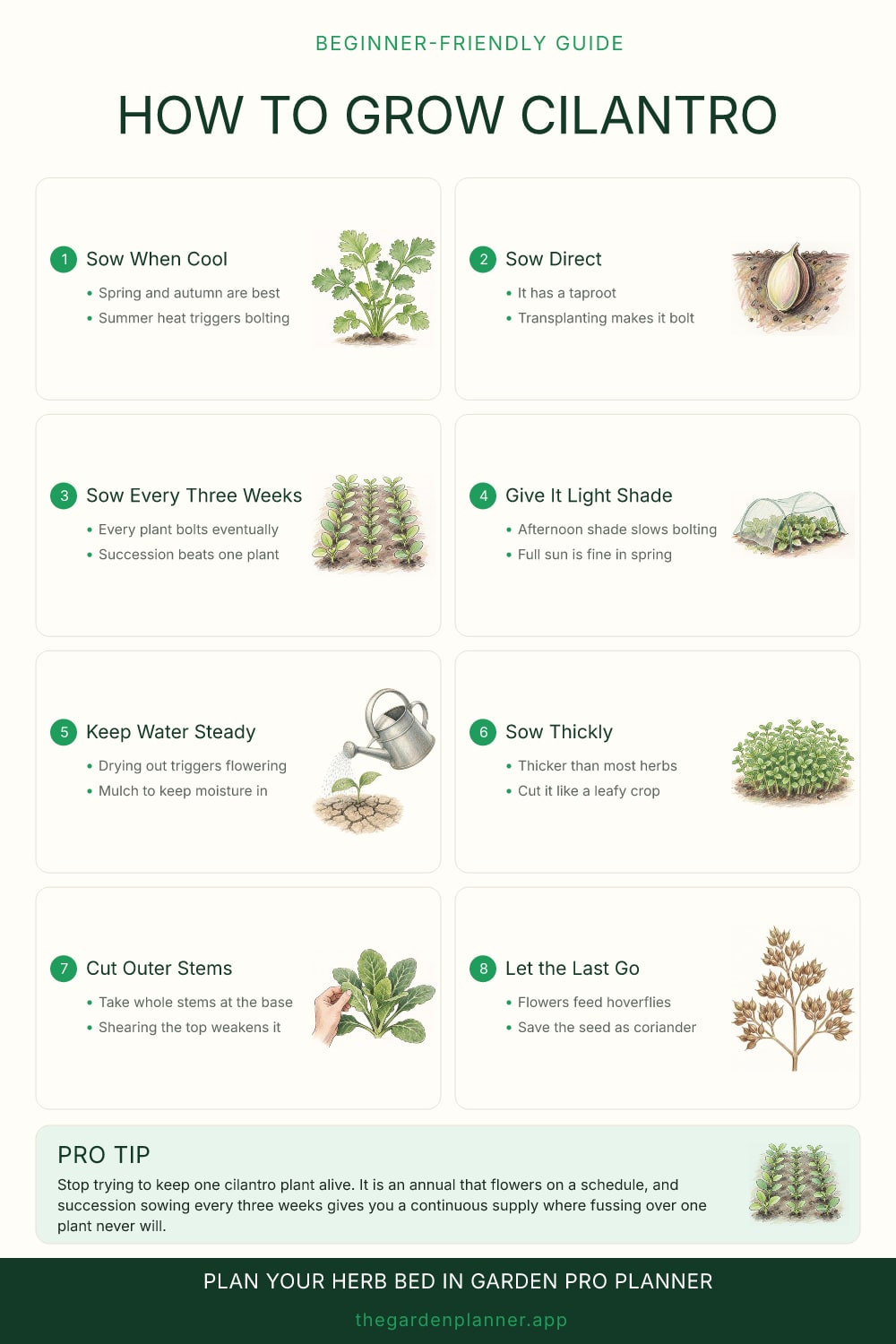
Sow a short row or a small pot every two to three weeks through spring and again in early autumn. Each sowing gives you a few weeks of good leaf before it starts to run up, and by then the next one is ready. It is the same principle as radishes, and it is the only reliable way to have cilantro on hand.
This is also why buying one supermarket pot never works. That pot is a dense clump of plants raised fast under glass, already stressed, and it will bolt almost immediately when it hits your windowsill. Treat it as a bunch of cut herbs that happens to still have roots, use it within the week, and sow your own alongside.
Cool, moist and undisturbed
Everything that stresses a cilantro plant pushes it toward flowering, so the growing conditions are all about removing stress. Sow in the cooler halves of the year rather than midsummer. Give it afternoon shade once the weather warms up. Keep the soil evenly moist, because a plant that dries out once will often bolt within days of it.
And sow it where it is going to grow. Like parsley, it makes a taproot and resents transplanting, and a checked seedling frequently responds by flowering while it is still tiny. If you must raise it in modules, use deep ones and plant out early.
Let the last sowing flower
When the season is ending, stop fighting it and let a patch run all the way up. The flowers are small, white and flat, and hoverflies and small parasitic wasps work them constantly, which is useful if you have aphids anywhere nearby.
After the flowers come the seeds, and those are coriander. Let them turn from green to pale brown on the plant, then cut the whole stem into a paper bag and hang it somewhere dry. Shake the bag and the seed falls out. Keep some for the kitchen and some for next year’s sowing, and you have closed the loop on a plant that most people treat as disposable.
Pro tip. Stop trying to keep one cilantro plant alive. It is an annual that flowers on a schedule, and succession sowing every three weeks gives you a continuous supply where fussing over one plant never will.