
How to Grow Cauliflower: A Beginner's Guide in 8 Steps
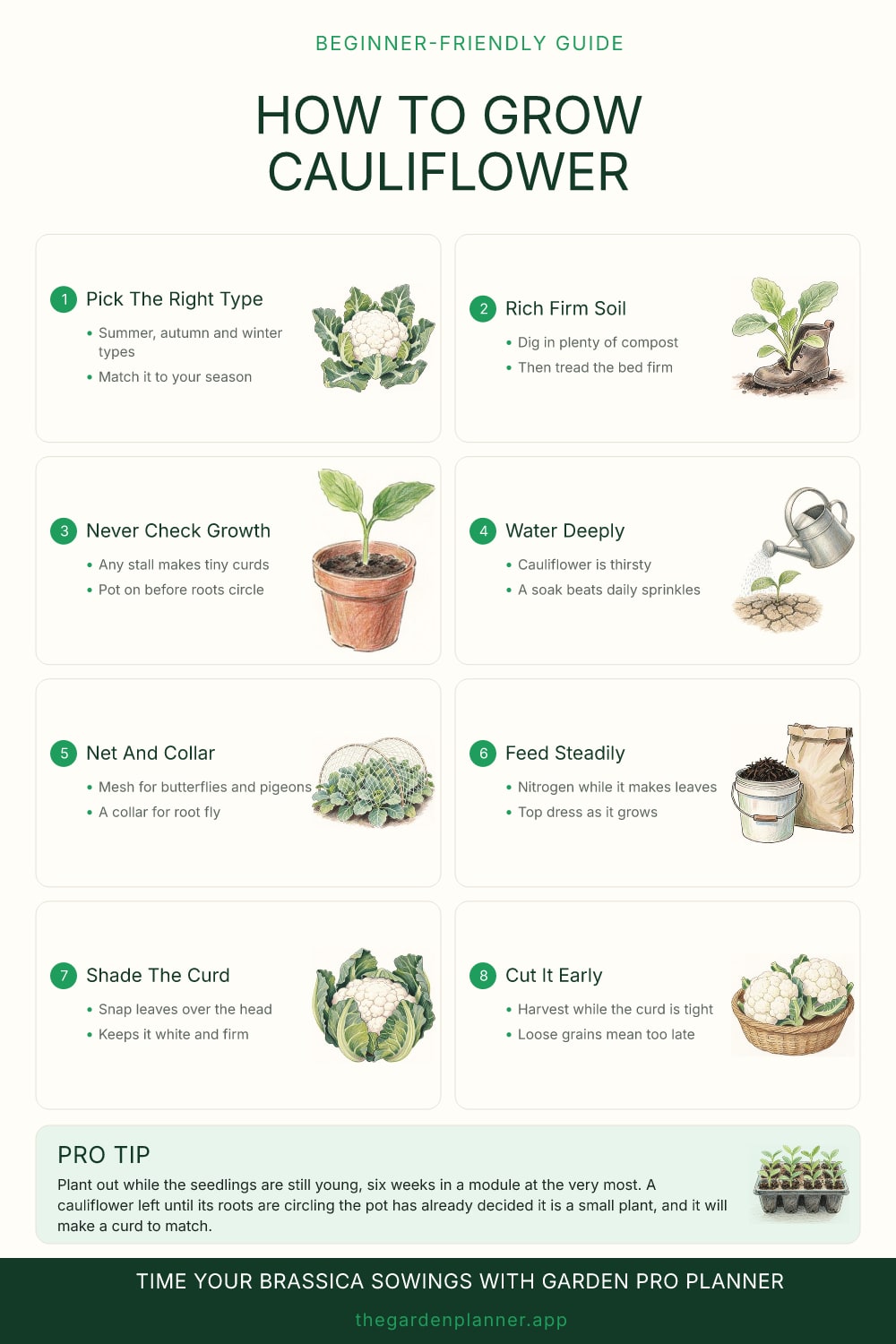
Cauliflower has a reputation as the hard brassica, and the reputation is earned. Cabbage forgives a rough patch. Cauliflower does not.
The plant makes one head, once, and it decides how big that head will be based on how well it was growing in the weeks beforehand. Almost every disappointing cauliflower is a plant that was checked at some point and never recovered.
A check is anything that stops it growing
Running dry for a few days is a check. Sitting in a small module until the roots wind round the bottom is a check. Being transplanted roughly, or into cold ground, or being eaten back by pigeons is a check.
The plant responds to any of these by cutting its ambitions. It will still make a curd, because that is what it is for, but it will be small, or it will form far too early on a plant with barely any leaf behind it. That last one has a name, buttoning, and once you have seen a fist sized plant with a curd the size of a coin you recognise it forever.
So the whole strategy is to keep the plant moving. Sow into decent sized cells, pot on rather than let it sit, plant out young, water before it needs it, and keep the pests off from day one.
Rich soil that has been trodden down
Cauliflower wants more feeding than most vegetables and firmer ground than feels natural. Work in plenty of compost or well rotted manure, then walk the bed down and rake it level before planting.
Heel each plant in hard. A cauliflower that rocks in wind is a cauliflower being checked every time it blows.
The leaves are the engine. A big plant with a lot of leaf behind it is what makes a big curd, so the nitrogen goes on early and generously, while it is building foliage. Once the curd starts to form there is nothing left to influence, and late feeding just produces soft growth for the slugs.
Match the type to the season
This causes more confusion than anything else about the crop, because cauliflower is sold for four different slots and the seed packets rarely make it obvious.
Summer types are sown under cover in late winter and cut in early summer. Autumn types are sown in spring for a late summer and autumn cut, and they are the easiest by some distance, so start there. Winter types are sown in spring, stand in the ground all winter looking like they have died, and head up in late winter or early spring. There are also fast growing mini varieties, planted close on purpose, that give single portion heads in a fraction of the time.
Sowing an autumn type in the slot meant for a winter one gives you a plant that heads in the wrong weather, and no amount of care fixes it.
Keep the curd white and cut it early
Sunlight turns a white curd yellow and frost damages it. Both are cosmetic rather than serious, but both are easy to avoid: once you can see the curd forming, snap two or three of the large outer leaves over the top of it and let them lie there. Some modern varieties wrap themselves and need no help.
Then watch it closely, because the window is short. A curd is ready while it is still tight and smooth, and it goes over quickly into a loose grainy head that separates into visible segments. In warm weather that can happen in a couple of days.
Harvest in the morning with a good length of stem and a few leaves left on as protection. If several are ready together, a cut cauliflower keeps well in the fridge, and it freezes better than most brassicas.
Pro tip. Plant out while the seedlings are still young, six weeks in a module at the very most. A cauliflower left until its roots are circling the pot has already decided it is a small plant, and it will make a curd to match.