
How to Build a Raised Bed You Can Actually Reach Across
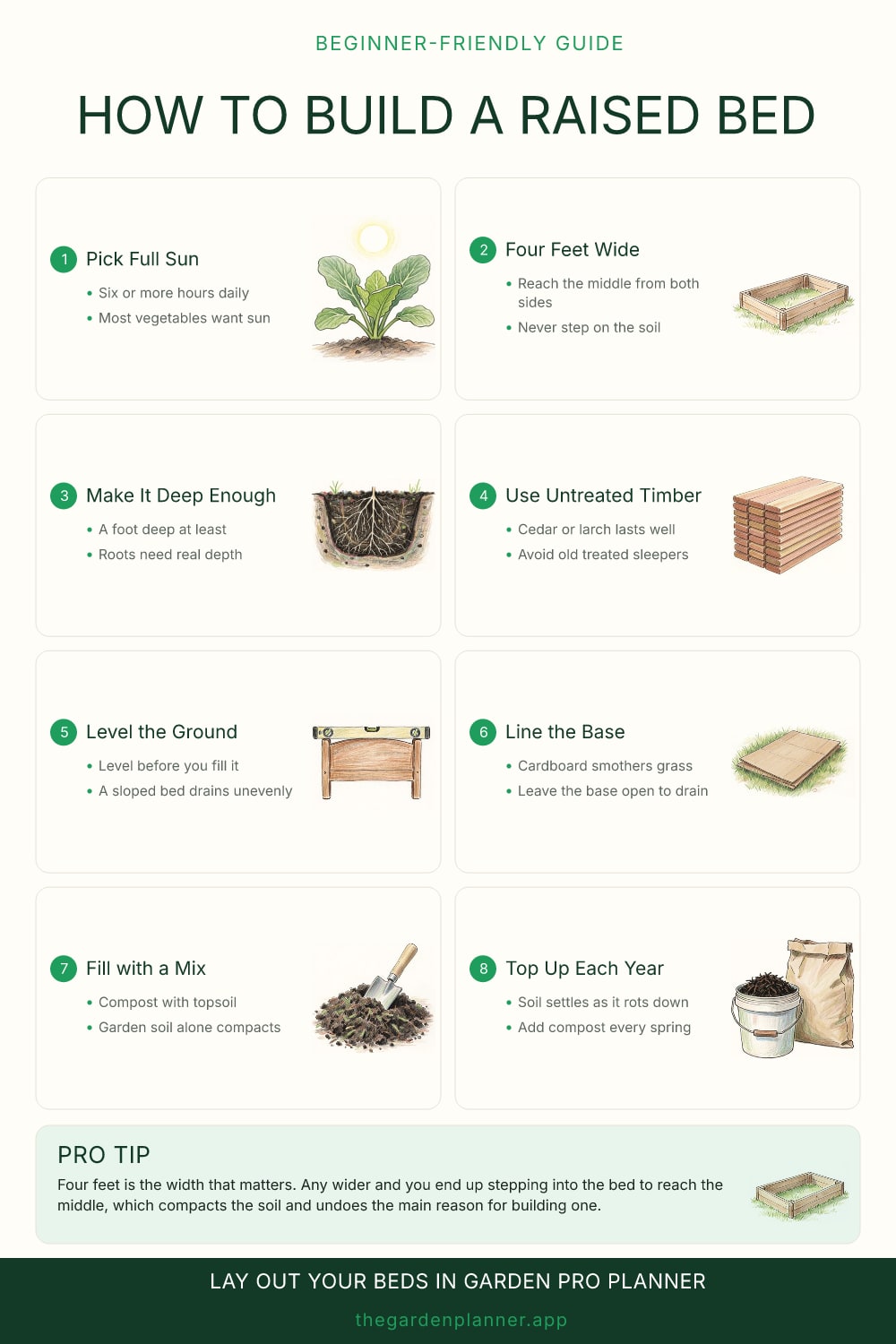
A raised bed is a box of soil you never stand on. That single sentence is most of the reason they work, and it is why the width of the bed matters more than the timber, the corners or the height.
Get the dimensions right and the bed does its job for a decade. Get them wrong and you spend ten years stepping into it and undoing the benefit.
Four feet, and the reason for it
The point of a raised bed is uncompacted soil. Soil that is never walked on keeps its structure, its air spaces and its drainage, and roots move through it far more easily than through ground that gets trodden every time you weed.
That only holds if you can reach the whole bed without stepping in. For most people that means a bed no more than about four feet wide, worked from both sides. Push it to five and you will start putting a knee or a boot on the soil to reach the middle, and once you do that regularly you have an expensive box of compacted soil. If the bed can only be reached from one side, because it is against a wall or a fence, halve it: two feet is the sensible limit for a single-sided bed. Length does not matter in the same way, though a bed longer than about eight feet tempts everyone into walking across it rather than round.
Depth, and what is underneath
A foot of depth is a good general target. That is enough for the large majority of vegetables, including carrots and potatoes, and it gives real drainage benefit over heavy ground.
What sits underneath matters as much as the height of the sides. Unless you are building on solid concrete, leave the base open to the soil below. Worms, water and roots all move between the bed and the ground, and a bed sealed at the bottom with plastic or membrane becomes a large container with all a container’s watering problems. If you are building over grass or weeds, lay plain cardboard directly on the ground first. It smothers what is underneath, and it rots away within a season once the bed is filled.
Timber, and what to keep out of the soil
Untreated cedar, larch or oak lasts well without any treatment because of natural oils and density. Ordinary untreated softwood such as pine is much cheaper and will last several years before it needs replacing, which many people are happy with.
Modern pressure-treated timber sold for garden use is generally considered fine for vegetable beds, but old reclaimed railway sleepers are a different matter. Those were often treated with creosote, which leaches and is no longer approved for domestic use. Old telegraph poles are the same. If you do not know what a piece of reclaimed timber was treated with, use it somewhere other than a food bed. Line the inside with heavy plastic sheeting if you want to use questionable timber anyway, keeping the base itself open.
Filling it, and topping it up forever
Do not fill a raised bed with garden soil alone, particularly if that soil is the heavy clay you built the bed to escape. It will settle into a dense block. A mix of roughly equal parts topsoil and compost, or something close to it, gives you structure from the soil and organic matter from the compost.
For a deep bed, the bottom third can be filled with rougher material such as woody prunings, turf laid upside down, or autumn leaves. It rots down and feeds the bed, and it saves a great deal of bought compost. Then expect the level to drop. A newly filled bed sinks noticeably in its first year as the organic matter breaks down, and it keeps sinking more slowly after that. Topping up with an inch or two of compost every spring is a permanent part of owning a raised bed, and it is also the entire feeding regime most beds ever need.
Pro tip. Four feet is the width that matters. Any wider and you end up stepping into the bed to reach the middle, which compacts the soil and undoes the main reason for building one.