
Stop Digging Sand Into Your Clay Soil
Clay soil has a bad reputation it half deserves. It is heavy, it is slow to warm in spring, it sets like rock in summer and it turns to porridge in winter.
It is also, once improved, the most fertile and moisture retentive soil you can garden on. Clay particles hold nutrients in a way sandy soil simply cannot. The goal is not to replace it, and the fastest way to make it worse is to try.
The sand thing is worth explaining properly
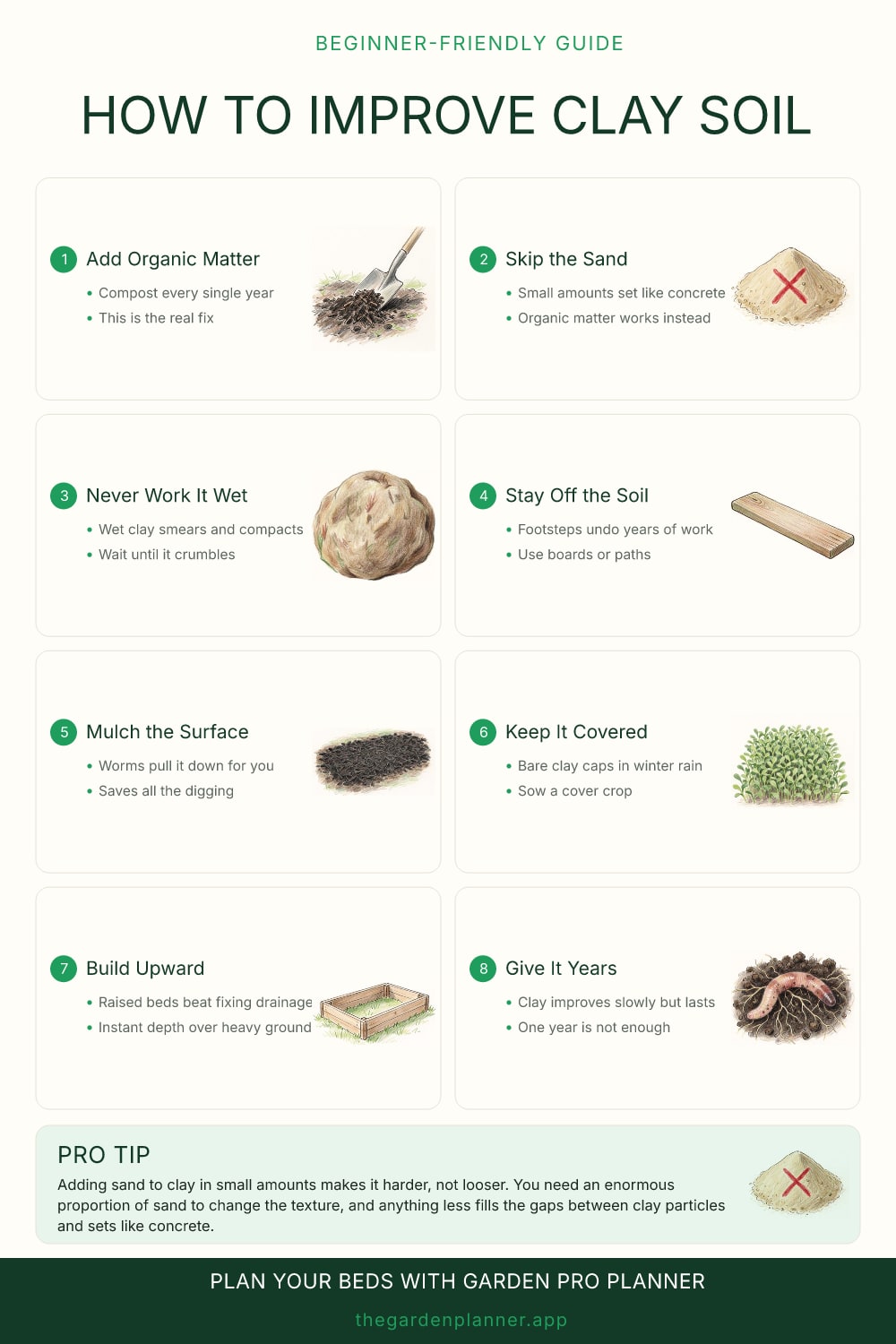
The advice to add sand to clay is everywhere and it is bad advice at garden scale. Clay particles are extremely fine. Sand grains are much larger. Mix a modest amount of sand into clay and the clay simply fills every gap between the sand grains, and you end up with something denser and harder than what you started with. The comparison people make to concrete is not far off, since that is roughly how concrete is made.
To genuinely change the texture by adding sand you would need the sand to become the dominant material by volume, which for a vegetable bed means tonnes of it. Nobody does this. Organic matter achieves the same goal by a different route: it physically separates clay particles, feeds the soil life that builds crumb structure, and keeps working as it breaks down.
Timing matters more than technique
The single most damaging thing you can do to clay is work it or walk on it when it is wet. Wet clay does not crumble, it smears. Every footstep and every spade cut squashes the air out and destroys the structure you are trying to build, and the damage lasts for seasons.
So the rule is simple and it takes discipline. Pick up a handful. If it rolls into a shiny sausage, stay off it. If it breaks apart into crumbs when you press it, you can work. In practice this means most clay gardens have a narrow window in spring and another in autumn. Permanent paths and beds you never step on are worth more on clay than on any other soil, because they let you get on with jobs in conditions that would otherwise be off limits.
Let the worms do the digging
The traditional approach was to dig compost into clay every autumn. It works, but it is enormous effort and it disturbs the structure and the fungal networks each time.
The easier method is to spread organic matter on the surface and leave it. A few inches of compost, rotted manure or leafmould laid on top over winter will largely disappear by spring, pulled down by earthworms who do the mixing far more gently than a spade. This also keeps the surface covered, which stops winter rain hammering bare clay into a hard cap. If you want to speed things up, sow a cover crop in autumn instead, and cut it down in spring to leave the roots in place. Roots are what build channels through clay, and dead roots leave those channels behind.
Sometimes the answer is to build upward
If the ground stays waterlogged for weeks and nothing you add is changing that, you may be trying to fix a drainage problem with a soil amendment, which does not work. Water has to go somewhere, and on flat heavy clay there is often nowhere for it to go.
Raised beds sidestep the whole argument. You get workable depth immediately, the bed drains into the clay below rather than sitting in it, and the soil warms earlier in spring. You are still gardening on clay, and the clay below will slowly improve as roots and worms work down into it, but you are no longer waiting years before you can grow a decent carrot. Improving clay in place is genuinely worth doing, and it is a project measured in seasons rather than weekends.
Pro tip. Adding sand to clay in small amounts makes it harder, not looser. You need an enormous proportion of sand to change the texture, and anything less fills the gaps between clay particles and sets like concrete.